IDENTITY AND PARTICIPATION OF COMMUNITY FOR THE PROMOTION OF CULTURAL TOURISM: KADEEJEEN AREA, WAT KANLAYA, THONBURI, BANGKOK
Keywords:
Community Identity, Community Participatory, Cultural Tourism, Kadeejeen AreaAbstract
This research article aimed to examine community identity and community participation in promoting cultural tourism in the Kadeejeen area in ways that are consistent with the local context. The study employed a qualitative approach. Key informants consisted of 13 individuals who play significant roles in driving tourism activities within the community and were selected through purposive sampling. Research instruments included in-depth interviews and focus group discussion guidelines. Data were analyzed using content analysis, involving transcription, categorization, and synthesis to ensure alignment with the research objectives.
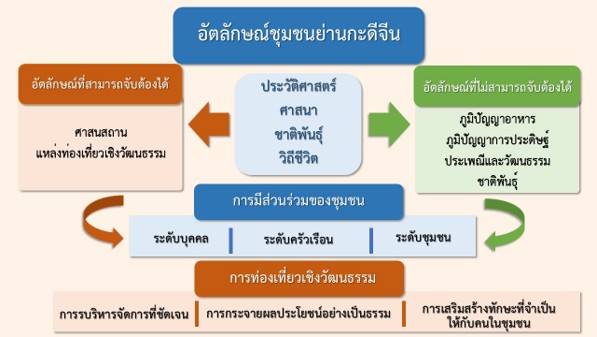
The findings revealed that the identity of the Kadeejeen area can be classified into two categories: tangible and intangible identity. Tangible identity includes architectural heritage as a historical legacy of the community, reflected in significant religious sites closely connected to local ways of life. These include Wat Prayurawongsawas Worawihan, Wat Kalayanamit Woramahawihan, Wat Buppharam Worawihan, Santa Cruz Church, Ton Son Mosque, and Kian Un Keng Shrine. It also encompasses cultural tourism sites that represent shared history and collective memory, such as the Baan Kudeejeen Museum, Chantanaphap House, and Phraya Rajanupradit House. Intangible identity consists of culinary wisdom shaped by ethnic integration Portuguese, Yuan (Vietnamese), Thai, and Chinese cuisines transmitted across generations; local craftsmanship, such as Moo Daeng Kradat (paper red pork); traditional festivals and cultural practices, including Good Friday, the Khao Mor Kaeng Festival, the Vegetarian Festival, the ritual charity, and temple celebrations; as well as the area’s multi-ethnic composition, particularly the coexistence of Thai, Portuguese, Chinese, and Muslim communities. Community participation in tourism promotion is grounded in cooperation and voluntary engagement at three levels. At the individual level, residents act as hosts or storytellers. At the household level, families open their homes as museums, restaurants, or activity spaces, utilizing their own resources. At the community level, residents collectively plan activities and manage identity-based cultural assets to generate both direct and indirect benefits and income, thereby ensuring sustainable tourism development rooted in the cultural foundation of the area. This study therefore generates knowledge on the community identity of the Kudeejeen area and community participation in promoting and developing cultural tourism in alignment with the local context.
References
จารุวรรณ ขำเพชร. (2561). ภูมิทัศน์ชาติพันธุ์ แผนที่ชุมชนชาติพันธุ์ในกรุงเทพมหานคร. กรุงเทพฯ: ศูนย์มานุษยวิทยาสิรินธร.
จุติพร ปริญโญกุล. (2567). อัตลักษณ์ชุมชนและการมีส่วนร่วมของชุมชน เพื่อส่งเสริมการท่องเที่ยวเมืองรอง อ.บ้านไร่ จ.อุทัยธานี. วารสารนิเทศศาสตร์, 42(2), 1-17.
ชิตาวีร์ สุขคร. (2562). การท่องเที่ยวเชิงวัฒนธรรมในประเทศไทย. Journal of Sustainable Tourism Development, 1(2), 1-7.
ณัฏฐพัชร มณีโรจน์. (2560). การจัดการการท่องเที่ยวโดยชุมชน. วารสารวิชาการการท่องเที่ยวไทยนานาชาติ, 13(2), 25-46.
เทียมจิตร์ พ่วงสมจิตร์ (2558). ชุมชนกลุ่มชาติพันธุ์ย่านธนบุรี: การศึกษาวิถีชีวิตและทรัพยากรทางวัฒนธรรมเพื่อการท่องเที่ยวเชิงวัฒนธรรม (รายงานผลการวิจัย). กรุงเทพฯ: มหาวิทยาลัยธรรมศาสตร์.
สิริกานต์ ทองพูน และคณะ. (2563). อัตลักษณ์ชุมชนเพื่อการส่งเสริมการท่องเที่ยวชุมชนบ้านลานคา จังหวัดสุพรรณบุรี. ใน การประชุมหาดใหญ่วิชาการระดับชาติและนานาชาติ ครั้งที่ 11. (น. 984-953). สงขลา: มหาวิทยาลัยหาดใหญ่.
องค์การบริหารการพัฒนาพื้นที่พิเศษ เพื่อการท่องเที่ยวอย่างยั่งยืน. (2558). การท่องเที่ยวโดยชุมชน. กรุงเทพฯ: องค์การบริหารการพัฒนาพื้นที่พิเศษ เพื่อการท่องเที่ยวอย่างยั่งยืน.
อินทิรา พงษ์นาค และศุภกรณ์ ดิษฐพันธุ์. (2558). อัตลักษณ์ชุมชนเมืองโบราณอู่ทองจังหวัดสุพรรณบุรี. Veridian E-Journal Silpakorn University, 8(3), 511-523.
Cohen, E. (1988). Authenticity and commoditization in tourism. Annals of Tourism Research, 15(3), 371-386.
Hall, S. (1996). Introduction: Who needs “identity”?. In S. Hall & P. du Gay (Eds.), Questions of cultural identity. (pp.1-17.) London: SAGE.
Jenkins, R. (2014). Social Identity (4th ed.). London: Routledge.
Downloads
Published
How to Cite
Issue
Section
Categories
License
Copyright (c) 2026 Academic Journal of Political Science and Public Administration

This work is licensed under a Creative Commons Attribution-NonCommercial-NoDerivatives 4.0 International License.