DIGITAL AND ARTIFICIAL INTELLIGENCE TECHNOLOGIES FOR ENHANCING THE ENFORCEMENT OF DRUG PREVENTION AND SUPPRESSION POLICIES: LESSONS FROM THAILAND, SINGAPORE, AND SOUTH KOREA
Keywords:
Digital Technology, Artificial Intelligence, Drug Policy, Digital Government, Policy ComparisonAbstract
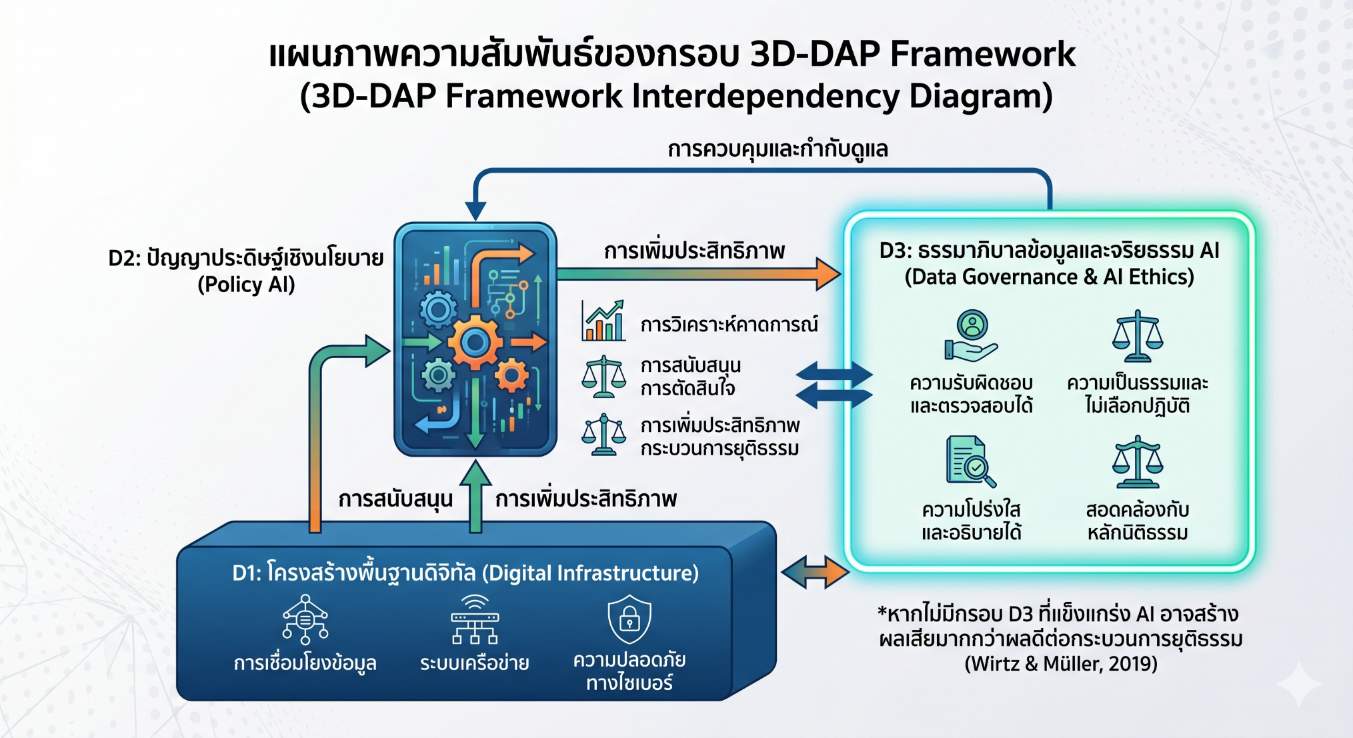
This academic article examines and analyzes the application of digital technologies and artificial intelligence (AI) in the enforcement of drug prevention and suppression policies, through a comparative study of three countries: Thailand, the Republic of Singapore, and the Republic of Korea. The study employs systematic literature review and document analysis drawing from policy reports, academic databases, and regional publications. Findings reveal that all three countries have adopted digital technologies with varying degrees of intensity and focus, shaped by their distinct societal contexts and digital infrastructure capacities. Thailand concentrates on information systems for asset tracking, Telepsychiatry in correctional facilities, and the V-Care system for high-risk psychiatric patients. Singapore stands out for its robust Digital Public Infrastructure (DPI) and near-universal digital identity coverage. South Korea leads with predictive artificial intelligence through the Multi-Agent-Based Modeling (MABM) system and the Basic AI Act framework, which establishes a trustworthy AI governance model. This article proposes a Three-Dimensional Digital-AI Policy Framework (3D-DAP Framework) comprising digital infrastructure, AI-driven policy intelligence, and data governance dimensions as a pathway for enhancing drug policy enforcement in developing country contexts. Key findings indicate that the critical success factors for deploying digital technologies and AI in drug prevention and suppression encompass three principal elements: seamlessly interoperable digital infrastructure, personnel capacity for technology acceptance and utilization, and a clearly defined data governance framework.
References
กรมสุขภาพจิต. (2567). รายงานประจำปีกรมสุขภาพจิต ปีงบประมาณ พ.ศ. 2567. นนทบุรี: กระทรวงสาธารณสุข.
กองทุนป้องกัน ปราบปราม และแก้ไขปัญหายาเสพติด. (2568). แผนปฏิบัติการระยะยาว 5 ปี (พ.ศ. 2566–2570) ฉบับทบทวน พ.ศ. 2568 และแผนปฏิบัติการประจำปีบัญชี 2569. กรุงเทพฯ: สำนักงานคณะกรรมการป้องกันและปราบปรามยาเสพติด.
สำนักงานคณะกรรมการป้องกันและปราบปรามยาเสพติด. (2567). รายงานผลการสำรวจครัวเรือนเพื่อคาดประมาณจำนวนประชากรผู้ใช้สารเสพติดของประเทศไทย พ.ศ. 2567. กรุงเทพฯ: บริษัท จรัลสนิทวงศ์การพิมพ์ จำกัด.
ปรีภัทร เกตุมงคลพงษ์ และคณะ. (2563). ปัจจัยการยอมรับการใช้งานเทคโนโลยีดิจิทัลที่มีผลต่อการตัดสินใจใช้งานเทคโนโลยีดิจิทัลในการปฏิบัติงานของบุคลากรในบริษัทเอกชน จังหวัดกรุงเทพมหานคร ในสถานการณ์การระบาดของโรคติดเชื้อไวรัสโคโรนา 2019. วารสารการบริหารการปกครองและนวัตกรรมท้องถิ่น, 4(3), 141–156.
ASEAN. (2025). ASEAN Plan of Action in Combatting Transnational Crime (2026-2035). Jakarta: Association of Southeast Asian Nations.
GovTech Singapore. (2025). Our digital government rankings. Retrieved April 26, 2026, from https://www.tech.gov.sg/about-us/our-achievements/our-digital-government-rankings/.
HTX. (2023). Enlisting Artificial Intelligence in the fight against Novel Psychoactive Substances. Home Team Science and Technology Agency (HTX), Singapore. Retrieved April 26, 2026, from https://www.htx.gov.sg/.
Mergel, I. et al. (2019). Defining Digital Transformation: Results from Expert Interviews. Government Information Quarterly, 36, 101385.
Mikhaylov, S. J. et al. (2018). Artificial intelligence for the public sector: Opportunities and challenges of cross-sector collaboration.
Philosophical Transactions of the Royal Society A: Mathematical, Physical and Engineering Sciences, 376(2128), 20170357.
Ministry of Home Affairs. (2025). 2025 Review (Part 1): Central Narcotics Bureau. Government of Singapore. Retrieved April 26, 2026, from https://www.mha.gov.sg/.
OECD. (2020). The OECD digital government policy framework: Six dimensions of a digital government. Retrieved April 26, 2026, from http://dx.doi.org/10.1787/f64fed2a-en.
_____. (2024). Digital government review of Korea: Harnessing digital and data to transform government.Retrieved April 26, 2026, from https://doi.org/10.1787/9defc197-en.
_____. (2024). Digital public infrastructure for digital governments. OECD Publishing.
_____. (2025). Government at a glance: Southeast Asia 2025: Singapore. Organisation for Economic Co-operation and Development. Retrieved April 26, 2026, from https://shorturl.asia/XE1Zo.
Supreme Prosecutors' Office (SPO). (2024). National Digital Forensic Center. Republic of Korea. Retrieved April 26, 2026, from https://www.spo.go.kr/site/eng/.
Venkatesh, V. et al. (2003). User acceptance of information technology:Toward a unified view. MIS Quarterly, 27(3), 425-478.
Wirtz, B. W. & Müller, W. M. (2019). An integrated artificial intelligence framework for public management. Public Management Review, 21(7), 1076-1100.
Downloads
Published
How to Cite
Issue
Section
Categories
License
Copyright (c) 2026 Academic Journal of Political Science and Public Administration

This work is licensed under a Creative Commons Attribution-NonCommercial-NoDerivatives 4.0 International License.