CHANGING HIGHER THE WORKING POTENTIAL OF THE ACTIVE AGING ELDERLY TO SUPPORT THE AGING SOCIETY WITH QUALITY
Keywords:
Working Potential, Skill Development, Aging Society, Health Application Integration, Quality Aging SocietyAbstract
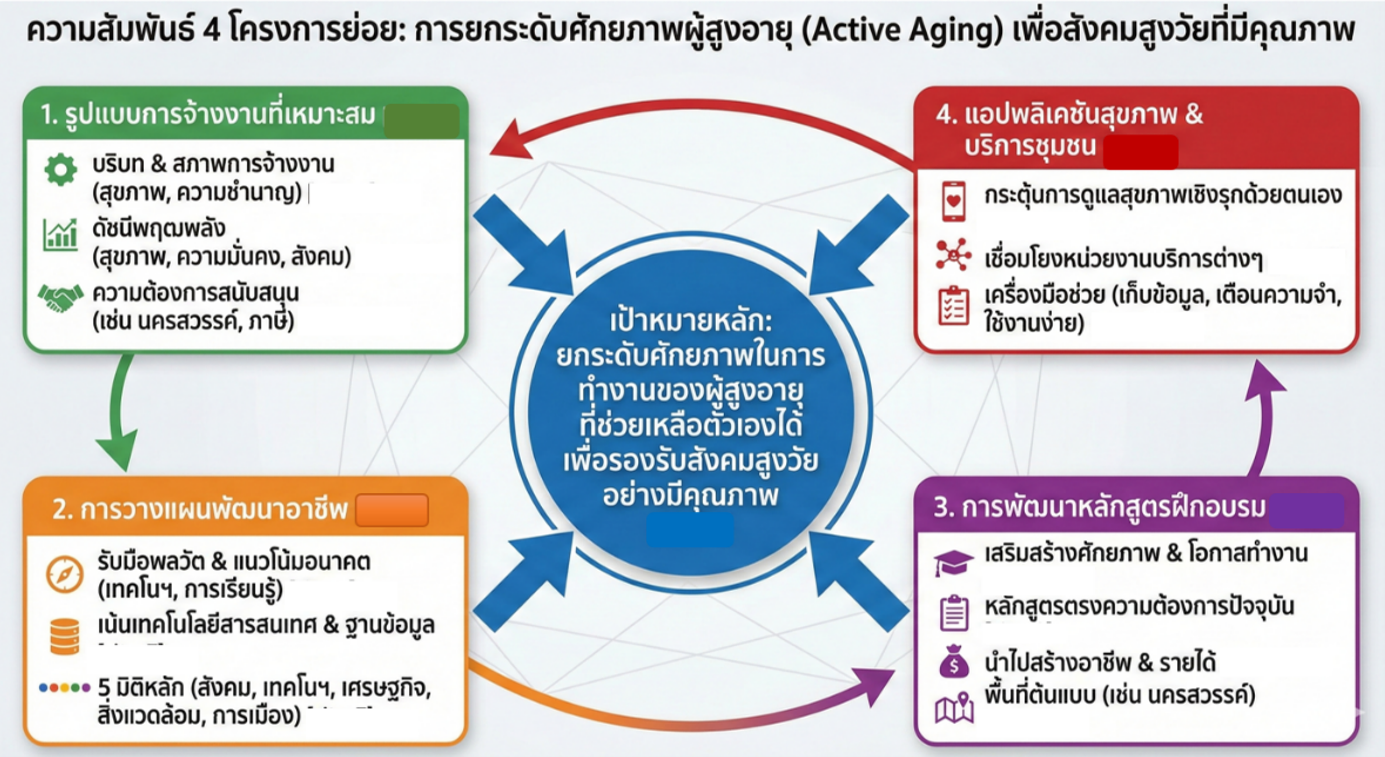
Objectives of this research were: 1. to develop an employment model appropriate for the active ageing potential of older adults; 2. to enhance the capacity of older adults in career development planning; 3. to develop a training curriculum to strengthen the competencies and employment opportunities of older adults; and 4. to promote proactive self-health care and community health service systems through a health application to support quality ageing. This study employed a qualitative research design using the policy dialogue technique. Key informants consisted of self-reliant older adults, representatives from the public sector, private sector, and local administrative organizations. The research instrument was a participatory observation record form. Data were analyzed using holistic analysis and pattern matching to identify relationships among the findings.
The findings revealed that: 1. enhancing the working potential of self-reliant elderly persons should include employment models appropriate to the active aging potential and abilities of the elderly in order to enable them to work meaningfully and suitably according to their physical conditions; 2. the development of potential in career development planning should be carried out systematically by considering the physical, emotional, and mental security of the elderly in order to achieve sustainable development; 3. the creation of training courses to enhance potential and employment opportunities should focus on transferring knowledge and skills appropriate to the working context of the elderly; and 4. stimulating proactive self-health care and community service systems through health applications helps the elderly gain knowledge in self-care, disease prevention, and disease relief, including creating valuable self-reliant communities through innovation in service accessibility by integrating movement-tracking technology called “Sukjai”.
References
คณะกรรมการส่งเสริมและประสานงานผู้สูงอายุแห่งชาติ สำนักนายกรัฐมนตรี. (2545). แผนผู้สูงอายุแห่งชาติ ฉบับที่ 2 (พ.ศ. 2545–2564). กรุงเทพฯ: โรงพิมพ์คุรุสภาลาดพร้าว.
ตุลระวี ไชยปัญโญ. (2557). แนวทางการพัฒนาอาชีพสำหรับผู้สูงอายุในเขตเทศบาลตำบลช้างเผือก อำเภอเมืองเชียงใหม่ (การค้นคว้าแบบอิสระศึกษาศาสตรมหาบัณฑิต สาขาวิชาอาชีวศึกษา). เชียงใหม่: มหาวิทยาลัยเชียงใหม่.
นงนุช สุนทรชวกานต์ และสายพิณ ชินตระกูลชัย. (2552). การสร้างโอกาสการทำงานของผู้สูงอายุ. กรุงเทพฯ: มหาวิทยาลัยธรรมศาสตร์.
พรรัตน์ แสดงหาญ และคณะ. (2560). การพัฒนารูปแบบการจ้างงานผู้สูงอายุในธุรกิจโรงแรมในเขตภาคตะวันออก (รายงานผลการวิจัย). ชลบุรี: มหาวิทยาลัยบูรพา.
พิมพงา เพ็งนาเรนทร์. (2564). การมีส่วนร่วมของชุมชนในการพัฒนาอาชีพเพื่อเพิ่มรายได้ของผู้สูงอายุ. วารสารมหาวิทยาลัยราชภัฏธนบุรี, 15(1), 42–58.
ภัทรพรรณ ทำดี และคณะ. (2565). การเตรียมความพร้อมเพื่อการพัฒนาระบบและกลไกรองรับสังคมสูงวัย อย่างมีศักยภาพในเขตสุขภาพที่ 1. วารสารการพัฒนาชุมชนและคุณภาพชีวิต, 10(1), 45–57.
มิ่งขวัญ คงเจริญ และกัมปนาท บริบูรณ์. (2562). การพัฒนารูปแบบโรงเรียนผู้สูงอายุโดยใช้ชุมชนเป็นฐาน (รายงานผลการวิจัย). กรุงเทพฯ: มหาวิทยาลัยศรีนครินทรวิโรฒ.
มูลนิธิสถาบันวิจัยและพัฒนาผู้สูงอายุไทย. (2559). สรุปผลการสัมมนา “แรงงานสูงวัย ลมหายใจของอนาคต”. สืบค้นเมื่อ 12 มกราคม 2568 จาก https://shorturl.asia/xsTDt.
ศุภชัย ศรีสุชาติ และคณะ. (2559). ครงการวิจัยถอดบทเรียนสถานประกอบการที่มีการจ้างแรงงานสูงวัย. กรุงเทพฯ: มูลนิธิสถาบันวิจัยและพัฒนาผู้สูงอายุไทย.
สำนักงานสภาพัฒนาการเศรษฐกิจและสังคมแห่งชาติ. (2564). รายงานภาวะเศรษฐกิจไทย ไตรมาสที่ 4 และทั้งปี 2563 และแนวโน้มปี 2564. สืบค้นเมื่อ 2 มกราคม 2568 จาก https://shorturl.asia/4r8wy.
สุทธิชัย จิตะพันธ์กุล. (2545). ผู้สูงอายุในประเทศไทย: รายงานการทบทวนองค์ความรู้และสถานการณ์ในปัจจุบัน ตลอดจนข้อเสนอแนะทางนโยบายและการวิจัย. กรุงเทพฯ: จุฬาลงกรณ์มหาวิทยาลัย.
อนุชา ม่วงใหญ่. (2561). แนวคิดและวิธีการเพื่อการดำรงชีวิตอย่างมีคุณค่าของผู้สูงอายุ. ใน รายงานสืบเนื่องจากการประชุมวิชาการระดับชาติ พะเยาวิจัย ครั้งที่ 7. (น. 2510–2518). พะเยา: มหาวิทยาลัยพะเยา.
อาชัญญา รัตนอุบล และคณะ. (2555). การพัฒนาแนวทางการส่งเสริมการจัดการศึกษา/การเรียนรู้เพื่อการพัฒนาศักยภาพผู้สูงอายุ. วารสารครุศาสตร์ จุฬาลงกรณ์มหาวิทยาลัย, 40, 14-28.
Alyami, M. A. & Song, Y.-T. (2016). Removing barriers in using personal health record systems. In 2016 IEEE/ACIS 15th International Conference on Computer and Information Science (ICIS). (pp. 1–8). New York: IEEE.
Pak, J. & Song, Y.-T. (2016). Health capability maturity model: Person-centered approach in personal health record system. In AMCIS 2016 Proceedings. (p.19). San Diego: Association for Information Systems.
Peek, S. T. et al. (2014).Factors influencing acceptance of technology for aging in place: a systematic review. International Journal of Medical Informatics, 83(4), 235-248.
Roehrs, A. et al. (2017). Personal Health Records: A Systematic Literature Review. Journal of Medical Internet Research, 19(1), 1-22.
Taba, H. (1962). Curriculum development: Theory and practice. New York, NY: Harcourt, Brace & World.
World Health Organization. (2002). Active ageing: A policy framework. Geneva, Switzerland: World Health Organization.
Downloads
Published
How to Cite
Issue
Section
Categories
License
Copyright (c) 2026 Academic Journal of Political Science and Public Administration

This work is licensed under a Creative Commons Attribution-NonCommercial-NoDerivatives 4.0 International License.