SOCIAL CAPITAL MANAGEMENT IN THE DIGITAL AGE TO SUPPORT THE WELL-BEING OF THE ELDERLY : A CASE STUDY OF SENIOR CITIZEN CLUBS IN MUEANG DISTRICT, KHON KAEN PROVINCE
Keywords:
Social Capital, Senior Well-being, Smart City in the Digital EraAbstract
Objectives of this research article were: 1. explore and describe the mechanisms of social capital management in the digital age among senior citizen clubs in Mueang District, Khon Kaen Province, and 2. synthesize an appropriate social capital management model and present practical recommendations for sustainably improving the well-being of the elderly. The research primarily employed a qualitative approach, using document analysis and in-depth interviews with 32 stakeholders across three key groups—senior citizen club members, primary local practitioners, and decision- and policy-makers/administrators—selected using purposive sampling. Participatory observation and focus group discussions with 10 representatives from the interviewed participants were also conducted. Data were analyzed using content analysis and summarized through inductive reasoning.
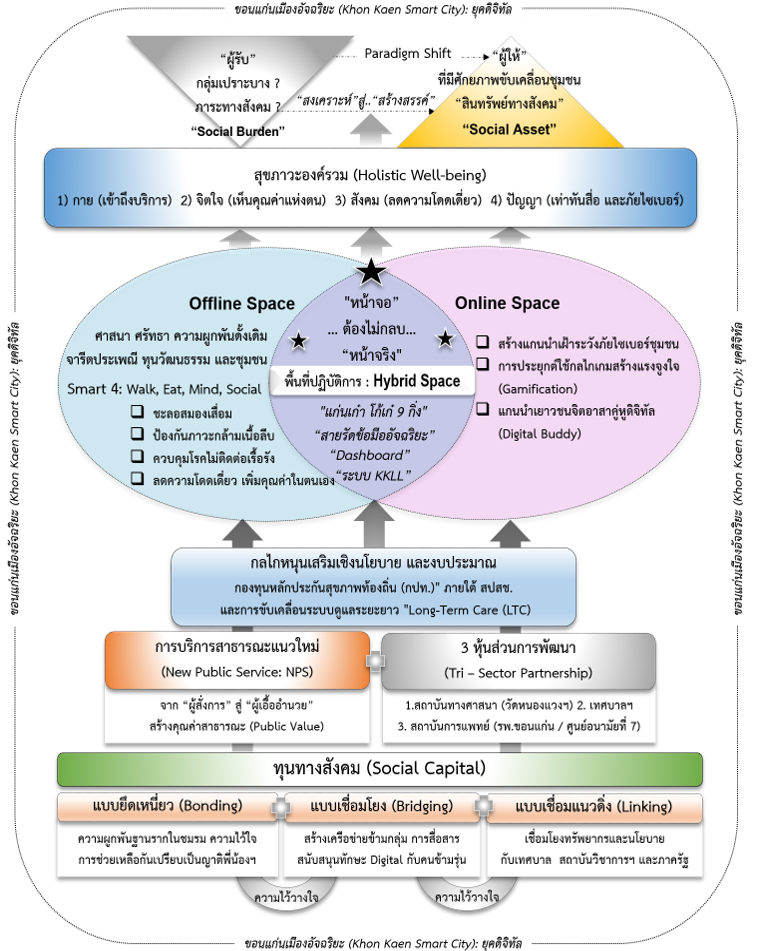
The research findings revealed that: 1. social capital management stems from a mechanism integrating physical and online spaces, with collaborative development partners including temples, local organizations, and medical institutions. This follows the New Public Service concept that integrates traditional social capital with digital technology, specifically the "Mali 2" smart wristband, which transmits health data via a dashboard display. Furthermore, the use of the Smart 4 health promotion program (Walk, Eat, Mind, and Social) supports long-term elderly care systems and holistic well-being; and 2. managing social capital appears in an integrated format, with key practical recommendations for implementation including: creating senior citizen leaders to monitor online threats, motivating self-care through gamification mechanisms, and establishing youth volunteer groups to act as Digital Buddies. These should be developed into curricula in collaboration with local educational institutions or communities to ensure the continuity and sustainability of the senior care system.
References
กมลชนก วิสิษฐดำรงค์กุล และคณะ. (2567). กลยุทธ์การขับเคลื่อนการพัฒนาสมรรถนะด้านเทคโนโลยีดิจิทัลของผู้สูงอายุ ในโรงเรียนผู้สูงอายุตำบลตะพง อำเภอเมือง จังหวัดระยอง. วารสารการบริหารการศึกษา มมร.วิทยาเขตร้อยเอ็ด, 4(3), 159-172.
จุลศักดิ์ ชาญณรงค์. (2567). บทบาทภาครัฐที่พึงประสงค์ต่อชมรมผู้สูงอายุไทย. วารสารสังคมศาสตร์ มหาวิทยาลัยศรีนครินทรวิโรฒ, 27(1), 1–13.
บุญทิพย์ สิริธรังศรี และชุติวัฒน์ สุวัตถิพงศ์. (2566). ผู้สูงอายุในยุคดิจิทัล: ความท้าทายทางสุขภาพ. วารสารสุขภาพและอาหารเชิงสร้างสรรค์, 1(1), 51–63.
เบญริสา ตันเจริญ. (2565). ผู้สูงวัยกับการรู้เท่าทันสื่อดิจิทัลเกี่ยวกับการดูแลสุขภาพ. วารสารมหาวิทยาลัยราชภัฏลำปาง, 11(2), 103–113.
วิทยาลัยการปกครองท้องถิ่น มหาวิทยาลัยขอนแก่น. (2565). ขอนแก่นสมาร์ทซิตี้: ทิศทางการจัดการนโยบายสาธารณะและการมีส่วนร่วมของพลเมือง. ขอนแก่น: ผู้แต่ง.
_____. (2568). รายงานการประเมินผลโครงการเมืองอัจฉริยะในมิติ Smart Living และการเรียนรู้ข้ามรุ่น. ขอนแก่น: ผู้แต่ง.
วิยะดา รัตนสุวรรณ และกฤติพิชญ์ ฐิติพิชญานันท์. (2564). การพัฒนาทุนทางสังคมเพื่อคุณภาพชีวิตของผู้สูงอายุ: การศึกษากรณีชุมชน จังหวัดพะเยา. วารสารการพยาบาลและการศึกษา, 14(3), 31–46.
ศูนย์ปฏิบัติการต่อต้านอาชญากรรมออนไลน์ จังหวัดขอนแก่น. (2566). รายงานสถานการณ์ภัยออนไลน์ในระดับพื้นที่ จังหวัดขอนแก่น ประจำปี 2566. ขอนแก่น: ศูนย์ปฏิบัติการต่อต้านอาชญากรรมออนไลน์ จังหวัดขอนแก่น.
สำนักงานคณะกรรมการดิจิทัลเพื่อเศรษฐกิจและสังคมแห่งชาติ. (2567). รายงานดัชนีความฉลาดทางดิจิทัลและพฤติกรรมการใช้เทคโนโลยีของประชากรสูงวัยในเขตเทศบาลนคร. กรุงเทพฯ: กระทรวงดิจิทัลเพื่อเศรษฐกิจและสังคม.
องค์การอนามัยโลก. (2545). ผู้สูงวัยอย่างมีศักยภาพ: กรอบแนวคิดเชิงนโยบาย (Active ageing: A policy framework). นนทบุรี: สำนักงานอนามัยโลก.
อุทิศ บำรุงชีพ และคณะ. (2566). การพัฒนาความเป็นพลเมืองดิจิทัลผ่านนวัตกรรมชุมชนแห่งการเรียนรู้ภูมิปัญญาอาหารสุขภาพของผู้สูงอายุ. วารสารวิจัยทางการศึกษา คณะศึกษาศาสตร์ มหาวิทยาลัยศรีนครินทรวิโรฒ, 18(2), 79–94.
Castells, M. (2010). The rise of the network society (2nd ed., with a new preface). Malden, MA: Wiley-Blackwell.
Coleman, J. S. (1988). Social capital in the creation of human capital. American Journal of Sociology, 94, S95–S120.
Denhardt, J. V. & Denhardt, R. B. (2015). The new public service: Serving, not steering (4th ed.). New York, NY: Routledge.
Moore, M. H. (1995). Creating public value: Strategic management in government. Cambridge, MA: Harvard University Press.
Putnam, R. D. (2000). Bowling alone: The collapse and revival of American community. New York, NY: Simon & Schuster.
Selwyn, N. (2004). The information aged: A qualitative study of older adults’ use of information and communications technology. Journal of Aging Studies, 18(4), 369–384.
Szreter, S. & Woolcock, M. (2004). Health by association? Social capital, social theory, and the political economy of public health. International Journal of Epidemiology, 33(4), 650–667.
van Dijk, J. A. G. M. & van Deursen, A. J. A. M. (2014). Digital skills: Unlocking the information society. New York, NY: Palgrave Macmillan.
Wellman, B. et al. (2001). Does the Internet increase, decrease, or supplement social capital? Social networks, participation, and community commitment. American Behavioral Scientist, 45(3), 436–455.
Woolcock, M. (2001). The place of social capital in understanding social and economic outcomes. ISUMA: Canadian Journal of Policy Research, 2(1), 11–17.
World Health Organization. (2021). Decade of healthy ageing: Baseline report. Geneva: World Health Organization.
Downloads
Published
How to Cite
Issue
Section
Categories
License
Copyright (c) 2026 Academic Journal of Political Science and Public Administration

This work is licensed under a Creative Commons Attribution-NonCommercial-NoDerivatives 4.0 International License.