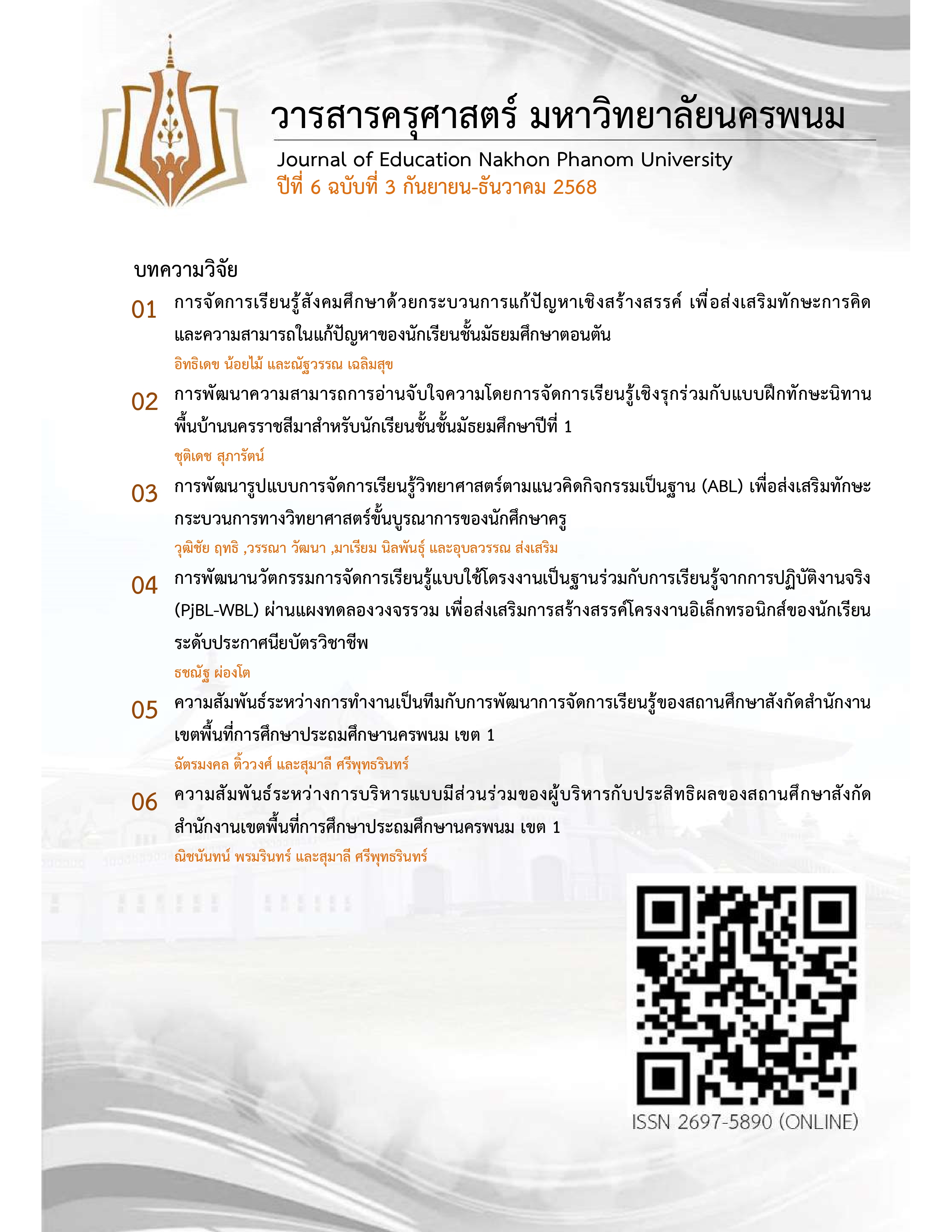
The Development of an Innovative Learning Management Approach Using Project-Based Learning Integrated with Work-Based Learning (PjBL-WBL) through Integrated Circuit Experiment Panels to Enhance Electronic Project Creativity of Vocational Certificate Stude
Article Sidebar
Main Article Content
Abstract
This research aimed to (1) to develop an instructional innovation integrating Project-Based Learning and Work-Based Learning (PjBL-WBL) through the use of an integrated circuit (IC) experimental board; (2) to examine the effectiveness of the developed PjBL-WBL instructional innovation; (3) to evaluate students’ performance in creating electronic projects after using the innovation; and (4) to investigate students’ satisfaction toward the PjBL-WBL instructional approach using the IC experimental board.
The research was conducted in four phases: studying and analyzing the needs of stakeholders and designing the innovation, (2) developing the PjBL-WBL instructional innovation and the integrated circuit training board, (3) implementing the innovation with a sample group of 30 third-year vocational certificate students in the Electronics Program selected by purposive sampling, and (4) evaluating and improving the innovation. The research instruments included an innovation quality assessment form, a project creativity assessment form, a satisfaction questionnaire, and an interview form. The research results indicated that the developed innovation had good to very good quality. The students were able to create projects effectively, with an overall performance score at a good level, and their satisfaction with the learning activities was rated at a high level.
The results of this study indicated that integrating Project-Based Learning and Work-Based Learning through the use of an IC experimental board is an effective approach for enhancing vocational students’ knowledge, creativity, and practical skills aligned with the needs of the 21st-century workforce.
Article Details

This work is licensed under a Creative Commons Attribution-NonCommercial-NoDerivatives 4.0 International License.
บทความที่ได้รับการตีพิมพ์เป็นลิขสิทธิ์ของวารสารครุศาสตร์ คณะครุศาสตร์ มหาวิทยาลัยนครพนม ข้อความที่ปรากฏในบทความแต่ละเรื่องในวารสารครุศาสตร์เล่มนี้เป็นความคิดเห็นส่วนตัวของผู้เขียนแต่ละท่านไม่เกี่ยวข้องกับมหาวิทยาลัยนครพนม และคณาจารย์ท่านอื่น ๆ ในมหาวิทยาลัยฯ แต่อย่างใด ความรับผิดชอบองค์ประกอบทั้งหมดของบทความแต่ละเรื่องเป็นของผู้เขียนแต่ละท่าน หากมีความผิดพลาดใด ๆ ผู้เขียนแต่ละท่านจะรับผิดชอบบทความของตนเองแต่ผู้เดียว
References
วิภา นาคะตะ. (2563). การเรียนรู้แบบโครงงานกับการส่งเสริมความคิดสร้างสรรค์ของนักเรียน. วารสารเทคโนโลยีและนวัตกรรมอาชีวศึกษา, 10(2), 112–125.
นภาพร รัตนวิชัย. (2564). ผลของการจัดการเรียนรู้แบบ PjBL-WBL ต่อคุณภาพโครงงานอิเล็กทรอนิกส์. วารสารวิชาชีพและการเรียนรู้, 15(3), 77–89.
สถาบันคุณวุฒิวิชาชีพ. (2564). รายงานการประเมินสมรรถนะ . สืบค้นเมื่อ 16 มีนาคม 2566.
จาก: https://www.tpqi.go.th/about-tpqi/quality-assurance/service-standard
สำนักงานเศรษฐกิจอุตสาหกรรม. (2565). รายงานประจำปี 2565. สืบค้นเมื่อ 16 มีนาคม 2566.
จาก: https://www.oie.go.th/view
สำนักงานพัฒนาธุรกิจการค้า. (2565). รายงานประจำปี 2565. สืบค้นเมื่อ 16 มีนาคม 2566.
จาก: https://www.dbd.go.th/storage/manual
Bell, S. (2010). Project-Based Learning for the 21st Century: Skills for the Future. The Clearing House, 83(2), 39–43.
Billett, S. (2009). Realising the educational worth of integrating work experiences in higher education. Studies in Higher Education, 34(7), 827-843.
Boud, D., Keogh, R., & Walker, D. (1985). Reflection: Turning Experience into Learning. London: Kogan Page.
Carless, D. (2007). Learning-oriented assessment: Conceptual bases and practical implications. Innovations in Education and Teaching International, 44(1), 57–66.
Fullan, M. (2013). The new meaning of educational change (4th ed.). New York: Teachers College Press.
Kolb, D. A. (1984). Experiential learning: Experience as the source of learning and development. Englewood Cliffs, NJ: Prentice-Hall.
Kolb, D. A. (1984). Experiential learning: Experience as the source of learning and development. Englewood Cliffs, NJ: Prentice-Hall.
Nonaka, I., & Takeuchi, H. (1995). The knowledge-creating company: How Japanese companies create the dynamics of innovation. Oxford University Press.
OECD. (2018). The Future of Education and Skills: Education 2030. OECD Publishing.
Popham, W. J. (1997). Classroom assessment: What teachers need to know. Allyn & Bacon.
Sadler, D. R. (1989). Formative assessment and the design of instructional systems. Instructional Science, 18, 119–144.
Suthep, S., & Chaiyaporn, P. (2018). Learner satisfaction in project-based learning and work-integrated learning. Vocational Education Journal, 13(2), 45–59.
Thomas, J. W. (2000). A Review of Research on Project-Based Learning. The Autodesk Foundation.
Trilling, B., & Fadel, C. (2009). 21st Century Skills: Learning for Life in Our Times. Jossey-Bass.
UNESCO. (2015). Education 2030: Incheon Declaration and Framework for Action.
Vygotsky, L. S. (1978). Mind in society: The development of higher psychological processes. Harvard University Press.
