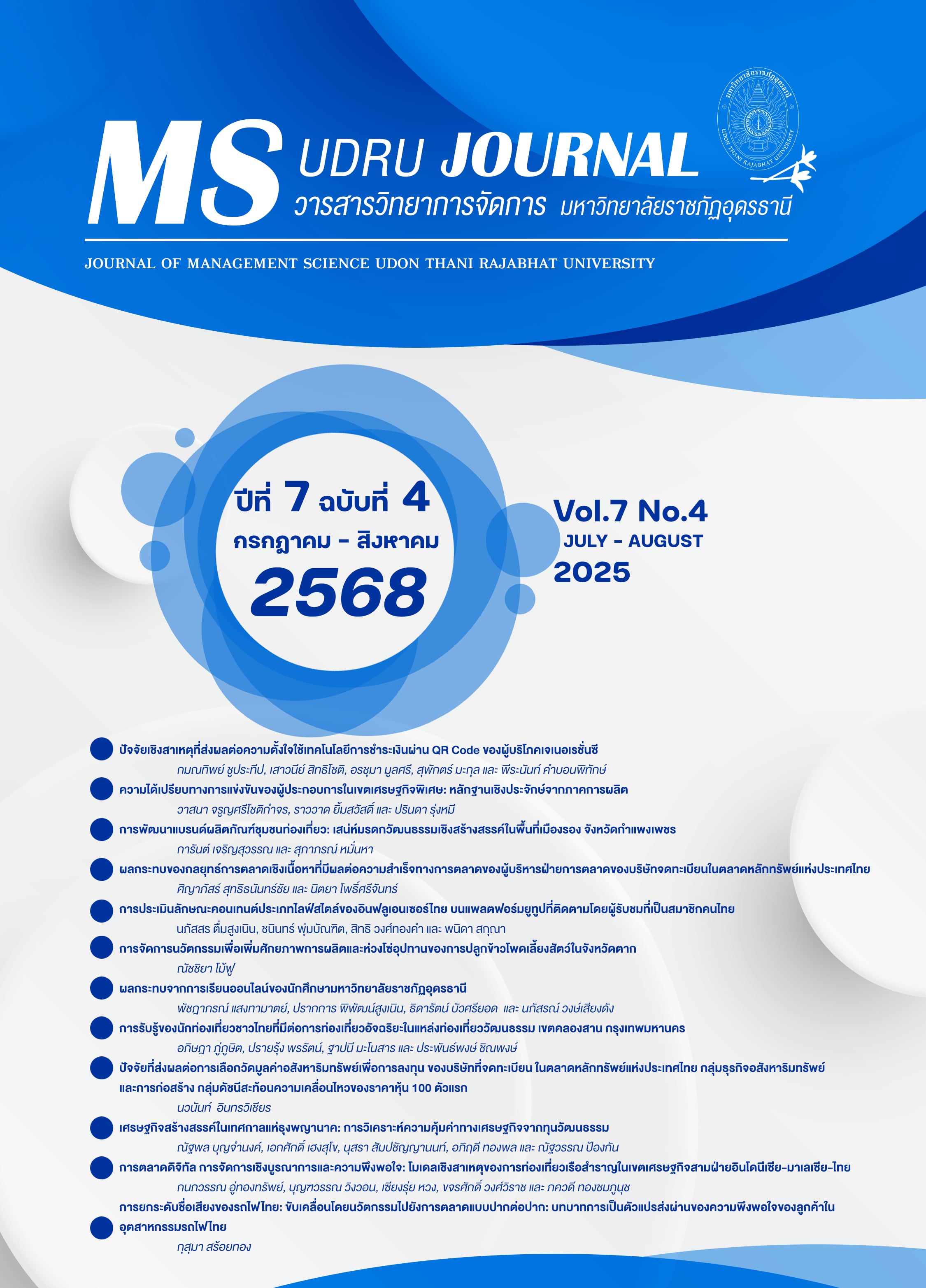
การตลาดดิจิทัล การจัดการเชิงบูรณาการและความพึงพอใจ: โมเดลเชิงสาเหตุของการท่องเที่ยวเรือสำราญในเขตเศรษฐกิจสามฝ่ายอินโดนีเซีย-มาเลเซีย-ไทย
Article Sidebar
Main Article Content
บทคัดย่อ
งานวิจัยมีวัตถุประสงค์เพื่อ 1) ศึกษาความสำคัญของการตลาดดิจิทัล คุณภาพบริการ การจัดการเชิงบูรณาและความพึงพอใจของนักท่องเที่ยวที่ใช้บริการเรือสำราญ 2) เพื่อยืนยันโมเดลอิทธิพลเชิงสาเหตุของการตลาดดิจิทัล คุณภาพบริการและการจัดการเชิงบูรณาการที่มีต่อความพึงพอใจของนักท่องเที่ยวสอดคล้องกับข้อมูลเชิงประจักษ์ และ 3) เพื่อศึกษาโมเดลอิทธิพลเชิงสาเหตุของการตลาดดิจิทัล คุณภาพบริการและ การจัดการเชิงบูรณาการที่มีต่อความพึงพอใจของนักท่องเที่ยวที่ใช้บริการเรือสำราญในเขตเศรษฐกิจสามฝ่ายอินโดนีเซีย-มาเลเซีย-ไทย เป็นการวิจัยเชิงปริมาณ กลุ่มตัวอย่าง คือ นักท่องเที่ยวที่เคยใช้บริการเรือสำราญเขตเศรษฐกิจสามฝ่าย จำนวน 480 ราย วิเคราะห์ข้อมูลด้วยสถิติพรรณนาเพื่อหาค่าร้อยละ ค่าเฉลี่ยและส่วนเบี่ยงเบนมาตรฐาน สถิติอนุมานวิเคราะห์ด้วยสมการโครงสร้าง
ผลการวิจัยพบว่าทุกปัจจัยมีความสำคัญระดับมากที่สุด โดยคุณภาพบริการมีความสำคัญเป็นอันดับ แรก รองลงมา คือ การตลาดดิจิทัลและการจัดการเชิงบูรณาการ ส่วนความพึงพอใจของนักท่องเที่ยวมีความสำคัญระดับมาก สอดคล้องกับข้อมูลเชิงประจักษ์ คือ Chi square=80.84 df.=69 p-value=0.1559 RMSEA=0.027 RMR=0.015 NFI=0.98 NNFI=0.99 GFI=0.98 AGFI=0.95 โดยค่าดัชนีทุกตัวผ่านเกณฑ์การพิจารณา ผลการวิเคราะห์สมการโครงสร้างพบว่าอิทธิพลเชิงสาเหตุของการตลาดดิจิทัล คุณภาพบริการและการจัดการเชิงบูรณาการที่มีต่อความพึงพอใจ สอดคล้องกับข้อมูลเชิงประจักษ์อย่างมีนัยสำคัญทางสถิติที่ระดับ 0.05 โดยปัจจัยการตลาดดิจิทัล คุณภาพบริการและการจัดการเชิงบูรณาการ ร่วมกันอธิบายความแปรปรวนของความพึงพอใจได้ร้อยละ 11 การตลาดดิจิทัลมีอิทธิพลทางตรงเชิงบวกต่อคุณภาพการบริการ และการจัดการเชิงบูรณาการ แต่ในขณะเดียวกันการจัดการเชิงบูรณาการมีอิทธิพลทางตรงในเชิงบวกต่อความพึงพอใจแต่คุณภาพบริการมีอิทธิพลทางตรงเชิงลบต่อความพึงพอใจ ทั้งนี้การตลาดดิจิทัลไม่มีอิทธิพลตรง แต่มีอิทธิพลทางอ้อมผ่านคุณภาพบริการและการจัดการเชิงบูรณาการต่อความพึงพอใจของลูกค้าที่ระดับนัยสำคัญ 0.05
Article Details

อนุญาตภายใต้เงื่อนไข Creative Commons Attribution-NonCommercial-NoDerivatives 4.0 International License.
บทความที่ได้รับการตีพิมพ์เป็นลิขสิทธิ์ของคณะวิทยาการจัดการ มหาวิทยาลัยราชภัฏอุดรธานี
ข้อความที่ปรากฏในบทความแต่ละเรื่องในวารสารวิชาการเล่มนี้
ไม่ใช่ความคิดเห็นและความรับผิดชอบของผู้จัดทำ บรรณาธิการ กองบรรณาธิการ และคณะวิทยาการจัดการ มหาวิทยาลัยราชภัฏอุดรธานี ความรับผิดชอบด้านเนื้อหาและการตรวจร่างบทความแต่ละเรื่องเป็นความคิดเห็นของผู้เขียนบทความแต่ละท่าน
เอกสารอ้างอิง
กรมเจรจาการค้าระหว่างประเทศ. (2566). รายงานความร่วมมือทางเศรษฐกิจสามฝ่าย IMT-GT. สืบค้นเมื่อ 23 มีนาคม 2568, จาก https://www.mfa.go.th/th
กระทรวงการท่องเที่ยวและกีฬา. (2567). แผนยุทธศาสตร์การส่งเสริมการท่องเที่ยวเรือสำราญ พ.ศ. 2561-2570. สืบค้นเมื่อ 23 มีนาคม 2568, จาก https://secretary.mots.go.th/category/59
กรุงเทพธุรกิจ. (2566). ส่องความคืบหน้า 3 ท่าเรือสำราญ จ่อเปิดบริการรับนักท่องเที่ยวปี 2571. สืบค้นเมื่อ 23 มีนาคม 2568, จาก https://www.bangkokbiznews.com
ณฐวัฒน์ พระงาม และจเร เถื่อนพวงแก้ว. (2563). การสื่อสารการตลาดดิจิทัลและส่วนประสมการตลาดบริการที่ส่งต่อการตัดสินใจท่องเที่ยวในภาคเหนือตอนล่าง. วารสารวิทยาการจัดการ มหาวิทยาลัยราชภัฏอุดรธานี. ปีที่ 2 ฉบับที่ 5 หน้า 11-27.
ธนาคารแห่งประเทศไทย. (2567). โครงการพัฒนาเขตเศรษฐกิจสามฝ่ายอินโดนีเซีย มาเลเซียและไทย. สืบค้นเมื่อ 23 มีนาคม 2568, จาก https://www.ryt9.com/s/ryt9/237032
Abd Ghani, M., Rahi, S., Mansour, M., Abed, H., & Alnaser, F. M. (2017). Determinants of Customer Loyalty: The Role of Service Quality, Customer Satisfaction and Bank Image of Islamic Banks in Palestine. International Journal of Economics & Management Sciences, 06(05). https://doi.org/10.4172/2162-6359.1000461
Adil, M. (2013). Modeling effect of perceived service quality dimensions on customer satisfaction in Indian bank settings. International Journal of Services and Operations Management, 15(3), 358–373.
Afriani, L., Filani, L., Puspitaningtias, R., & Priyanto, R. (2024). The influence of product quality, service quality and ease of use on bni mobile banking customer loyalty, purbalingga regency. Journal of Management Science (JMAS), 7(1), 578-584.
Afrina, Y., Sadia, T., Kaniz, F. (2015). Effectiveness of Digital Marketing in the Challenging Age: An Empirical Study. International Journal of Management Science and Business Administration, 1(5), 69-80.
Alonazi, B. S. (2023). Tourist behavior in the cruise industry post COVID 19: An examination of service quality, corporate image and intentions to pay and revisit. Sustainability, 15(11), Article 8623. https://www.mdpi.com/2071-1050/15/11/8623
Anuar, A. R., Irewati, A., & Raharjo, S. N. I. (2024). Promoting the Sabang–Phuket–Langkawi Tourism Belt Under the IMT-GT Subregional Cooperation Framework. Journal of Sustainability Science and Management, 19(12), 87–106.
Arefieva, O. (2023). Managing the Integrated Value of an Enterprise through Digital Marketing Tools. Business Inform. 3(542), 211-220.
Best, R., & Kahn, J. V. (1993). Research in Education. (7th ed.). Boston: Allyn and Bacon.
Blazey, M. L. (2008). The integrated management system: Components of optimum performance; The necessary and sufficient. Quality Press.
Branch, T., Branch, U., Nobar, H. B. K., & Rostamzadeh, R. (2018). The Impact of Customer Satisfaction, Customer Experience, and Customer Loyalty on Brand Power. Journal of Economics and Management, 19(2), 417–430.
Cheung, G. W., Cooper-Thomas, H. D., Lau, R. S., & Wang, L. C. (2024). Reporting reliability, convergent and discriminant validity with structural equation modeling: A review and best-practice recommendations. Asia Pacific Journal of Management, 41(2), 745–783.
Chu, A. M. C., & Hsu, C. H. C. (2023). Cruise revenue management: Cross-discipline literature review and development of an integrated cruise revenue management framework. International Journal of Contemporary Hospitality Management, 35(10), 3542–3569.
Cruise Market Watch. (2024). Market. Retrieved February 4, 2025, from https://cruisemarketwatch.com/growth
Çullu, B., Özispa, N., & Arabelen, G. (2024). Cruise Passengers’ Perceived Service Quality During the Pandemic Period via User-Generated Content. Journal of ETA Maritime Science, 12(2), 186-198.
Dwiwijaya, K. A. (2024). E-Business and digital marketing: Integrating management information systems for competitive advantage. Global International Journal of Innovative Research, 2(6), 1056-1067.
Fadlilah, R., Syah, T. Y. R., Indradewa, R., & Pusaka, S. (2019). The Role of Service Quality and Customer Satisfaction: a Case Study for Applications of Go-Food. Russian Journal of Agricultural and Socio-Economic Sciences, 91(7), 263–269.
Grönroos, C. (2007). Service Management and Marketing: Customer Management in Service Competition. New Jersey: John Wiley & Sons.
Hadi, D. P., & Indradewa, R. (2019). The service quality effects on corporate reputation, customer satisfaction, and loyalty. Journal of Multidisciplinary Academic 51 JoMA, 3(3). 23-38.
Hair, J. F., Black, W. C., Babin, B. J., Anderson, R. E., & Tatham, R. L. (2010). Multivariate Data Analysis. New Jersey: Pearson Prentice Hall.
Huang, M. L., Li, Y. M., Ho, P. T., & Huang, H. C. (2024). A Study on the Impact of Cruise Tourism Experience on Satisfaction, Revisit Behavior, and Consumer Spending Behavior. Advances in Management and Applied Economics, 14(6), 1-13.
Jia, S. S. (2019). Understanding cruise tourists' satisfaction by analyzing their online ratings and reviews. Journal of Management and Strategy. 10(4), 1-6.
Joreskog, K. G., & Sorbom, D. (1996). LISREL8: User’s reference guide. Mooresville: Scientific Software.
Kaplan, R. S., & Norton, D. P. (1996). The Balanced Scorecard: Translating Strategy into Action. Harvard Business Review Press.
Katz, J. (2025). Rapid economic growth in countries like China, India, and Southeast Asian nations increases consumer spending on leisure and travel. Retrieved January 23, 2025, from https://cruising.org/cruise-market/asia
Khamis, F. M. D., & AbRashid, R. (2018). Service quality and customer’s satisfaction in Tanzania’s Islamic banks: A case study at People’s Bank of Zanzibar (PBZ). Journal of Islamic Marketing, 9(4), 884-900.
Li, F., Lu, H., Hou, M., Cui, K., & Darbandi, M. (2021). Customer satisfaction with bank services: The role of cloud services, security, e-learning, and service quality. Technology in Society, 64, 101487.
Likert, R. (1970). A Technique for the Measurement of Attitude. In G.F. Summer. New York: Rand McNally.
Nunnally, J. C. (1978). Psychometric Theory. (2nd ed.). New York: McGraw-Hill.
Parasuraman, A., Zeithaml, V.A. and Berry, L. (1985) A Conceptual Model of Service Quality and Its Implications for Future Research. Journal of Marketing, 49, 41-50.
Poliakov, I. B., Kampov, H. C., & Kasinecz, O. B. (2024). Digital principles of management and quality adjustment of tourism products in small businesses. Аrросвіт, 18(1), 98-103.
Porter, M. E. (1985). Competitive Advantage: Creating and Sustaining Superior Performance. New York: Free Press.
Promnoon, P., Fuengfu, T., Anusart, N., Kani, F., Chedo, S., Supaluksuttha, Y., & Anantamongkolkul, C. (2024). Cruise Tourist Experience: An Analysis from TripAdvisor Reviews. Prooceeding 4th International Conference of Business and Social Sciences. Surabaya, October 26-27th, 2024, 353-361.
Qu, C. (2023). Research on the evaluation system and satisfaction of cruise tourism in China based on the decentralized Internet. Bohrium, 13(1), 108–117.
Ranjbar, S. E., & Vares, H. (2023). The effect of digital marketing on customer satisfaction of online stores. Journal of Namibian Studies, 37, 903–921.
Rasulova, M. T. (2024). Methods of using digital technologies to improve the quality of tourism services. International Journal of Management and Economics Fundamental. 4(11):179-184.
Rovinelli, R.J., & Hambleton, R. K. (1977). On the use of content specialists in the assessment of criterion-referenced test item validity. Tijdschrift Voor Onderwijs Research, 2, 49-60.
Rungroueng, T. (2024). A Model for Managing Standardization of Cruise Port Attributes Influencing Cruise Passenger Satisfaction Toward Positive Word-Of-Mouth: The GSCA Application Approach. ABAC Journal, 44(2), 241-267.
Saputra, J. B. (2024). The Importance of Digital Marketing Integration in Strategic Management Planning. Action Research Literate. 8(5), 1-8.
Sharafuddin, M. A., Madhavan, M., & Wangtueai, S. (2024). Assessing the Effectiveness of Digital Marketing in Enhancing Tourist Experiences and Satisfaction: A Study of Thailand’s Tourism Services. Administrative Sciences, 14(11), 273.
Shelly, M. W. (1975). Responding to Social Change. Pennsylvania: Downer, Hutchison Press.
Sriboonlue, U. (2022). The Effects of Cultural Dimensions on Service Quality, Customer Engagement, Customer Satisfaction and Customer Loyalty in Multi-National Airline Sectors. Asian Administration and Management Review, 5(2), 12–23.
Sun, X. (2023). Exploring cruise tourists’ sentiment expression pattern from online reviews: An insight into market positioning. Tourism Management Perspectives, 49(2), 101195. Retrieved August 27, 2025, from https://www.sciencedirect.com.
Tabachnick, B. G., & Fidell, L. S. (2007). Experimental designs using ANOVA. California: Thomson Brooks/Cole.
Travel and Tour World. (2025). Indonesia Drives Cruise Tourism Forward with Unstoppable Growth, as Bali Breaks Tourism Records, Prompting Port Expansions and Preparations for 2025. Retrieved January 23, 2025, from https://www.travelandtourworld.co.th/
Vajčnerová, I. (2011). IQM of a tourism destination as a tool of competitiveness. Acta Universitatis Agriculturae et Silviculturae Mendelianae Brunensis. 59(2), 407-412.
Wijaya, I., Rahardjo, K., Abdillah, Y., & Riza, M. F. (2025). The influence of sustainable leadership, organizational culture, and digital marketing on sustainable performance: A study on tourism sector companies in Indonesia. Sustainability, 17(14), 6238.
