
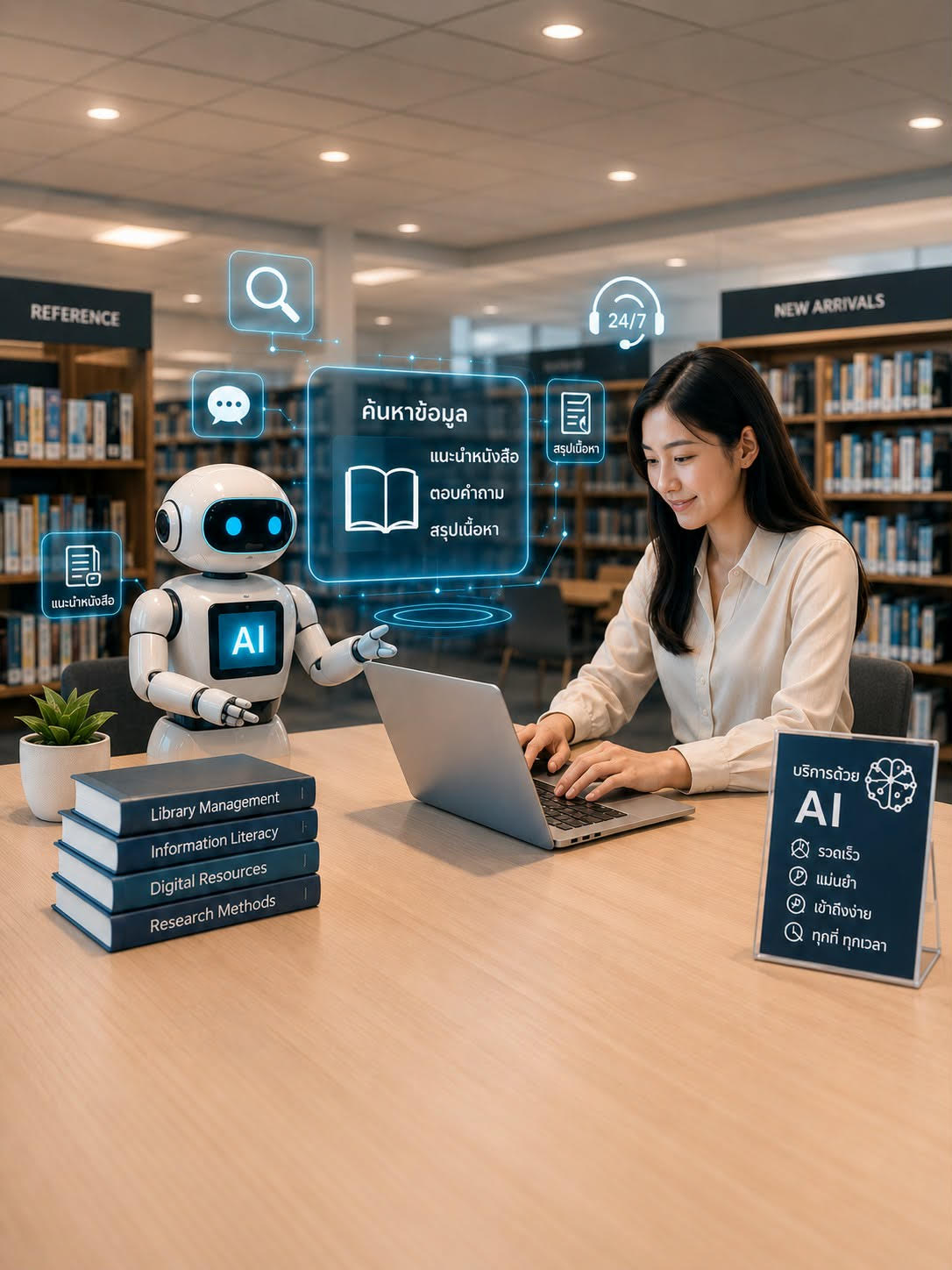
Application of Artificial Intelligence for Academic Libraries
Keywords:
Artificial Intelligence, Libraries, Higher Education InstitutionsAbstract
This quantitative research, entitled “The Application of Artificial Intelligence in Higher Education Libraries,” aimed to (1) investigate the application of artificial intelligence (AI) technologies in higher education libraries, (2) examine the level of AI technology acceptance among higher education library personnel, and (3) propose appropriate AI technologies for higher education libraries. Data were collected using a questionnaire administered to 360 library personnel from 153 higher education institutions. The data were analyzed using descriptive statistics (percentages), one-way analysis of variance (ANOVA) to examine relationships, and regression analysis to identify factors influencing the dependent variables.
The findings revealed that (1) libraries most frequently employed generative AI for automatic language translation in service provision, while content creation for public relations was the most common operational application. The most widely subscribed AI applications were chatbots and content generation tools, followed by tools for research support and information retrieval. The most popular AI platforms were ChatGPT, Gemini, EndNote, Copilot, and Claude, respectively. (2) Regarding technology acceptance, social influence, knowledge and understanding enhancement, core factors, and facilitating factors all demonstrated high mean levels. Among these, knowledge and understanding enhancement exerted the strongest positive influence on AI adoption. These results are consistent with the Technology Acceptance Model (TAM). The model exhibited high predictive accuracy, with a coefficient of determination (R-squared) of .775 and a very low mean absolute percentage error (MAPE), indicating that the adoption of AI in libraries is likely to be well accepted by library personnel. (3) Appropriate AI technologies for libraries include chatbots and content generation tools; AI for research and information retrieval; creative content generation (images, videos, and audio); reference management; and language and grammar enhancement tools. Key success factors include administrative support, policies, and vision; personnel skills, knowledge, and professional development; and budgetary allocation and resource support. The study recommends that the Ministry of Higher Education, Science, Research and Innovation serve as the primary agency for procuring AI tools for higher education institutions, and that institutions provide continuous financial support and regular training for library personnel.
Keywords: Artificial Intelligence, Libraries, Higher Education Institutions
References
กระทรวงการอุดมศึกษา วิทยาศาสตร์ วิจัย และนวัตกรรม และกระทรวงดิจิทัลเพื่อเศรษฐกิจและสังคม. (2566). แผนปฏิบัติการด้านปัญญาประดิษฐ์แห่งชาติเพื่อการพัฒนาประเทศไทย (พ.ศ. 2565 - 2570). https://ai.in.th/wp-content/uploads/2022/12/20220726-AI.pdf
ชลธิชา แสงสีดา. (2567). “AI” การปลดแอกทางนวัตกรรม เทคโนโลยีสารพัดประโยชน์และความ ท้าทายทางด้านจริยธรรม.
https://www.tcdcmaterial.com/th/article/technology-innovation/34501
ณปภัช เสโนฤทธิ์. (2567). ปัจจัยที่ส่งผลต่อการยอมรับการใช้ AI Chatbot ในการปรึกษาด้านสุขภาพจิต. วิทยานิพนธ์วิทยาศาสตรมหาบัณฑิต, มหาวิทยาลัยธรรมศาสตร์.
ธัญญวีร์ รสมัย. (2567). Generative AI ประเภทต่าง ๆ. https://race.nstru.ac.th/home_ex/blog/topic/show/9580
ธีรพงศ์ เสรีสำราญ. (2565). มาสร้างสรรค์บทเพลงของคุณแบบง่าย ๆ ได้ด้วย AI MUSIC GENERATOR. https://www.beartai.com/buzz/1133523
นวพรรณ อินสกุล. (2567). การศึกษาปัจจัยที่ส่งผลต่อการยอมรับการใช้แชท GPT 4.0 ของนักศึกษามหาวิทยาลัยธรรมศาสตร์. วิทยานิพนธ์วิทยาศาสตรมหาบัณฑิต, มหาวิทยาลัยธรรมศาสตร์.
ปราโมทย์ ลือนาม. (2554). แนวความคิด และวิวัฒนาการของแบบจำลองการยอมรับการใช้เทคโนโลยี. วารสารการจัดการสมัยใหม่, 9(1), 9-17.
ปรีดี นุกุลสมปรารถนา. (2566). รวม Generative AI ทั้ง 7 หมวดหมู่สำหรับการใช้งานในยุคดิจิทัล. https://www.popticles.com/marketing/generative-ai-category/
ปัทมาพร สมุทรประภูต และสมพล ทุ่งหว้า. (2568). ทักษะดิจิทัลและการยอมรับเทคโนโลยีที่ส่งผลต่อการประยุกต์ใช้ปัญญาประดิษฐ์ ของพนักงานบริษัทเอกชนเขตกรุงเทพมหานคร. วารสารการจัดการโซ่คุณค่าและกลยุทธ์ธุรกิจ, 4(2), 106-119.
วลัยลักษณ์ คงพระจันทร์. (2566). ช้าไปไหม ทำไมต้องมี? ถอดรหัสแผนปฏิบัติการ AI Thailand. https://ai.in.th/news/ai-thailand-interview-1/
โศภิรตา วณิชวัชระกุล. (2566). Generative AI ในอุตสาหกรรมโฆษณา: กรณีศึกษา AI-Deate ของ บริษัท Yell Advertising จำกัด. มหาวิทยาลัยธรรมศาสตร์, คณะวารสารศาสตร์และสื่อสารมวลชน.
สำนักงานคณะกรรมการส่งเสริมวิทยาศาสตร์ วิจัยและนวัตกรรม. (2567). สกสว. ร่วมงานแถลงนโยบาย "อว. for AI" โดย "ศุภมาส". https://www.facebook.com/ ThailandScienceResearchandInnovation/posts/pfbid0L31Q6XUfGUdFzSmFidsYzbriNf9zTRMhcYjwFGZjNZAY7Nkpf6WWRWRD6ENbg5vxl
สำนักงานพัฒนาธุรกรรมทางอิเล็กทรอนิกส์. (2567). แนวทางการประยุกต์ใช้ Generative AI อย่างมีธรรมาภิบาลสำหรับองค์กร. https://library.ipst.ac.th/wp-content/uploads/2024/10/GenerativeAIGovernanceGuideline_Vol1_AIGC.pdf
สำนักงานวิทยทรัพยากร จุฬาลงกรณ์มหาวิทยาลัย. (2567). บริการ Chula AIX: Generative AI. https://www.car.chula.ac.th/prnews_detail4.php?id=292
สำนักบรรณสารการพัฒนา สถาบันบัณฑิตพัฒนบริหารศาสตร์. (2565). รายงานการปรับปรุงกระบวนการจัดการหนังสือสู่ผู้ใช้บริการ (กระบวนงานวิเคราะห์หมวดหมู่และการลงรายการหนังสือ). https://library.nida.ac.th/wp-content/uploads/2022/09/R2R-2560-2-การปรับปรุงกระบวนการจัดการหนังสือ.pdf
สำนักหอสมุด มหาวิทยาลัยเกษตรศาสตร์. (2568). AI ตัวท็อปเวอร์ชันพรีเมียม พร้อมให้ใช้ ฟรี!. https://www.lib.ku.ac.th/2024/article/view/621
สุทิพย์ ประทุม. (2565). การยอมรับเทคโนโลยีสารสนเทศในยุควิถีชีวิตใหม่. วารสารลวะศรี มหาวิทยาลัยราชภัฏเทพสตรี, 6(1), 1-18.
เสาวภา หลิมวิจิตร. (2565). การจัดการความเปลี่ยนแปลงในยุคดิจิทัล: กรณีศึกษาห้องสมุดสถาบันอุดมศึกษาในประเทศไทย. อินฟอร์เมชั่น (Information), 29(1), 19-46.
ห้องสมุดมหาวิทยาลัยธรรมศาสตร์. (2567). อัพสกิล AI เพื่อสร้างทักษะการเรียนรู้และการวิจัยของตนเอง. https://www.instagram.com/p/DBgZCGAJ-Ge/
ACRL Research Planning and Review Committee. (2024). 2024 top trends in academic libraries. College & Research Libraries News, 85(6), 231-246.
Akinyemi, O. (2023). Enhancing academic library service delivery using artificial intelligence (AI). Library Philosophy and Practice (e-journal), 8042. https://digitalcommons.unl.edu/libphilprac/8042
Ali, M. Y., Naeem, S. B., & Bhatti, R. (2024). Artificial intelligence (AI) applications and usage among the LIS professionals of Pakistan. Journal of Librarianship and Information Science, 57(3). https://doi.org/10.1177/09610006241241306
Bangkok Bank InnoHub. (2566). ทำความรู้จัก Generative AI ทั้ง 5 ประเภทที่ช่วยผลิตงานสร้างสรรค์ได้อย่างมีประสิทธิภาพ. https://www.bangkokbankinnohub.com/5-types-of-generative-ai-tools-to-unlock-your-creativity/
Bhui, T. (2024). Transforming libraries with artificial intelligence: A comprehensive exploration of applications and implications. International Research Journal of Modernization in Engineering Technology and Science, 6(3), 2444-2451.
Chandrashekara, G. S., & Mulimani, M. (2024). The impact of artificial intelligence on library and information science (LIS) services. International Journal of Innovative Practice and Applied Research, 14(5), 50-56.
https://doi.org/10.2139/ssrn.4856459
Clarivate. (2024). 60% of libraries evaluating or planning for AI integration - report. Research Information. https://www.researchinformation.info/news/60-libraries-evaluating-or-planning-ai-integration-report/
Dixit, C et al. (2024). Role of academic libraries and information services: A study. International Journal of Modern Achievement in Science, Engineering and Technology (IJSET), 1(2), 76-82. https://doi.org/10.63053/ijset.28
Georgetown University Library. (2025). AI tools for research. Georgetown University. https://guides.library.georgetown.edu/ai/tools
Harkawal, A. (2023, February 2). Academic library: Types and functions. Retrieved from https://blog.harkawal.in/2023/02/02/academic-library-types-and-functions/
Jagannara, M. (2023). A study of the AI tools performing innovative services in academic libraries. IJCSPUB, 13(2), 201-205.
Kalbande, D., Yuvaraj, M., Verma, M., A., S., Suradkar, P., & Chavan, S. (2024). Exploring the integration of artificial intelligence in academic libraries: A study on librarians’ perspectives in India. Open Information Science, 8(1), 20240006. https://doi.org/10.1515/opis-2024-0006
Lucy Jelagat Sang, & Macharia, S. (2025). Artificial intelligence (AI) for smart library systems: A focus on awareness and level of adoption in the Kenyan university libraries. The CUEA Journal of Science, 2(1), 1-19.
Martin, J., & Armstrong, M. (2024). AI developments and resources for academic librarians. ACRL Instruction Section, Spring.
Molaudzi, A. I., & Ngulube, P. (2025). Use of artificial intelligence innovations in public academic libraries. IFLA Journal, 51(3). https://doi.org/10.1177/03400352241301780
Ritu. (2024). Libraries in AI era: Applications and perspectives. Thiagarajar College of Preceptors Edu Spectra, 6(2), 45-52.
STKS. (2566). Text-to-video AI generator. https://www.thailibrary.in.th/2023/03/07/text-to-video-ai-generator/
Tandel, B. (2024). Artificial intelligence (AI) tools used in libraries. International Journal of Research Publication and Reviews, 5(6), 4195-4199.
https://ijrpr.com/uploads/V5ISSUE6/IJRPR30235.pdf
Tijani, L. T., et al. (2024). Artificial intelligence in academic libraries and its impact on library services and operation. OMANARP International Journal of Library & Information Science, 1, 53-61.
University of South Florida Libraries. (2025). Tools for research: AI tools and resources. https://guides.lib.usf.edu/c.php?g=1315087&p=9678775
Venkatesh, A., & Davis, F. D. (1996). A model of the antecedents of perceived ease of use: Development and test. Decision Sciences, 27, 451-481.
Venkatesh, V., & Bala, H. (2008). Technology acceptance model 3 and a research agenda on interventions. Decision Sciences, 39(2), 273-315. https://doi.org/10.1111/j.1540-5915.2008.00192.x
Venkatesh, V., & Davis, F. D. (2000). A theoretical extension of the technology acceptance model: Four longitudinal field studies. Management Information Systems Quarterly, 24(4), 115-139. https://doi.org/10.2307/3250959



 Contact: Miss Wanvisa Phonkayun (Aim) Tel:
