
An Analysis of Sak Khalai in the Angulimala Mural at Wat Buak Khrok Luang: Dimensions of Self-Development and Buddhist Socialization
Keywords:
Sak Khalai, Angulimala, Wat Buak Khrok Luang, The Raw and The Cooked, SocializationAbstract
This article analyzes the mural painting of “Angulimala Chasing the Buddha” at Wat Buak Khrok Luang, Chiang Mai Province, with the objective of decoding the cultural meanings of "Sak Khalai" (traditional Lanna leg tattoos) and "Yak Rang" (tucked loincloth attire) within the Lanna socio-cultural context. The study employs a qualitative approach through semiotic analysis, integrating Claude Lévi-Strauss’s structuralist concept of "The Raw and The Cooked" with Pierre Bourdieu’s Cultural Capital Theory. The findings reveal that Lanna artists utilized ethnographic realism to construct Angulimala’s physique with the distinct identity of a "Nak Leng Lanna" (local strongman). His tattoos symbolize embodied cultural capital and the status of being "socially cooked" (culturally matured through pain rituals); however, his aggressive behavior reflects a state of remaining "spiritually raw". The narrative illustrates the futility of physical power and sorcery when confronted with the spiritual authority of the Buddhadhamma. Ultimately, the mural serves as a mechanism for Buddhist socialization, guiding Lanna men to transition from being merely physically "cooked" to becoming fully "spiritually cooked" through the Fourfold Development (Bhavana 4).
References
น. ณ ปากน้ำ. (2544). จิตรกรรมฝาผนังวัดบวกครกหลวง. เมืองโบราณ.
เผ่าทอง ทองเจือ. (2543). ผ้าและการแต่งกายในสมัยโบราณจากจิตรกรรมฝาผนัง. อมรินทร์พริ้นติ้งแอนด์พับลิชชิ่ง.
พระธรรมปิฎก (ป.อ. ปยุตฺโต). (2546). พุทธธรรม ฉบับปรับขยาย. มหาจุฬาลงกรณราชวิทยาลัย.
พระวัชรวีร์ วชิรเมธี. (2550). ประวัติและตำนานวัดบวกครกหลวง. สำนักพิมพ์ MaxxPrint (ดาวคอมพิวกราฟิก).
พระศุภชัย ชยสุโภ. (2567). สมุดภาพต้นแบบลายสัก (อัดสำเนา), วัดสวนดอก.
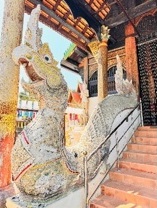
วิโรจ นาคชาตรี. (2567). ภาพถ่ายนาคปากครุฑหน้าวิหารมหาอุด วัดบวกครกหลวงและพระเจ้าทันใจ.
สมเจตน์ วิมลเกษม. (2542). สักสี กายวิทยาล้านนา: ลายสักยันต์และเครื่องราง. สำนักงานกองทุนสนับสนุนการวิจัย.
สารานุกรมวัฒนธรรมไทย ภาคเหนือ. (2542). มูลนิธิสารานุกรมวัฒนธรรมไทย ธนาคารไทยพาณิชย์.
Angulimala. (n.d.). The story of Angulimala. https://angulimala.org.uk/the-story-of- angulimala/
Bock, C. A. (1986). Temples and elephants: Travels in Siam in 1881–1882. Oxford University Press.
Bourdieu, P. (1986). The Forms of Capital. In J. Richardson (Ed.), Handbook of Theory and Research for the Sociology of Education (pp. 241-258). Greenwood.
Chang Puak Magazine. (2025). Architecture & Murals.
https://changpuakmagazine.com/en-article/ARCHITECTURE-/326735/
De Saussure, F. (1966). Course in general linguistics (C. Bally & A. Sechehaye, Eds.; W. Baskin, Trans.). McGraw-Hill Book Company.
Lévi-Strauss, C. (1969). The raw and the cooked: Introduction to a science of mythology (J. Weightman & D. Weightman, Trans.; Vol. 1). Harper & Row.



 Contact: Miss Wanvisa Phonkayun (Aim) Tel:
