
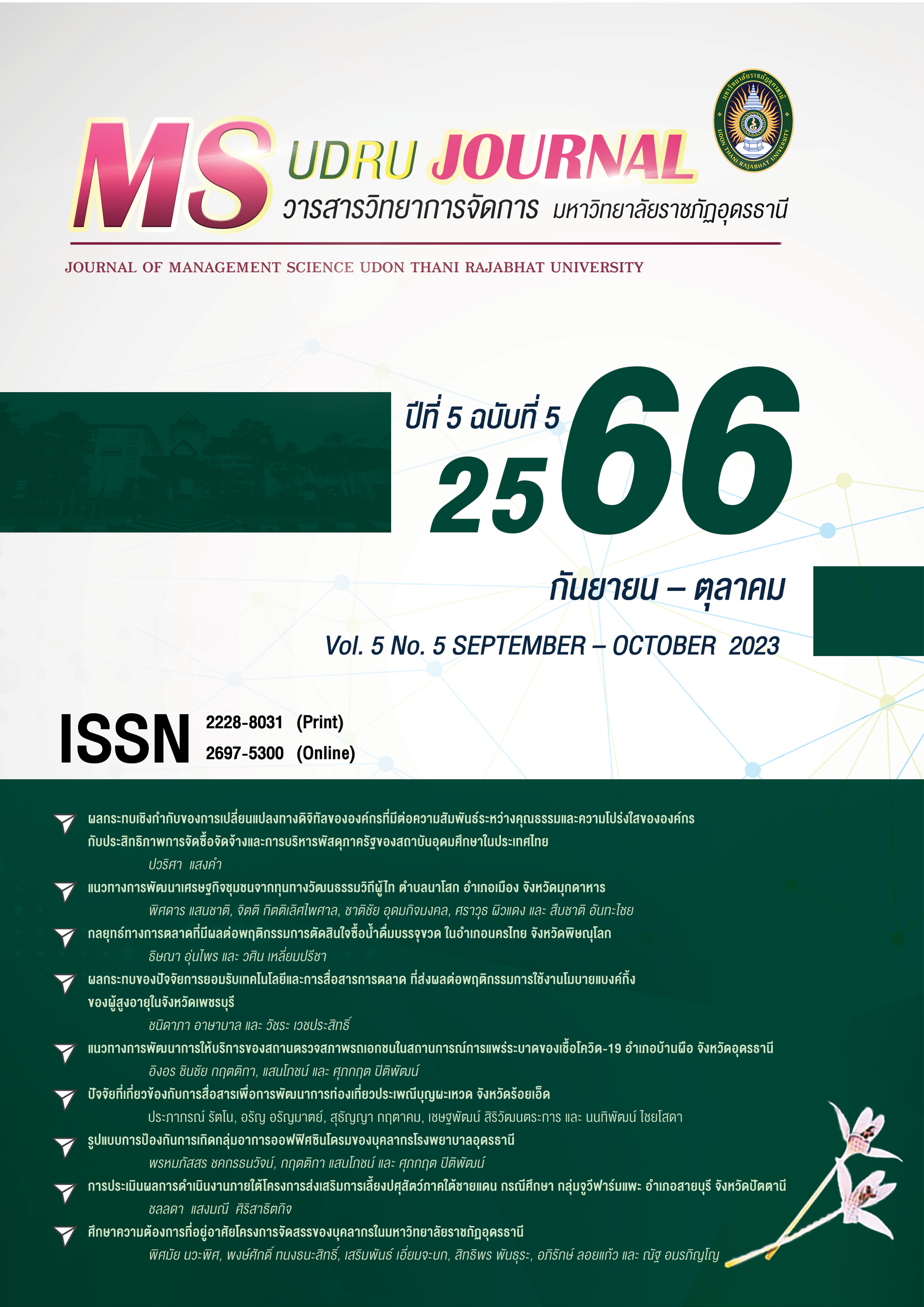
THE IMPACT OF TECHNOLOGICAL ACCEPTANCE FACTORS AND MARKETING COMMUNICATION AFFECTING MOBILE BANKING USAGE BEHAVIOR OF THE ELDERLY IN PHETCHABURI PROVINCE
Article Sidebar
Main Article Content
Abstract
The impact of technology adoption factors and marketing communication affecting mobile banking usage behavior of the elderly in Phetchaburi province. Research objectives: 1) Study the influence of technology acceptance on the attitudes toward mobile banking among the elderly in Phetchaburi province. 2) Study the influence of marketing communication on the attitudes toward using mobile banking among the elderly in Phetchaburi province. 3) Study the influence of attitudes on mobile banking usage behavior of the elderly in Phetchaburi province. 4) Study the influence of technology acceptance on the behavior of mobile banking users in Phetchaburi province. 5) Study the influence of marketing communication on the behavior of mobile banking users in Phetchaburi province. The sample consisted of 400 randomly selected elderly people in Phetchaburi Province who utilize mobile banking. Questionnaires were utilized for data collection. We utilized both descriptive statistics and inferential Statistics for data analysis. The research results were as follows: 1) Risk perception technology acceptance factors and social Influence positively influence attitudes towards mobile banking usage among the elderly in Phetchaburi province was found to be significant with a value of 0.01. The perception of benefits effect on attitudes toward using mobile banking among the elderly in Phetchaburi province was not statistically significant. 2) Advertising marketing communication factor sales by staff and sales promotion Positive influence on attitudes towards mobile banking usage among the elderly in Phetchaburi province was found to be significant with a value of 0.01. The perceived ease factor and the perception of benefits had no influence on attitudes toward using mobile banking among the elderly in Phetchaburi Province. 3) The correlation coefficient between the internal variables of attitudes towards mobile banking usage was positively correlated with mobile banking behavior among the elderly in Phetchaburi province with a significance value of 0.01. 4) Risk perception technology acceptance factor, ease of perception benefit perception and social Influence positive influence on mobile banking usage behavior of the elderly in Phetchaburi province was found to be significant with a value of 0.01. 5) Advertising marketing communication factors sales by staff Promotion and in terms of news distribution and public relations positive Influence on mobile banking usage behavior of the elderly in Phetchaburi province was found to be significant with a value of 0.01.
Article Details

This work is licensed under a Creative Commons Attribution-NonCommercial-NoDerivatives 4.0 International License.
บทความที่ได้รับการตีพิมพ์เป็นลิขสิทธิ์ของคณะวิทยาการจัดการ มหาวิทยาลัยราชภัฏอุดรธานี
ข้อความที่ปรากฏในบทความแต่ละเรื่องในวารสารวิชาการเล่มนี้ ไม่ใช่ความคิดเห็นและความรับผิดชอบของผู้จัดทำ บรรณาธิการ กองบรรณาธิการ และคณะวิทยาการจัดการ มหาวิทยาลัยราชภัฏอุดรธานี ความรับผิดชอบด้านเนื้อหาและการตรวจร่างบทความแต่ละเรื่องเป็นความคิดเห็นของผู้เขียนบทความแต่ละท่าน
References
กวินณา เจะโสะ และคณะ. (2563). การยอมรับและพฤติกรรมการใช้โมบายแบงก์กิ้งในแต่ละเจเนอเรชั่น: กรณีศึกษา ผู้ใช้ในจังหวัดสงขลา. วารสารวิชาการการตลาดและการจัดการ, 7(1), 74-85.
ฉัตรชนก ศิริโสภณกิจสกูล. (2558). การสื่อสารการตลาดที่สัมพันธ์ต่อภาพลักษณ์องค์กรของธนาคารกสิกรไทย สาขาชะอำ อำเภอชะอำ จังหวัดเพชรบุรี. วิทยานิพนธ์ปริญญาศิลปศาสตร มหาบัณฑิต สาขาการจัดการภาครัฐและภาคเอกชน บัณฑิตวิทยาลัย มหาวิทยาลัยศิลปากร.
ฐานิดา สวัสดี. (2560). การสื่อสารการตลาดที่ส่งผลต่อความพึงพอใจในการใช้บริการเคไซเบอร์ แบงก์กิ้งของผู้บริโภคในกรุงเทพมหานคร. การค้นคว้าอิสระศิลปศาสตรมหาบัณฑิต สาขาวิชาการสื่อสารการตลาด คณะเทคโนโลยีสื่อสารมวลชน วิทยาลัยเทคโนโลยีราชมงคลพระนคร.
ธนาคารแห่งประเทศไทย. (2563). แนวนโยบาย/แนวปฏิบัติระบบการชำระเงิน. สืบค้นเมื่อ 18 เมษายน 2564, จาก https://www.bot.or.th/Thai/PaymentSystems/StandardPS/Pages/default.aspx.
ธนาภิญญ์ อัตตฤทธิ์ และคณะ. (2563). ทัศนคติ ความไว้วางใจที่มีต่อความตั้งใจใช้งานนวัตกรรมทางการเงินในประเทศไทย. วารสารวิชาการมหาวิทยาลัยราชภัฏอุดรธานี, 2(5), 29-43.
บุษรา ประกอบธรรม. (2554). การศึกษาการยอมรับเครือข่ายสังคมออนไลน์ของนักศึกษา: กรณีศึกษา มหาวิทยาลัยกรุงเทพ. วารสารสุทธิปริทัศน์, 27(81), 93-108.
ปวิตรา สอนดี และชุติมา เกศดายุรัตน์. (2561). การยอมรับนวัตกรรมโมบายแบงค์กิ้งแอพพลิเคชั่นของกลุ่มผู้สูงอายุ. การค้นคว้าอิสระนิเทศศาสตรมหาบัณฑิต มหาวิทยาลัยกรุงเทพ.
วิจัยธนาคารกรุงศรี. (2564). บริการธนาคารเพื่อผู้สูงอายุในยุคดิจิทัล. สืบค้นเมื่อ 30 เมษายน 2564, จาก https://www.krungsri.com/th/research/research-intelligence/ri-elders-20.
ศูนย์วิจัยธนาคารออมสิน. (2562). Mobile Banking ตัวช่วยแห่งยุคดิจิทัล. สืบค้นเมื่อ 15 เมษายน 2564, จาก https://www.gsbresearch.or.th./
สิริพร ฑิตะลำพูน และคณะ. (2560). การยอมรับเทคโนโลยีแบบจำลองแทมม์. วารสารการสื่อสารมวลชน, 5(1), 64-75.
เอกพงศ์ มุสิกะเจริญ. (2556). A Technology Acceptance Model หรือ TAM. สืบค้นเมื่อ 14 มิถุนายน 2564, จาก www.clinictech.most.go.th.
Contactless Payment. (2563). การใช้ Mobile Banking และ e-Wallet เติบโตต่อเนื่อง. สืบค้นเมื่อ 25 เมษายน 2564, จาก https://www.moneyandbanking.co.th/article/news/kresearch-contactless-payment-mobile-banking-e-wallet-covid-1/.
Etzel, Michael J, Bruce J. Walker and William J. Stanton. (2004). Marketing. 13th ed. Boston: Mcgraw-Hill, Inc.
George, R. (2007). A TAM Framework to Evaluate User’ Perception towards Online Electronic Payment. Journal of Internet Banking and Commerce: December, 12(3), 1-6.
Kotler, Philip. (1997). Principles of Marketing. New Jersey: Prentice-Hall, Inc.
Luarn, P. and Lin, H.H. (2005). Toward an Understanding of the Behavioral Intention to Use Mobile Banking. Computers in Human Behavior, 21(6), 873-891.
Techsauce. (2564). สรุปพฤติกรรมการใช้งาน Digital และอินเทอร์เน็ตของไทย 2021. สืบค้นเมื่อ 25 เมษายน 2564, จาก https://techsauce.co/tech-and-biz/digital-2021-overview-report.
Wen-shan Yeh, Y., & Chen, Y.Y. (2006). Determinants of User Adoption of E-payment Service. Journal of American Academy of Business, 17(6), 190-198.
