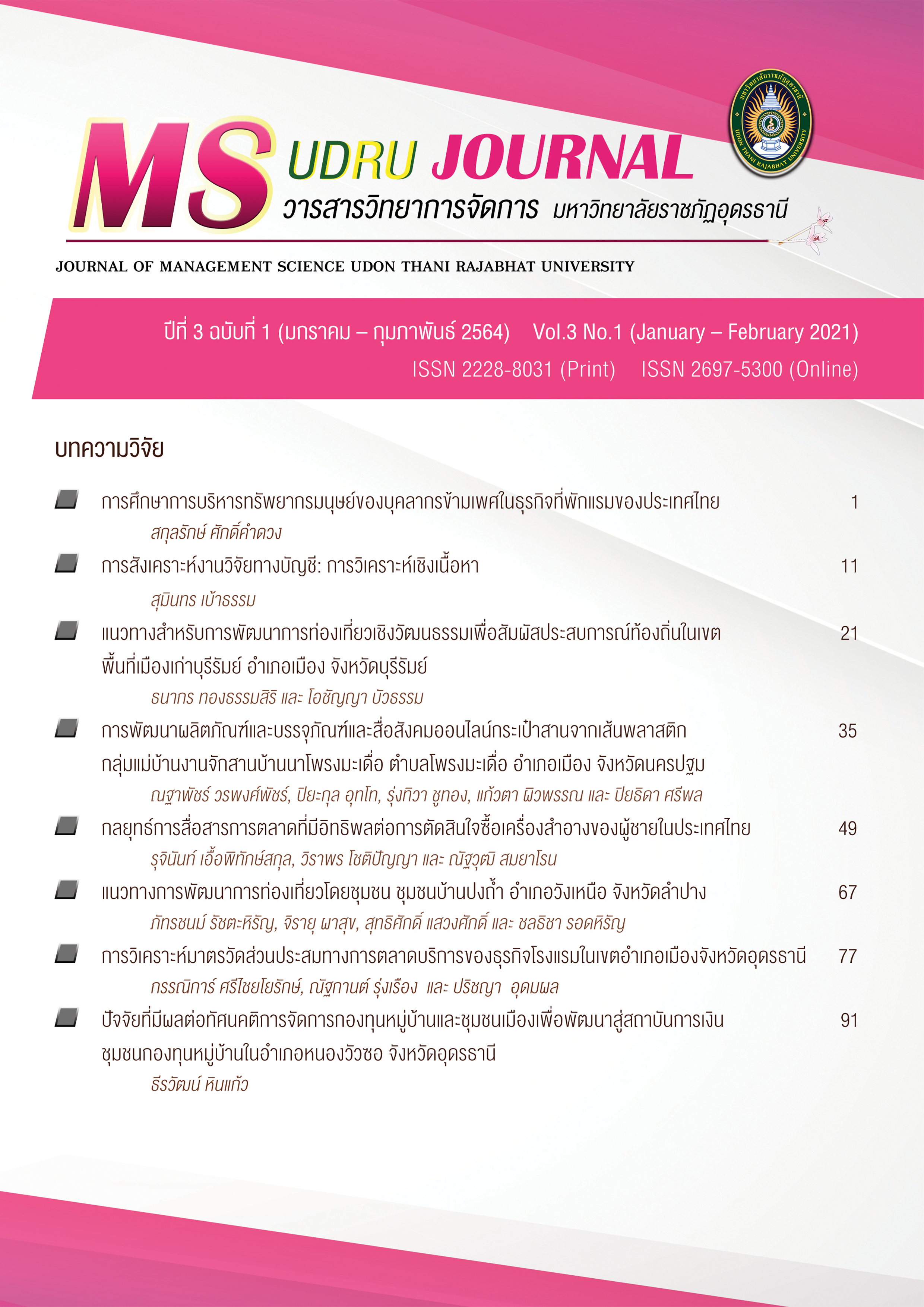
GUIDELINE FOR DEVELOPMENT OF CLUTURAL TOURISM IN THE LOCAL AREA TO EXPERIENCE THE OLD TOWN DISTRICT OF BURIRAM PROVINCE
Article Sidebar
Main Article Content
Abstract
This study was purposively conducted to 1) explore the background, general information, characteristics, and resources for cultural tourism around Buriram Old Town in Buriram province; 2) investigate the tourism potentials of the old town to be develop as a cultural tourism attraction in Muang Buriram District; and 3) provide the guideline for cultural tourism development to present the local experience of Buriram Old Town. This mixed-method quantitative research employed the questionnaire for data collection. The sample group comprised 370 Thai and 15 local stakeholders. The results revealed that the tourism potentials of Buriram old town were generally high in most cases for cultural tourism development as it also required strong collaboration from all partners supported by the private sectors, and community which related to the potential of the area meets the 5 tourist attraction elements: attraction accessibility accommodation activities and destination amenities. The potential of Buriram Old Town Most of them were at a high level, and suggestions on how to develop to be a cultural tourist destination. Must receive cooperation from the government, private sectors and communities as follows: Public relations to the place within the community, The private sectors must assist with the budget for the maintenance of the building, the community member should collaborate to continually create tourism activities plan; and The community members should keep their places clean and offer the tourists with all required information about the local tourist attractions within their community.
Article Details

This work is licensed under a Creative Commons Attribution-NonCommercial-NoDerivatives 4.0 International License.
บทความที่ได้รับการตีพิมพ์เป็นลิขสิทธิ์ของคณะวิทยาการจัดการ มหาวิทยาลัยราชภัฏอุดรธานี
ข้อความที่ปรากฏในบทความแต่ละเรื่องในวารสารวิชาการเล่มนี้ ไม่ใช่ความคิดเห็นและความรับผิดชอบของผู้จัดทำ บรรณาธิการ กองบรรณาธิการ และคณะวิทยาการจัดการ มหาวิทยาลัยราชภัฏอุดรธานี ความรับผิดชอบด้านเนื้อหาและการตรวจร่างบทความแต่ละเรื่องเป็นความคิดเห็นของผู้เขียนบทความแต่ละท่าน
References
กรมการท่องเที่ยว. (2552). คู่มือการประเมินมาตรฐานคุณภาพแหล่งท่องเที่ยวทางวัฒนธรรม. กรุงเทพฯ: กระทรวงการท่องเที่ยวและกีฬา.
ปริวัตร ปาโส (2554). แนวทางการพัฒนาการท่องเที่ยวเชิงวัฒนธรรมจังหวัดร้อยเอ็ด. กรุงเทพฯ: จุฬาลงกรณ์มหาวิทยาลัย.
วิวัฒน์ชัย บุญยภักดิ์. (2550). ศักยภาพในการท่องเที่ยวเชิงวัฒนธรรม. นนทบุรี: มหาวิทยาลัย สุโขทัยธรรมาธิราช.
ศิริมาลย์ วัฒนา, อำนาจ เย็นสบาย, สาธิต ทิมวัฒนบรรเทิง และ จักรพงษ์ แพทย์หลักฟ้า. (2559). ศักยภาพของชุมชนกับการพัฒนาแหล่งท่องเที่ยวเชิงวัฒนธรรมของอำเภอแม่แจ่ม จังหวัดเชียงใหม่, วารสารวิจัยและพัฒนา มหาวิทยาลัยราชภัฏสวนสุนันทา, 8(1), 83-96.
สำนักงานการท่องเที่ยวและกีฬา จังหวัดบุรีรัมย์. (2562). นักท่องเที่ยวชาวไทยที่เดินทางมาชุมชนพื้นที่เมืองเก่าบุรีรัมย์. สืบค้นเมื่อ 15 กุมภาพันธ์ 2563, จาก https://buriram.mots.go.th/.
อังค์ริสา แสงจำนงค์. (2561). ความท้าทายของชุมชนเชิงมรดกทางวัฒนธรรมต่อการพัฒนาแหล่งท่องเที่ยวอย่างยั่งยืน. วารสารกระแสวัฒนธรรม, 19(36), 82-91.
Krejcie, R. V., & Morgan, D. W. (1970). Determining sample size for research activities. Educational and psychological measurement, 30(3), 607-610.
Liu, Y. D. (2012). Cultural events and cultural tourism development: Lessons from the European Capitals of Culture. European Planning Studies, 22(3), 498-514.
Mohammad, I.M. (2013). Identification of Tourist Potential Regions for Balanced Tourism Development in Pahalgam Tourist Destination of Kashmir Valley. Geography, 2(4), 189-190.
Tourism Western Australia. (2008). What is a backpacker. Retrieved February 16, 2020, from https://studylib.net/doc/18840246/what-is-a-backpacker---tourism-western-Australia.
