
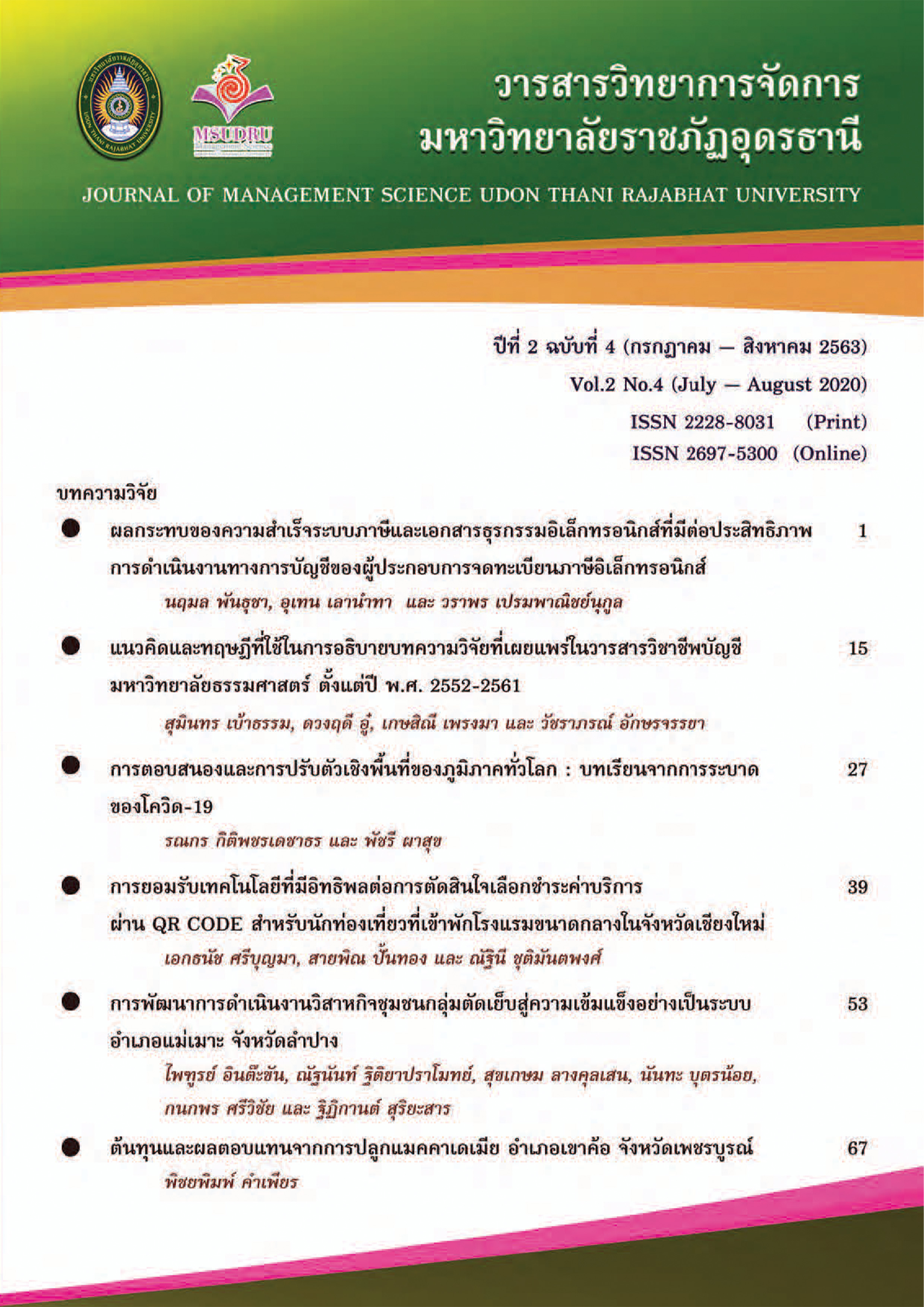
EFFECTS OF TAX SYSTEM AND E-DOCUMENTS SUCCESS ON ACCOUNTING OPERATIONAL EFFICIENCY OF ELECTRONIC TAX REGISTRANTS
Article Sidebar
Main Article Content
Abstract
The main purpose of this research was to study the effects of tax system and e-document on accounting operational efficiency of electronic tax registrants. A questionnaire was used as a tool to collect data and responded by 106 accounting executives’ electronic tax registrants. The statistical techniques used for data analysis were multiple correlation analysis and multiple regression analysis. The findings revealed that tax system and e-document in the system quality, information quality, service quality, using, user satisfaction, and net benefit had positive relationships with and effect on accounting operational efficiency as a whole. Therefore, electronic tax registrants should realize the success of applying tax system and e-document as operational in order to reduce redundant procedures: save time and expense in delivering documents, save space for document storage, allowing operations to be convenient fast and can be used for further processing in the organization’s information system it is more effective as well as causing the operational efficiency to be more successful.
Article Details

This work is licensed under a Creative Commons Attribution-NonCommercial-NoDerivatives 4.0 International License.
บทความที่ได้รับการตีพิมพ์เป็นลิขสิทธิ์ของคณะวิทยาการจัดการ มหาวิทยาลัยราชภัฏอุดรธานี
ข้อความที่ปรากฏในบทความแต่ละเรื่องในวารสารวิชาการเล่มนี้ ไม่ใช่ความคิดเห็นและความรับผิดชอบของผู้จัดทำ บรรณาธิการ กองบรรณาธิการ และคณะวิทยาการจัดการ มหาวิทยาลัยราชภัฏอุดรธานี ความรับผิดชอบด้านเนื้อหาและการตรวจร่างบทความแต่ละเรื่องเป็นความคิดเห็นของผู้เขียนบทความแต่ละท่าน
References
กรมสรรพากร. (2562). รายชื่อผู้ประกอบการที่ได้รับอนุมัติให้จัดทำ ส่งมอบ และเก็บรักษาใบกำกับภาษีอิเล็กทรอนิกส์ และใบรับอิเล็กทรอนิกส์. สืบค้นเมื่อ 16 พฤศจิกายน 2562, จาก https://etax.rd.go.th/etax_staticpage/app/#/index/registered#top
กรมสรรพากร. (2561). ภาพรวมการจัดทำใบกำกับภาษีอิเล็กทรอนิกส์และใบรับอิเล็กทรอนิกส์. สืบค้นเมื่อ 20 มกราคม 2562, จาก https://etax.rd.go.th/etax_staticpage/app/?fbclid=IwAR2VQW4pWhiNEftXo2PIeQDZdzzzd6w7cSKO_tJifX4Lzsrb9R4Lb4yUuIA#/index/main%23top
จันทร์จิรา ตลับแก้ว และ เพ็ญพันธ์ เพชรศร. (2559). การประเมินประสิทธิภาพการใช้งานระบบ สารบรรณอิเล็กทรอนิกส์มหาวิทยาลัยเทคโนโลยีราชมงคลอีสาน. อินฟอร์เมชั่น, 23(1), 23-38.
จารุวรรณ ลิมป์ไพบูลย์. (2558). อิทธิพลของการสนับสนุนจากผู้บริหารระดับสูงที่มีต่อคุณภาพระบบสารสนเทศ คุณภาพการให้บริการ และประโยชน์สุทธิขององค์กร. วารสารวิทยาการจัดการสมัยใหม่มหาวิทยาลัยราชภัฏลำปาง, 8(2), 199.
ปัฐมา ตั้งศักดิ์สุพรรณ และ ชฎาพร ฑีฆาอุมากร. (2562). ความพร้อมในการจัดทำใบกำกับภาษีและใบรับอิเล็กทรอนิกส์ของผู้ประกอบการในเขตกรุงเทพมหานคร และปริมณฑล. วารสารวิจัยธุรกิจและการจัดกา เพื่อความเป็นเลิศ มหาวิทยาลัยรามคำแหง, 1(1), 1-13.
พงศ์ศิรภพ ทองดีรวิสุรเกตุ. (2562). ปัจจัยที่มีผลต่อการจัดเก็บภาษีเงินได้นิติบุคคลในการยื่นแบบแสดงรายการและชำระภาษีอากรทางออนไลน์ (E-FILING). วารสารวิชาการ มหาวิทยาลัยราชภัฏธนบุรี, 8(2), 176-177.
พิธุวรรณ กิติคุณ. (2562). การปฏิรูปการบริหารราชการแผ่นดิน:การบริหารงานและการให้บริการภาครัฐผ่านระบบดิจิทัล HOT ISSUE. สืบค้นเมื่อ 5 มกราคม 2562, จาก http://www.parliament.go.th/library
วัฒนา วงศ์เกียรติรัตน์. (2553). การวางแผนกลยุทธ์: ศิลปะการกำหนดแผนองค์กรสู่ความเป็นเลิศ. พิมพ์ครั้งที่ 3. กรุงเทพฯ: สถาบันส่งเสริมผลผลิตแห่งชาติ.
สมบัติ ท้ายเรือคำ. (2552). ระเบียบวิธีวิจัยสำหรับมนุษยศาสตร์และสังคมศาสตร์. พิมพ์ครั้งที่ 8.มหาสารคาม: มหาวิทยาลัยมหาสารคาม.
อุเทน เลานำทา และ นาถนภา นิลนิยม. (2561). การสำรวจความพึงใจของการนำส่งงบการเงินทางอิเล็กทรอนิกส์ DBD E-Filing โดยสมัครใจของบริษัทจดทะเบียนในตลาดหลักทรัพย์แห่งประเทศไทย. วารสารวิชาการมหาวิทยาลัยฟาร์อีสเทอร์น, 12(Supplement), 71-82.
Aaker, D. A., Kumar, V., and Day, G. (2001). Marketing Research. (7th ed.). New York: John Wiley and Sons.
DeLone, W. H., and McLean, E. R. (2003). The DeLone and McLean Model of Information System Success. Journal of Management Information Systems, 19(4), 9-30.
Hair, J. F., Black, W. C., and Anderson, R. E. (2006). Multivariate Data Analysis. (6th ed.). New Jersey: pearson.
Muhammad, S., Aneela, M., Mahmud, A., and Awais, S. (2019). Exploring the interrelationships between technological predictors and behavioral mediators in online tax filing: The moderating role of perceived risk. Government Information Quarterly, 36(2), 237-251.
Sadress, N., and Juma, B. (2018). The Mediating role of adoption of an electronic tax system in the relationship between attitude towards electronic tax system and tax compliance. Journal of Economics, Finance and Administrative Science, 25(49), 73-88.
Sharda, H., Bharti, M., and Sukhjeet, K. (2015). Behavioral Intention of Taxpayers towards Online Tax Filing in India: An Empirical Investigation. Journal of Business & Financial Affairs, 4(1), 1-5.
Utetiwabo, S., Patrick, M. and Oluoch, O. (2018). Effect of Electronic Tax System on Tax Compliance among small and medium Tax Payers in Rwanda: Case study Of Nyarugenge Sector. Journal of Management and Commerce Innovations, 6(1), 1169–1178.
