
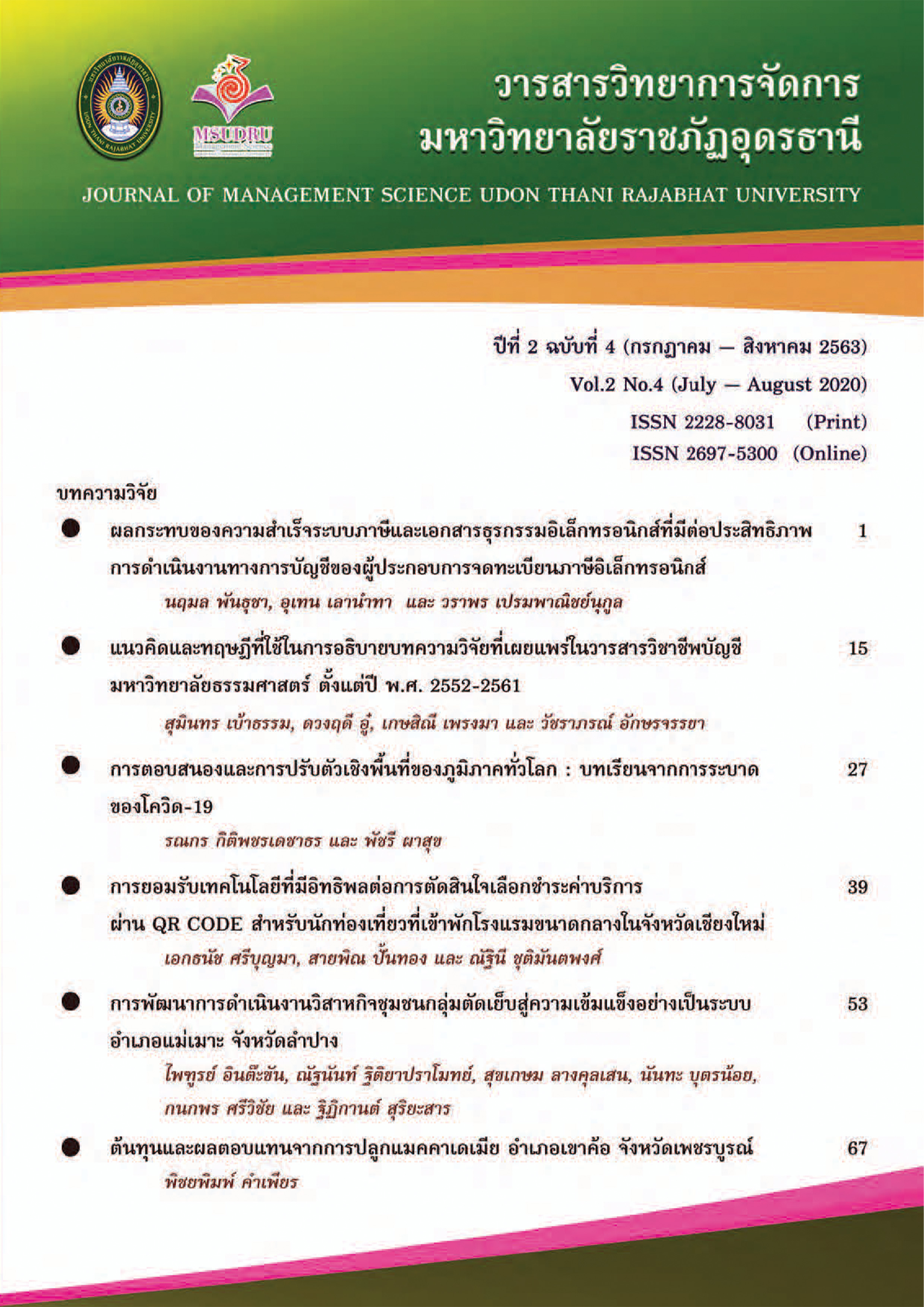
RESPONSIVENESS AND WORLD REGIONAL ADAPTATION: LESSON FROM COVID-19 PANDAMIC
Article Sidebar
Main Article Content
Abstract
This paper aims to study the responsiveness and world regional adaptation to cope with the spread of Coronavirus disease (COVID-19) in all regions around the world. The authors employed an ordered logistic regression model for measuring latent impact on adaptation for the Coronavirus situation. This study assumed a homogeneous spatial distribution within each region. The data included number of cases, death and recovery obtaining from 185 countries during the period of March-April 2020 retrieved from the World Health Organization and analyzed by using a partial marginal effect technique. The result indicated that the region of Asia, Europe, and North America showed the highest level of responsiveness and adaptation when confronting with the Coronavirus situation of level 3 or more, especially in the European regions In contrast, they showed no significant sign of responsiveness and adaptation when facing the Coronavirus situation of level 2 or less.
Article Details

This work is licensed under a Creative Commons Attribution-NonCommercial-NoDerivatives 4.0 International License.
บทความที่ได้รับการตีพิมพ์เป็นลิขสิทธิ์ของคณะวิทยาการจัดการ มหาวิทยาลัยราชภัฏอุดรธานี
ข้อความที่ปรากฏในบทความแต่ละเรื่องในวารสารวิชาการเล่มนี้ ไม่ใช่ความคิดเห็นและความรับผิดชอบของผู้จัดทำ บรรณาธิการ กองบรรณาธิการ และคณะวิทยาการจัดการ มหาวิทยาลัยราชภัฏอุดรธานี ความรับผิดชอบด้านเนื้อหาและการตรวจร่างบทความแต่ละเรื่องเป็นความคิดเห็นของผู้เขียนบทความแต่ละท่าน
References
Akaike, H. (1973). Information theory and an extension of the maximum likelihood principle. (2nd ed.). New York: Springer-Verlag.
Areajo, M., & Naimi, B. (2020). Spread of SARS-CoV-2 Coronavirus likely to be constrained by climate. Retrieved April 16, 2020, from https://www.medrxiv.org/content/10.1101/2020.03.12.20034728v3
Bank of Thailand. (2020). Measure Foreign Fiscal Spending on COVID-19. Retrieved April 23, 2020, from https://www.bot.or.th/Thai/FinancialInstitutions/COVID19/Documents/Measure_Foreign.pdf
Berkeley, L., & Noah, H. (2020). It’s a ‘false hope’ coronavirus will disappear in the summer like the flu, WHO says. Retrieved April 16, 2020, from https://www.cnbc.com/2020/03/06/its-a-false-hope-coronavirus-will-disappear-in-the-summer-like-the-flu-who-says.html
Bliss, C. I. (1934). The Method of Probits. Science, 79(2037), 38-39.
Chen, X., & Yu, B. (2020). First two months of the 2019 Coronavirus Disease (COVID-19) epidemic in China: real-time surveillance and evaluation with a second derivative model. Global Health Research and Policy, 5(1), 2-9.
Gujarati, D. N., & Porter, D. C. (2009). Basic Econometrics. (5th ed.). New York: McGraw-Hill Education.
Jianxi, L. (2020). When Will COVID-19 End. Retrieved April 23, 2020, from https://ddi.sutd.edu.sg/
Jone, C., Philippon, T., & Venkateswaran, V. (2020). Optimal Mitigation Policies in a Pandemic: Social Distancing and Working from Home. Retrieved April 23, 2020, from https://callumjones.github.io/files/covid.pdf
Kaplan, G., Moll, B., & Violante, G. (2020). Pandemics According to HANK. Retrieved April 29, 2020, from https://benjaminmoll.com/wpcontent/uploads/2020/03/HANK_pandemic.pdf
Kermack, W. O., & McKendrick, A. G. (1927). A Contribution to the Mathematical Theory of Epidemics. Proceedings of the Royal Society of London Series A, 115(772), 700-721.
Kinross, P. et al. (2020). Rapidly increasing cumulative incidence of coronavirus disease (COVID-19) in the European Union/European Economic Area and the United Kingdom, 1 January to 15 March 2020. Eurosurveillance, 25(11), 2-6.
Krueger, D., Uhlig, H., & Xie, T. (2020). Macroeconomic Dynamics and Reallocation in an Epidemic. Retrieved April 29, 2020, from https://www.nber.org/papers/w27047.pdf
Matt, H. (2020). Scientists found regions hit hard by coronavirus share similar climate. Retrieved April 16, 2020, from https://www.inkstonenews.com/science/scientists-found-regions-hit-hard-coronavirus-share-similar-climate/article/3075085
Sajadi, M. et al. (2020). Temperature and Latitude Analysis to Predict Potential Spread and Seasonality for COVID-19. Retrieved April 16, 2020, from https://blogs.chapman.edu/wpcontent/uploads/sites/46/2020/03/Temperature-and-latitude-analysis-to-predict-potential-spread-and-seasonality-for-COVID-19.pdf
Spiteri, G. et al. (2020). First cases of coronavirus disease 2019 (COVID-19) in the WHO European Region, 24 January to 21 February 2020. Eurosurveillance, 25(9). 2-7.
Stoecklin, S. B. et al. (2020). First cases of coronavirus disease 2019 (COVID-19) in France: surveillance, investigations and control measures, January 2020. Eurosurveillance, 25(6). 20-26.
World Health Organization. (2020). COVID-19 Strategic Preparedness and Response Plan. Retrieved April 23, 2020, from https://www.who.int/publications-detail/strategic-preparedness-and-response-plan-for-the-new-coronavirus
