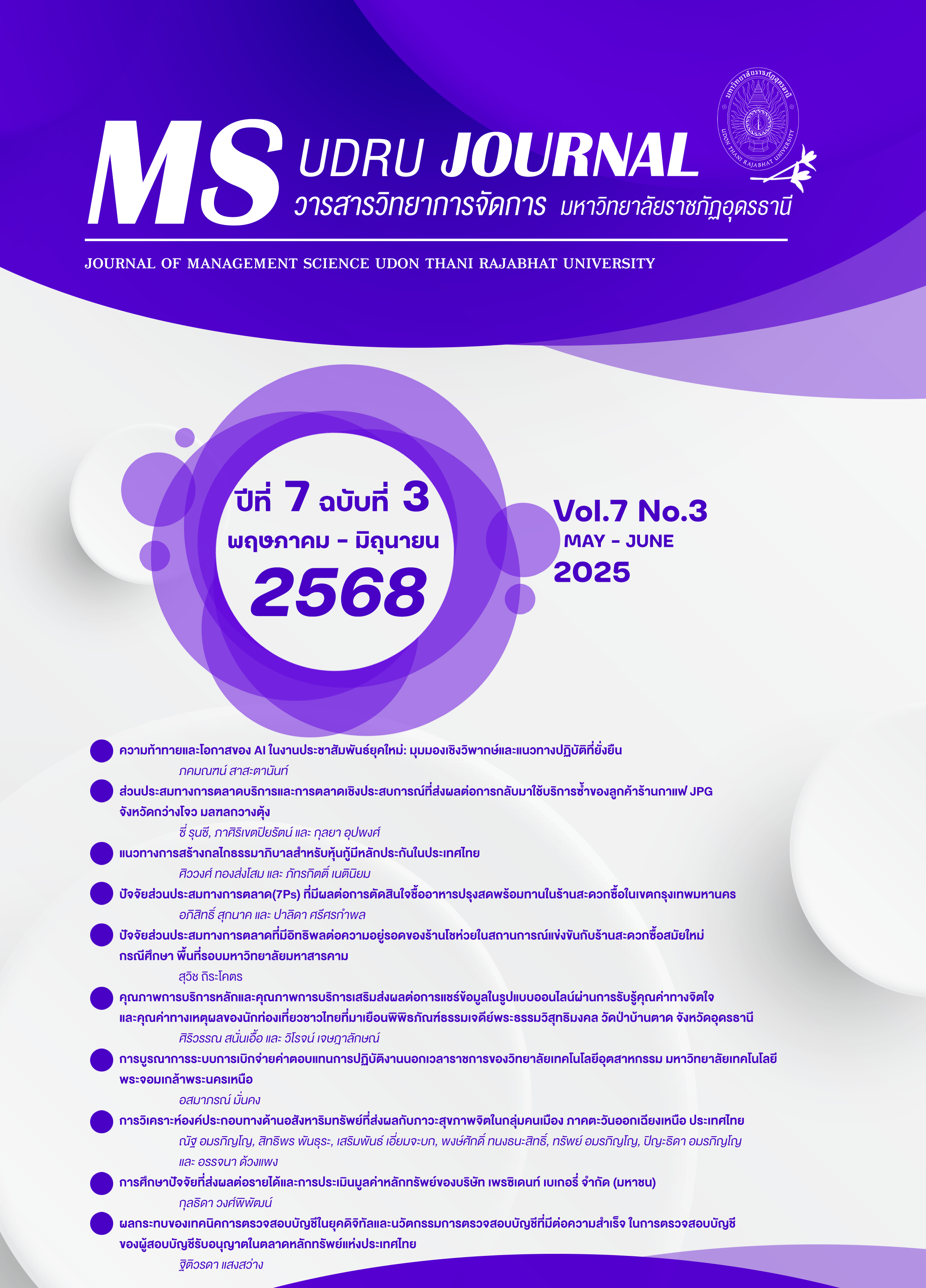
CHALLENGES AND OPPORTUNITIES OF AI IN MODERN PUBLIC RELATIONS: A CRITICAL PERSPECTIVE AND SUSTAINABLE PRACTICES
Article Sidebar
Main Article Content
Abstract
This article explores the role of artificial intelligence (AI) in public relations (PR), focusing on both the opportunities and ethical challenges arising from its use in areas such as content creation, audience analysis, and crisis communication. The study is based on in-depth interviews with twelve PR professionals from Thai and international organizations in Bangkok, each with more than five years of experience in the field. The findings reveal that while AI can enhance efficiency, particularly in predictive insights and real-time engagement, several ethical concerns remain. These include algorithmic bias, lack of transparency, privacy risks, and the absence of emotional and cultural sensitivity. Participants emphasized that AI should be used to support, not replace, human expertise. They recommended that ethical AI practices in PR should prioritize transparency, fairness, data protection, and human oversight to ensure responsible communication and maintain public trust.
Article Details

This work is licensed under a Creative Commons Attribution-NonCommercial-NoDerivatives 4.0 International License.
บทความที่ได้รับการตีพิมพ์เป็นลิขสิทธิ์ของคณะวิทยาการจัดการ มหาวิทยาลัยราชภัฏอุดรธานี
ข้อความที่ปรากฏในบทความแต่ละเรื่องในวารสารวิชาการเล่มนี้ ไม่ใช่ความคิดเห็นและความรับผิดชอบของผู้จัดทำ บรรณาธิการ กองบรรณาธิการ และคณะวิทยาการจัดการ มหาวิทยาลัยราชภัฏอุดรธานี ความรับผิดชอบด้านเนื้อหาและการตรวจร่างบทความแต่ละเรื่องเป็นความคิดเห็นของผู้เขียนบทความแต่ละท่าน
References
Anjum, A. (2024). Impact of AI-driven digital marketing on data privacy and consumer behavior: An SEM study. IUP Journal of Marketing Management, 23(4).
Azmi, M., Mansour, A., & Azmi, C. (2023). A context-aware empowering business with AI: Case of chatbots in business intelligence systems. Procedia Computer Science, 224, 479–484.
Bozkurt, A., & Sharma, R. C. (2024). Trust, credibility, and transparency in human-AI interaction: Why we need explainable and trustworthy AI and why we need it now. Asian Journal of Distance Education, 19(2).
Cheng, Y., Lee, J., & Qiao, J. (2024). Crisis communication in the age of AI: Navigating opportunities, challenges, and future horizons. In Media and Crisis Communication (pp. 172–194).
du Preez, V., Bennet, S., Byrne, M., Couloumy, A., Das, A., Dessain, J., ... & van Heerden, L. (2024). From bias to black boxes: Understanding and managing the risks of AI—An actuarial perspective. British Actuarial Journal, 29, e6.
Ferrara, E., Fragale, L., Fortino, G., Song, W., Perra, C., Di Mauro, M., & Liotta, A. (2019). An AI approach to collecting and analyzing human interactions with urban environments. IEEE Access, 7, 141476–141486.
Ferm, L. E. C., Quach, S., & Thaichon, P. (2022). Data privacy and artificial intelligence (AI): How AI collects data and its impact on data privacy. In Artificial intelligence for marketing management (pp. 163–174). Routledge.
Germinder, L. A., & Capizzo, L. (2024). A strategic communication practitioner imperative: Contextualizing responsible AI as part of responsible advocacy. International Journal of Strategic Communication, 1–17.
Kasap, G. H. (2021). Can artificial intelligence ("AI") replace human arbitrators? Technological concerns and legal implications. Journal of Dispute Resolution, 209.
Luttrell, R., & Wallace, A. A. (Eds.). (2025). Public relations and the rise of AI. Taylor & Francis.
Nobre, G. (2020). Artificial intelligence (AI) in communications: Journalism, public relations, advertising, and propaganda.
Panda, G., Upadhyay, A. K., & Khandelwal, K. (2019). Artificial intelligence: A strategic disruption in public relations. Journal of Creative Communications, 14(3), 196–213.
Pinto, R., & Bhadra, A. (2024). Smarter public relations with artificial intelligence: Leveraging technology for effective communication strategies and reputation management—A qualitative analysis. REDVET-Revista Electrónica de Veterinaria, 25(1).
Statista. (2023). Share of marketing professionals using artificial intelligence (AI) tools worldwide from 2018 to 2023. Retrieved from www.statista.com
Seidenglanz, R., & Baier, M. (2023). The impact of artificial intelligence on the professional field of public relations/communications management: Ethical issues, challenges, and an attempt at a forecast. In Artificial intelligence in public relations and communications: Cases, reflections, and predictions (p. 124).
Shaikh, Z. P. (2025). Artificial intelligence-based emotional intelligence and effective leadership: Applications, implications, and ethical bias. In Emotionally intelligent methods for meaningful leadership (pp. 223–254). IGI Global Scientific Publishing.
Tuncer, S., & Ramirez, A. (2022, June). Exploring the role of trust during human-AI collaboration in managerial decision-making processes. In International Conference on Human-Computer Interaction (pp. 541–557). Springer Nature Switzerland.
Vanel, Z. (2023). The role of artificial intelligence in public relations activities ethically. In Investigating the impact of AI on ethics and spirituality (pp. 53–61). IGI Global.
Vujnovic, M., Kruckeberg, D., Swiatek, L., & Galloway, C. (2025). AI regulation and ethical considerations surrounding the use of artificial intelligence in PR: The need for transparency and accountability. In Public relations and the rise of AI (pp. 77–93). Routledge.
