
FACTORS INFLUENCING TOURISM PERFORMANCE IN THAILAND: THE ROLES OF GOVERNMENT SUPPORT, SERVICE QUALITY, AND DESTINATION E-MARKETING
Article Sidebar
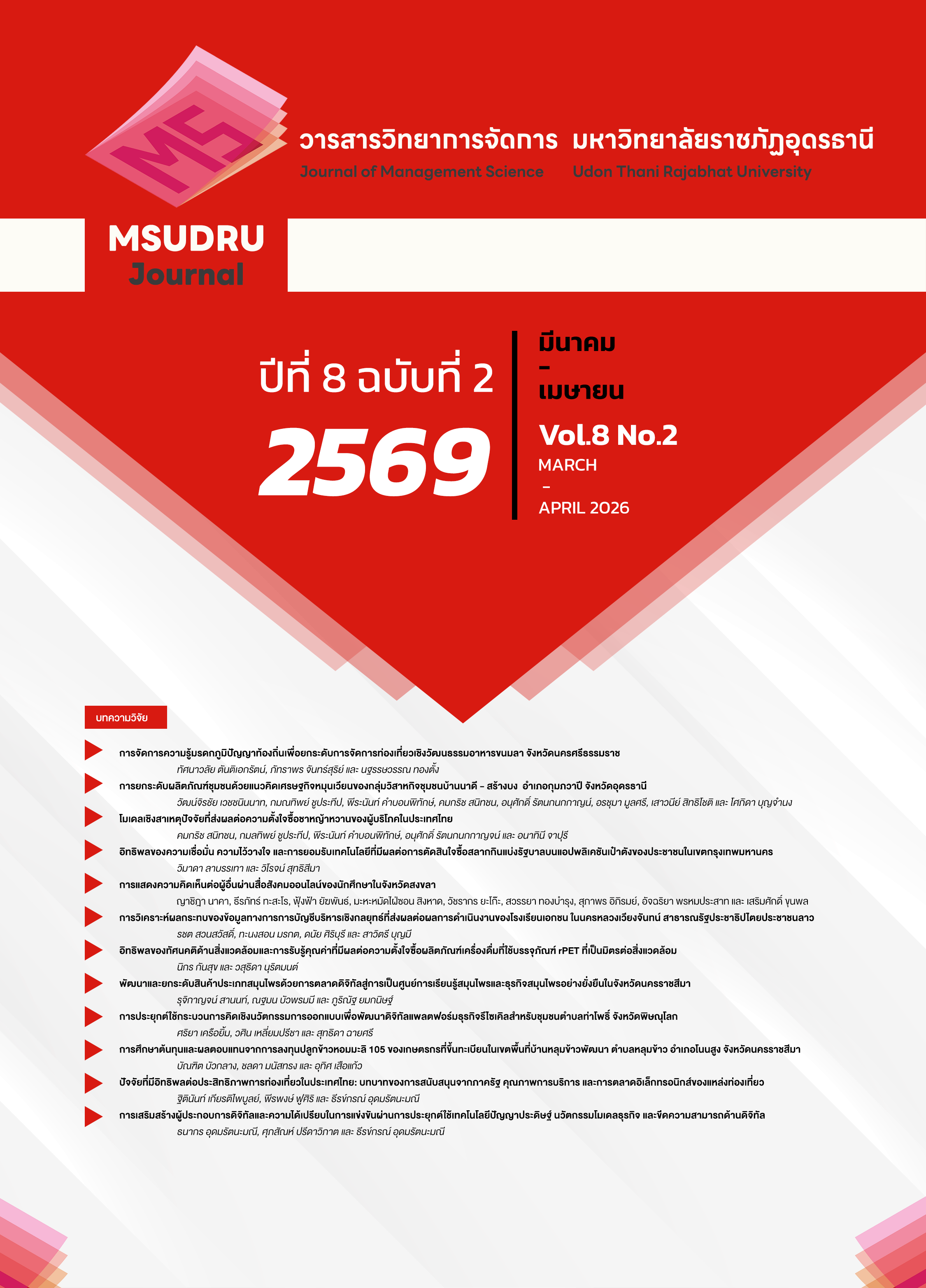
Main Article Content
Abstract
Tourism is a central driver of Thailand’s economy, and enhancing its performance is essential for achieving sustainable growth and competitiveness. This study investigates the influence of government support, service quality, and destination e-marketing on tourism performance in Thailand. A structured questionnaire was distributed to 400 domestic and international tourists who had visited Thailand within the previous twelve months. Data were analyzed using multiple linear regression (MLR) to assess both the individual and combined contributions of the predictors. The regression model explained 63.4% of the variance in tourism performance (R² = 0.634; Adjusted R² = 0.625), demonstrating strong explanatory power. ANOVA results confirmed that the model was highly significant (F = 5504.644, p < 0.001). Path coefficient analysis revealed that government infrastructure and environmental support, service responsiveness and assurance, as well as influencer engagement and information provision in e-marketing, were the most influential factors. These findings highlight the importance of integrated strategies in which supportive policies, reliable service quality, and innovative digital marketing work together to strengthen tourism performance. The study provides practical implications for policymakers and tourism managers, while also suggesting directions for future research to expand the model, apply longitudinal designs, and conduct cross-cultural comparisons to further enhance generalizability.
Article Details

This work is licensed under a Creative Commons Attribution-NonCommercial-NoDerivatives 4.0 International License.
บทความที่ได้รับการตีพิมพ์เป็นลิขสิทธิ์ของคณะวิทยาการจัดการ มหาวิทยาลัยราชภัฏอุดรธานี
ข้อความที่ปรากฏในบทความแต่ละเรื่องในวารสารวิชาการเล่มนี้ ไม่ใช่ความคิดเห็นและความรับผิดชอบของผู้จัดทำ บรรณาธิการ กองบรรณาธิการ และคณะวิทยาการจัดการ มหาวิทยาลัยราชภัฏอุดรธานี ความรับผิดชอบด้านเนื้อหาและการตรวจร่างบทความแต่ละเรื่องเป็นความคิดเห็นของผู้เขียนบทความแต่ละท่าน
References
Ali, F., Ryu, K., & Hussain, K. (2016). Influence of experiences on loyalty and word-of-mouth: The role of satisfaction and image. International Journal of Hospitality Management, 54, 95–104.
Assaf, A. G., & Josiassen, A. (2019). Tourism performance: A review of the measurement and drivers. Tourism Management, 75, 288–300.
Chen, C. F., & Chen, F. S. (2010). Experience quality, perceived value, satisfaction and behavioral intentions for heritage tourists. Tourism Management, 31(1), 29–35.
Dwyer, L., & Kim, C. (2003). Destination competitiveness: Determinants and indicators. Current Issues in Tourism, 6(5), 369–414.
Export Finance Australia. (2025). Annual report 2024–2025. Australian Government. https://www.exportfinance.gov.au/annual-report/
Hair, J. F., Hult, G. T. M., Ringle, C., & Sarstedt, M. (2022). A primer on partial least squares structural equation modeling (PLS-SEM) (3rd ed.). SAGE Publications.
Hall, C. M. (2008). Tourism planning: Policies, processes and relationships (2nd ed.). Pearson.
Khan, M. J., Chelliah, S., & Ahmed, S. (2017). Factors influencing destination image and visit intention among young women travelers: Role of travel motivations, perceived risks, and travel constraints. Asia Pacific Journal of Tourism Research, 22(11), 1139–1155.
Mariani, M., Borghi, M., & Cappa, F. (2021). Online reviews, cultural distance, and international travelers’ satisfaction: A big data cross-cultural analysis. Tourism Management, 83, Article 104217.
Nguyen, T. H. H., Tran, M. D., & Nguyen, L. V. (2020). Government support and tourism development: Evidence from emerging economies. Journal of Sustainable Tourism, 28(9), 1313–1332.
Parasuraman, A., Zeithaml, V. A., & Berry, L. L. (1988). SERVQUAL: A multiple-item scale for measuring consumer perceptions of service quality. Journal of Retailing, 64(1), 12–40.
Prayag, G., Hosany, S., Muskat, B., & Del Chiappa, G. (2017). Understanding the relationships between tourists’ emotional experiences, perceived overall image, satisfaction, and intention to recommend. Journal of Travel Research, 56(1), 41–54.
Reuters. (2024a, April 2). Thailand records 9.4 mln tourists in first 3 months, 454 bln baht spending. https://www.reuters.com/world/asia-pacific/thailand-records-94-mln-tourists-first-3-months-124-billion-spending-government-2024-04-02/
Reuters. (2024b, July 30). Thailand welcomed 20.3 million foreign tourists from January to late July. https://www.reuters.com/world/asia-pacific/thailand-welcomed-203-million-foreign-tourists-january-late-july-2024-07-30/
Ritchie, J. R. B., & Crouch, G. I. (2003). The competitive destination: A sustainable tourism perspective. CABI.
The Economic Times. (2025, January 7). Thailand tourism bounces back with 35 million visitors in 2024.
Tourism Authority of Thailand. (2024, July 15). TAT aims for 2025 to be a "Grand Tourism and Sports Year" with strategic focus on "Thai Charms" and "Hidden Gem Cities". https://www.tatnews.org/2024/07/tat-aims-for-2025-to-be-a-grand-tourism-and-sports-year-with-strategic-focus-on-thai-charms-and-hidden-gem-cities/
World Tourism Organization. (2022). International tourism highlights: 2022 edition. https://www.e-unwto.org/doi/book/10.18111/9789284423781
Xiang, Z., & Gretzel, U. (2010). Role of social media in online travel information search. Tourism Management, 31(2), 179–188.
Xiang, Z., Magnini, V. P., & Fesenmaier, D. R. (2015). Information technology and consumer behavior in travel and tourism: Insights from travel planning using the internet. Journal of Retailing and Consumer Services, 22, 244–249.