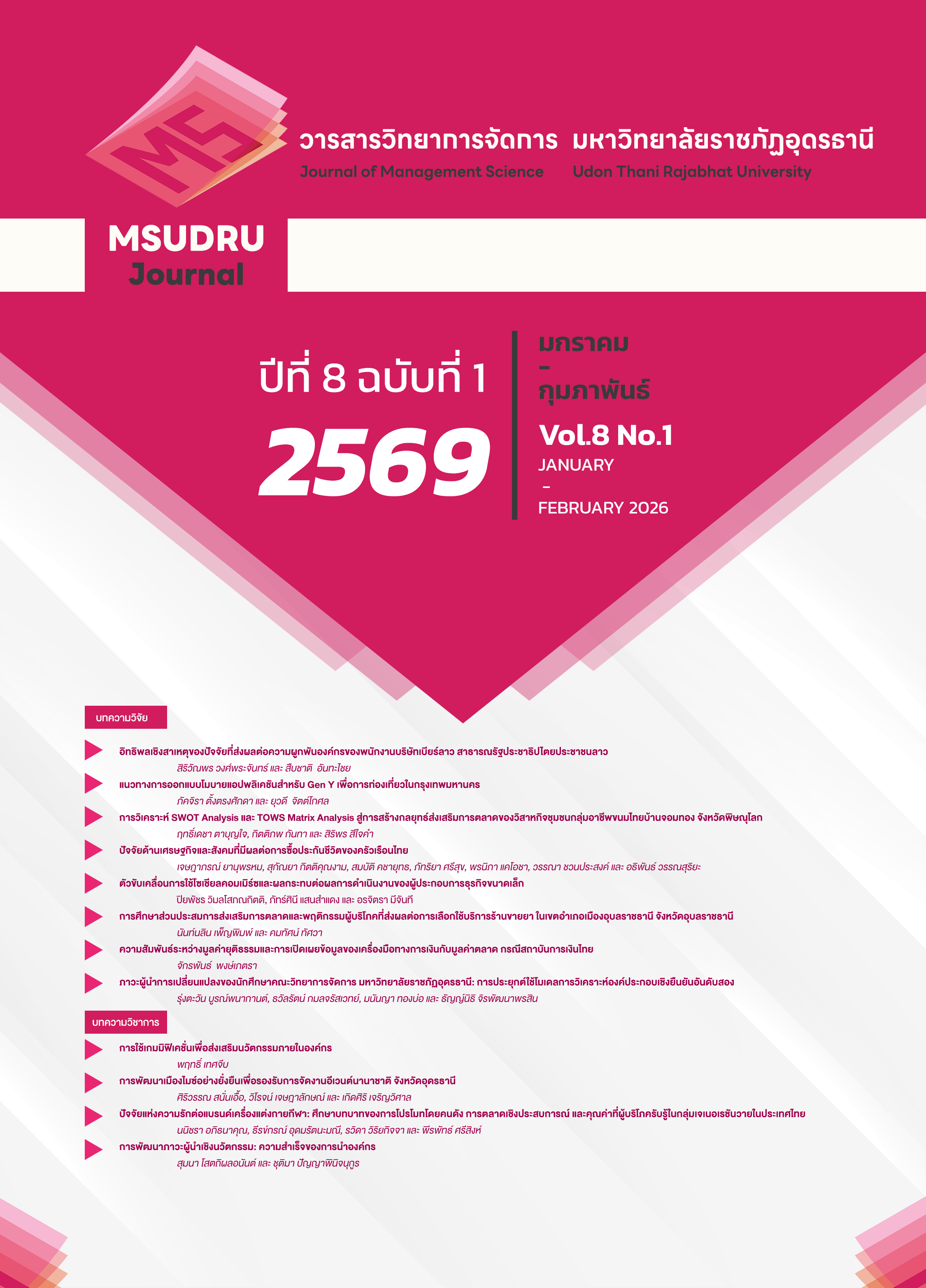
การพัฒนาเมืองไมซ์อย่างยั่งยืนเพื่อรองรับการจัดงานอีเวนต์นานาชาติ จังหวัดอุดรธานี
Article Sidebar
Main Article Content
บทคัดย่อ
การพัฒนาเมืองไมซ์อย่างยั่งยืนเป็นการพัฒนาเมืองที่มีต้นทุนด้านศักยภาพของเมืองในการรองรับการจัดการประชุม การเดินทางเพื่อเป็นรางวัล การจัดประชุมวิชาชีพ และงานแสดงสินค้า ตลอดถึงมีการส่งเสริมให้เมืองจัดกิจกรรมต่างๆ อย่างการจัดงานอีเวนต์ที่ช่วยสร้างเศรษฐกิจ และรายได้ให้เกิดขึ้นในเมือง โดยที่ผ่านมาการพัฒนาเมืองไมซ์ดังกล่าวขาดความต่อเนื่อง และยังไม่มีแนวทางปฏิบัติที่นำไปสู่การพัฒนาเมืองไมซ์อย่างยั่งยืน ประกอบกับจังหวัดอุดรธานีจะเป็นเจ้าภาพในการจัดงานพืชสวนโลก ในปี 2569 จังหวัดจึงต้องมีแนวทางการพัฒนาเมืองไมซ์ที่ชัดเจน เป็นรูปธรรม ที่สามารถนำไปสู่การพัฒนาเมืองที่สร้างความยั่งยืนได้อย่างแท้จริง ดังนั้นบทความวิชาการนี้จึงมีวัตถุประสงค์เพื่อวิเคราะห์และเสนอแนวทางในการพัฒนาเมืองไมซ์อย่างยั่งยืนเพื่อรองรับการจัดงานอีเวนต์นานาชาติ จังหวัดอุดรธานี ซึ่งเขียนขึ้นจากการสังเคราะห์ผลงานวิชาการเกี่ยวกับการพัฒนาเมืองไมซ์อย่างยั่งยืนเพื่อรองรับการจัดงานอีเวนต์นานาชาติ จังหวัดอุดรธานี โดยได้นำเสนอองค์ประกอบที่สำคัญ 7 ด้าน ได้แก่ 1) ด้านการจัดการทรัพยากรและสิ่งแวดล้อม 2) ด้านการมีส่วนร่วมของชุมชน 3) ด้านการสนับสนุนจากผู้มีส่วนได้ส่วนเสีย 4) ด้านการสร้างการรับรู้การจัดงานอีเวนต์นานาชาติ 5) ด้านอัตลักษณ์ของเมืองที่เด่นชัด 6) ด้านความพร้อมของสถานที่ และ 7) ด้านการสร้างเศรษฐกิจด้วยงานเทศกาล เพื่อเป็นแนวทางในการพัฒนาศักยภาพอุตสาหกรรมไมซ์ของจังหวัด และเพิ่มศักยภาพอุตสาหกรรมไมซ์ของประเทศต่อไป
Article Details

อนุญาตภายใต้เงื่อนไข Creative Commons Attribution-NonCommercial-NoDerivatives 4.0 International License.
บทความที่ได้รับการตีพิมพ์เป็นลิขสิทธิ์ของคณะวิทยาการจัดการ มหาวิทยาลัยราชภัฏอุดรธานี
ข้อความที่ปรากฏในบทความแต่ละเรื่องในวารสารวิชาการเล่มนี้
ไม่ใช่ความคิดเห็นและความรับผิดชอบของผู้จัดทำ บรรณาธิการ กองบรรณาธิการ และคณะวิทยาการจัดการ มหาวิทยาลัยราชภัฏอุดรธานี ความรับผิดชอบด้านเนื้อหาและการตรวจร่างบทความแต่ละเรื่องเป็นความคิดเห็นของผู้เขียนบทความแต่ละท่าน
เอกสารอ้างอิง
กรมส่งเสริมคุณภาพและสิ่งแวดล้อม. (2566). คู่มือการประเมินเมืองสิ่งแวดล้อมยั่งยืน. กลุ่มส่งเสริมการจัดการสิ่งแวดล้อมเมืองยั่งยืน, จาก https://pattani.mnre.go.th/th/information/more/1784
กระทรวงเกษตรและสหกรณ์. (2566). ไทยพร้อมเป็นเจ้าภาพจัดงานมหกรรมพืชสวนโลกจังหวัดอุดรธานี พ.ศ. 2569. สืบค้นเมื่อ 5 พฤษภาคม 2566, จาก https://www.moac.go.th/news-preview- 441991792898
จิรภา สุชนวณิช. (2566). นโยบายการส่งเสริมอุตสาหกรรมไมซ์ของหน่วยงานภาครัฐ. ใน รายงานการประชุมวิชาการรัฐประศาสนศาสตร์ระดับชาติ ครั้งที่ 16 วันที่ 31 มีนาคม 2566, หน้า 96-109. กรุงเทพฯ: มหาวิทยาลัยมหาจุฬาลงกรณราชวิทยาลัย.
จารุวรรณ สุวรรณ. (2564). นวัตกรรมการบริการภาครัฐเพื่อพัฒนาเมืองให้มีศักยภาพในการแข่งขันอุตสาหกรรมไมซ์. สืบค้นเมื่อ 25 พฤษภาคม 2566, จาก https://cgi/viewcontent.cgi?article=6183&context=chulaetd
ณฤทธิ์ เจียอาภา. (2562). How to Turn Risks into Opportunities in the Disruptive Era. EET. สืบค้นเมื่อ 11 เมษายน 2567, จาก http://www.setsustainability.com/libraries/789/item/-2
ธันวดี สุขสาโรจน์, ชีระวิทย์ รัตนพันธ์ และวิริยะ เตชะรุ่งโรจน์. (2561). โครงการการศึกษาแนวทางเพิ่มประสิทธิภาพการพัฒนาเมืองสู่ความยั่งยืนผ่านกระบวนการมีส่วนร่วม กรณีศึกษาเมืองศาลายา จังหวัดนครปฐม. รายงานการวิจัยเมืองยั่งยืนสำนักงานกองทุนสนับสนุนการวิจัยฝ่ายสวัสดิภาพสาธารณะ, มหาวิทยาลัยมหิดล.
บุญเลิศ จิตตั้งวัฒนา. (2554). ธุรกิจไมซ์ (MICE BUSINESS). นนทบุรี: เฟิร์นข้าหลวงพริ้นติ้งแอนด์พับลิชชิ่ง. แผนพัฒนาเศรษฐกิจและสังคมแห่งชาติ. (2566). แผนพัฒนาเศรษฐกิจและสังคมแห่งชาติ ฉบับที่ 13 (2566-2570). สืบค้นเมื่อ 1 มกราคม 2566, จาก http://nscr.nesdc.go.th/nesdp.
พิมพรรณ สุจารินพงศ์. (2553). การจัดนำเที่ยว. กรุงเทพฯ: โอเดียนสโตร์.รัถยานภิศ รัชตะวรรณ, ธมลวรรณ แก้วกระจก, วรรณรัตน์ จงเขตกิจ, ปิยะพร พรหมแก้ว, ดาลิมา สำแดงสาร, และดลปภัฏ ทรงเลิศ. (2561). กระบวนการมีส่วนร่วมของชุมชนในการพัฒนาสุขภาวะ. วารสารเทคโนโลยีภาคใต้, 11(1), 231-238.
สำนักงานจังหวัดอุดรธานี. (2566). แผนพัฒนาจังหวัดอุดรธานี (พ.ศ. 2566-2570). สืบค้นเมื่อ 5 เมษายน 2567, จาก https://www.nesdc.go.th/download/Plan13/Doc/Plan13_Final.pdf
สำนักงานสภาพัฒนาการเศรษฐกิจและสังคมแห่งชาติ. (2568). แผนพัฒนาเศรษฐกิจและสังคมแห่งชาติฉบับที่สิบสาม พ.ศ. 2566-2570. สืบค้นเมื่อ 3 มกราคม 2568, จาก https://www.nesdc.go.th/download/Plan13/Doc/Plan13_DraftFinal.pdf
สำนักงานส่งเสริมการจัดประชุมและนิทรรศการ. (2561). รายงานงบประมาณประจำปี 2561. สืบค้นเมื่อ 1 พฤษภาคม 2566, จาก https://www.businesseventsthailand.com/files/annual-reports/TCEB-AR2018-JULY07.pdf
สำนักงานส่งเสริมการจัดประชุมและนิทรรศการ. (2564). หลักเกณฑ์การประเมินเมืองเพื่อเป็นเมืองไมซ์ซิตี้.สืบค้นเมื่อ 1 พฤษภาคม 2566, จาก https://elibrary.tceb.or.th/getattachment/3494941c-229e-480e-ba81- ae96b71a3aad/6243.aspx
สำนักงานส่งเสริมการจัดประชุมและนิทรรศการ. (2565). ประเทศไทยได้รับการคดเลือกให้จัดงานพืชสวนโลก ปี 2569 ที่อุดรธานี. สืบค้นเมื่อ 3 มีนาคม 2566, จาก https://www.businesseventsthailand.com/th/press-media/news-press-release/detail/1386
สำนักงานส่งเสริมการจัดประชุมและนิทรรศการ. (2566). คู่มือการจัดงานอย่างยั่งยืน. สืบค้นเมื่อ 15 พฤษภาคม 2566, จาก https://www.micecapabilities.com/mice/uploads/attachments/Thailand_Sustainable_Events_Guide_(TH).pdf
สำนักงานส่งเสริมการจัดประชุมและนิทรรศการ. (2567). Festival Economy สร้างเสริมเศรษฐกิจไทยด้วยงานเทศกาล. สืบค้นเมื่อ 12 พฤษภาคม 2567, จาก https://intelligence.businesseventsthailand.com/en/blog/festival-economy
Aitken, J. (2002). The role of events in the promotion of cities. In Proceedings of the International Conference-Events and Place Making July 10-16, 2002, pp. 3-7. Sydney: Australia.
Alananzeh, O., Albadarneh, M., Almkhadmeh, A., & Jawabreh, O. (2019). Factors influencing MICE tourism stakeholders’ decision making: The case of Aqaba in Jordan. Journal of Convention and Event Tourism, 20(1), 24–43.
Aldebert, B., Dang, R. J., & Longhi, C. (2011). Innovation in the tourism industry: The Case of Tourism. Tourism Management, 32(5), 1204-1213.
Alhujran, O., Aloudat, A., & Altarawneh, I. (2013). Factors Influencing Citizen Adoption of EGovernment in Developing Countries: The Case of Jordan. International Journal of Technology and Human Interaction, 9(2), 1–19.
Anttiroiko, V., Valkama, P., & Bailey, S. J. (2013). Smart Cities in the New Service Economy: Building Platforms for Smart Services. AI and Society, 29(3), 323–334.
Antchak, V., Ziakas, V., & Getz, D. (2019). Event Portfolio Management: Theory and methods for event management and tourism. Retrieved May 20, 2024, from https://www.torrossa.com/en/resources/an/5825855.
Balmer, J. M. (2008). Identity based views of the corporation: Insights from corporate identity, organizational identity, social identity, visual identity, corporate brand identity and corporate image. European Journal of Marketing, 42(9-10), 879–906.
Crouch, G. I., Del, C. G., & Perdue, R. R. (2019). International convention tourism: A choice modelling experiment of host city competition. Retrieved May 30, 2024, from https://www.sciencedirect.com/science/article/abs/pii/S0261517718302371
Dipietro, R. B., Breiter, D., Rompf, P., & Godlewska, M. (2008). An exploratory study of differences among meeting and exhibition planners in their destination selection criteria. Journal Convent Event Tour, 9(4), 258–276.
Elston, K., & Draper, J. (2012). A Review of Meeting Planner Site Selection Criteria Research. Journal of Convention and Event Tourism, 13(3), 203–220.
Fenich, G. G. (2002). Convention center ownership and management: The case of the United States. Retrieved May 16, 2024, from https://www.researchgate.net/publication/279511818_Convention_Tourism_international_research_and_industry_perspectives.
Fenich, G. G., & Bordelon, B. M. (2008). Is there an optimal type of ownership and organizational structure when developing convention and entertainment facilities. Journal of Convention and Event Tourism, 9(3), 182–198.
Holmes, K., Hughes, M., Mair, J., & Carlsen, J. (2015). Events and sustainability. London & New York: Routledge.
Hawary, M. E. D. (2018). Urban observatories and their role in managing the spatial development of areas of historical value, Policies and Programs. Internationals scientific journal in architecture engineering and technology, 1(1), 15.
Kim, I., Choi, S., Kim, D., & Choi, N. (2022). How long do regional MICE events survive? The case of Busan, Korea. Journal of Tourism Research, 27(8), 807–822.
Kim, S., & Lee, J. (2012). E-Participation Transparency and Trust in Local Government. Public Administration Review, 72(6), 819–828.
Korea National Tourism Organization. (2019). The Economic Impact of Korea MICE Industry. Retrieved June 16, 2024, from https://english.seoul.go.kr/policy/culture-tourism-ord/raising-competitiveness-in-tourism-mice-industry/
Jago, L. K., & Shaw, R. N. (1998). Special Events: A Conceptual and Definitional Framework. Festival Management and Event Tourism, 5(1-2), 21-32.
Lee, H., & Lee, J. S. (2017). An exploratory study of factors that exhibition organizers look for when selecting convention and exhibition centers. Journal of Travel and Tourism Marketing 2017, 34(3), 1-17.
Lee, S. (2015). Research note: Quality of government and tourism destination competitiveness. Tourism Economics, 21(4), 881–888.
Lim, W. M. (2016). A blueprint for sustainability marketing: Defining its conceptual boundaries for progress. Marketing Theory, 16(2), 232–249.
Moradi, E., Ehsani, M., Saffari, M., & Norouzi, R. (2023) How can destination competitiveness play an essential role in small island sports tourism development Integrated ISM-MICMAC modelling of key factors. The Journal of Hospitality and Tourism Insights, 6(3), 1222–1252.
Mohammed, A. K. A. G., & Saba, J. N. A. K. (2021). Black and Red Urban Spaces; Crime and Terrorism. Turkish Journal of Computer and Mathematics Education, 12(12), 4437-4451.
Natalia, S. (2017). The internationalization of the Meetings Incentives Conventions and Exhibitions (MICE) industry: Its influences on the actors in the tourism business activity. Journal of Economics and Management, 27(1), 1732-1948.
Nicolaides, A. (2015). Tourism Stakeholder Theory in practice: instrumental business grounds fundamental normative demands or a descriptive application. Retrieved March 1, 2024, from https://uir.unisa.ac.za/handle/10500/20642
Omar, A., Mohammad. A. B., Ahmad, A. M., & Omar, A. A. J. (2019). Factors influencing MICE tourism stakeholders decision making: The case of Aqaba in Jordan. Journal of Convention and Event Tourism, 20(1), 24-43.
Pereira, L., Jeronimo, C., Sempiterno, M., Lopes D. C., R., Dias, A., & Antonio, N. (2021). Events and festivals contribution for local sustainability. Sustainability, 13(3), 1520.
Presbury, R. & Edwards, D. (2005). Incorporating sustainability in meetings and event management education. Int. Journal Event Management, 1(1), 30–45.
Richards, G., & Palmer, R. (2010). Eventful cities: Cultural management and urban revitalization. Routledge. Retrieved March 10, 2024, from https://www.researchgate.net/publication/254786282_Eventful_Cities_Cultural_Management_and_Urban_Revitalisation
Singh, K., & Kiran, A. (2013). E-Governance Success Factors: an Analysis of E-Governance Initiatives of Ten Major States of India. International Journal of Public Sector Management, 26(4), 320–336.
Solomon, M. R. (1990). Consumer Behavior. New Jersey: Prentice-Hall.
Thailand Convention and Exhibition Bureau. (2012). TCEB's 5-Year (2012-2016) Master Plan Report. Retrieved March 12, 2024, from https://www.businesseventsthailand.com/files/annual-reports/TCEB_Annual_Report_2012.pdf
William, E. (1976). Electoral Participation in a Low Stimulus Election. Rural Development, 4(1), 111-124.
Wu, A. & Weber, K. (2005). Convention center facilities, attributes and services: The delegates’ perspective. Asia Pacific. Journal of Tourism Research, 10(4), 399–410.
Xu, J. B. (2010). Perceptions of tourism products. Tourism Management, 31(5), 607-610.
Zainab, H. R., & Assmaa, M. A. M. (2017). Factors affected trends of Contemporary Mosques Architecture, Retrieved March 20, 2023, from https://www.iasj.net/iasj/download/713dee4917b26337.
