
About the Journal
 Aims of the Journal
The Jornal of Dhamma for Life is an academic journal with the following objectives: 1. To disseminate the dharma content of the Foundation for Buddhist Studies 2. To develop a journal of academic quality and be up to the standard the standards of the Thai Journal Citation Index Center (TCI) 3. To be a standardized journal for publishing works of foundation members and the general public.
Scope of the Journal
The scope of content that the journal accepts is 1) Buddhism 2) Philosophy, Language, Arts and Culture 3) Political Science, Public Administration, Law 4) Economics, Business Administration 5) Education, including interdisciplinary humanities and social sciences.
Process of Publication
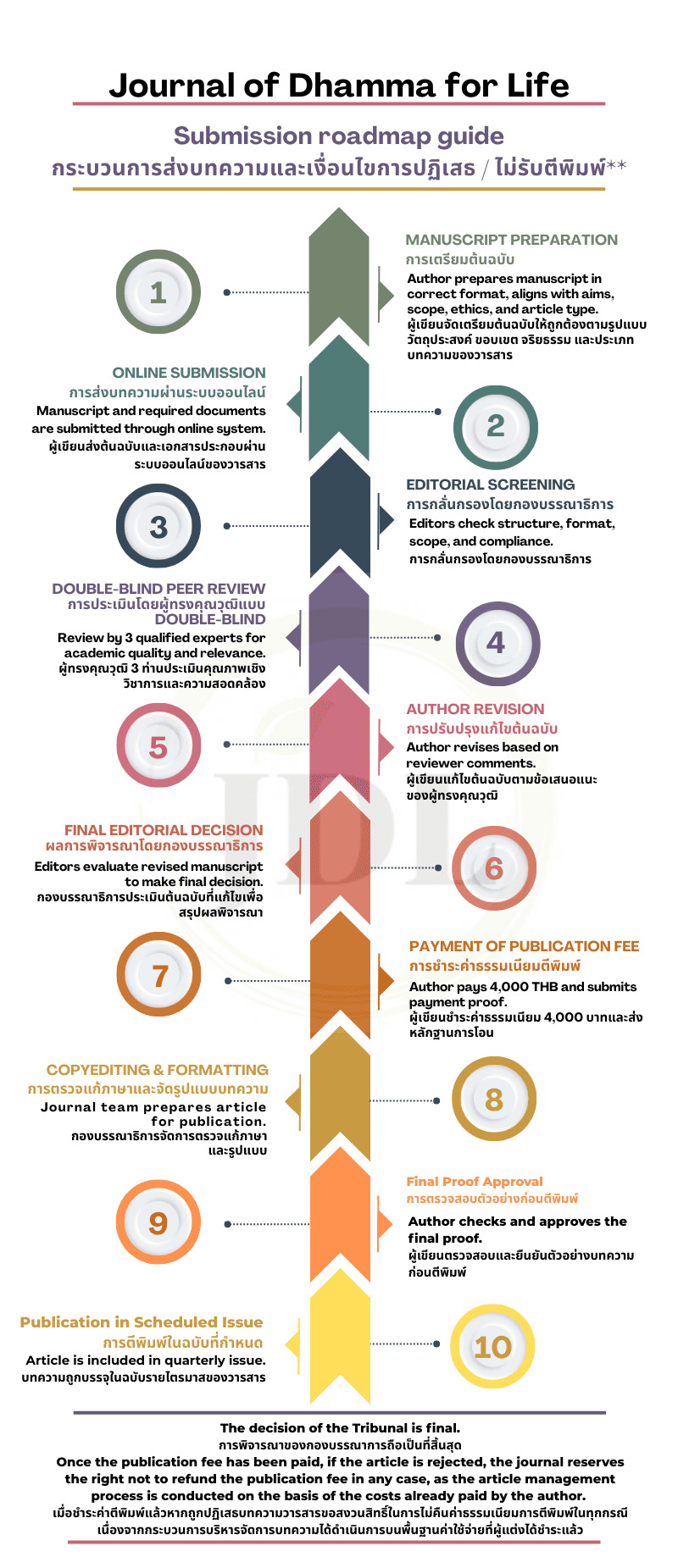
The editorial team gives importance to the journal's preparation process from the selection of articles. Quality assessment by qualified 3 expertise within experts in relevant fields to academic standards. It is a double-blind Peer Review and the original article must not have been published or is not being considered by the editorial team or experts for publication in another journal.
The author must strictly adhere to the criteria for submitting articles for publication in this journal. Including the citation, system must follow the criteria set by the journal. In the event that the editorial team or experts invited to review articles are of the opinion that they should be revised.
The editorial team will return the manuscript to the owner for re-editing based on the recommendations of the experts. We reserve the right to reject publication if the article does not encounters the objectives and format of this journal or does not pass the review of the editorial team or experts. If any article is considered by experts to be published. The author will receive a publishing certificate from the journal.
Texts, tables, images, graphs or opinions appearing in the Journal of Dhamma for Life are the responsibility of the author of the article and not the responsibility of the Dhamma Life Journal editorial team.
Ethical Considerations
• Authors must conduct research with the highest standards of integrity, honesty, and transparency, following ethical guidelines and legal requirements.
• Authors involving human subjects must ensure informed consent is obtained, detailing the nature of the study, potential risks, and benefits. This includes ensuring the confidentiality and anonymity of participants.
• If the research involves animals, authors must adhere to ethical standards, providing evidence of proper care, humane treatment, and compliance with relevant regulations.
• Authors must obtain approval from the appropriate ethics review board or institutional review board
Types of Articles
1) Original Research Article
2) Academic Article
3) Book Review)
Scheduled to publish 4 issues per year (every 3 months)
Issue 1 January-March
Issue 2 April-June
Issue 3 July-September
Issue 4 October-December
Languages
Thai and English
Payment Instructions for Publication Fees
Please register and submit your articles to our online journal system promptly. Additionally, kindly note that there is a publication fee of 4,000 Thai-Baht per article. The payment process is as follows:
-
Transfer the fee to the following account: Bank: Siam Commercial Bank (SCB) Branch code: 0055, Thanasin Road Branch
-
Account name: Buddhist Education Foundation, Wat Buranasirimattayaram Account number: 055-247452-7
-
After making the payment, please submit the proof of transfer (payment slip) in the discussion thread within the online journal system. This serves as evidence for further processing.
Thank you for your cooperation and support in our journal endeavors. Should you have any inquiries or require further information, please feel free to contact our team through the journal's messaging system.
We appreciate your commitment to advancing our journal.
Use of Artificial Intelligence (AI)
This journal permits the responsible use of Artificial Intelligence (AI) and AI-assisted technologies for language improvement, translation, formatting, and other supportive functions. Authors must disclose any substantive use of AI in the manuscript. AI tools cannot be listed as authors and cannot assume responsibility for the work. Authors remain fully accountable for the accuracy, originality, integrity, and ethical compliance of all submitted content. Failure to disclose significant AI use or the submission of AI-generated fabricated content may result in rejection, retraction, or other editorial actions.
Authors are required to disclose any use of Artificial Intelligence (AI) and AI-assisted technologies in a dedicated section entitled “Declaration of AI Use.” This declaration must clearly identify the AI tool(s) utilized, describe the purpose of their use, and specify the extent of their contribution to the manuscript. All AI-generated content must be critically reviewed, validated, and, where necessary, revised by the authors. The authors retain full responsibility for the accuracy, originality, integrity, and scholarly quality of the manuscript and must ensure that all content complies with the journal’s ethical and publication standards prior to submission.
Policy on the Use of Artificial Intelligence (AI) and AI-Assisted Technologies in Scholarly Publishing
- Purpose
This journal supports the responsible, transparent, and ethical use of Artificial Intelligence (AI) and AI-assisted technologies in scholarly research and publication. The policy aims to maintain research integrity, accountability, originality, and transparency while allowing appropriate use of emerging technologies.
- General Principles
- Authors remain fully responsible for the accuracy, originality, validity, and integrity of all submitted content, regardless of whether AI tools were used.
- AI systems, including but not limited to ChatGPT, Gemini, Claude, Copilot, Midjourney, DALL·E, and similar technologies, cannot be listed as authors or co-authors.
- AI tools cannot assume legal responsibility, intellectual accountability, conflict-of-interest disclosure, or copyright ownership.
- Any substantive use of AI must be transparently disclosed.
- Acceptable Use of AI
Authors may use AI tools for:
- Language editing and grammar correction and independently validated.
- Improving readability and writing style and independently validated.
- Translation assistance and independently validated.
- Formatting and reference style checking and independently validated.
- Preliminary idea exploration and literature organization and independently validated.
- Coding assistance, provided that all outputs are verified by the authors and independently validated.
- Data processing support, provided that the methodology is fully described and independently validated.
- Prohibited Use of AI
The following practices are not permitted:
- Listing AI as an author or co-author.
- Generating or fabricating research data, results, images, tables, or references.
- Creating fictitious citations or unverifiable sources.
- Using AI to produce conclusions that are not supported by the actual research.
- Submitting AI-generated content without human review and verification.
- Using AI to conceal plagiarism, duplicate publication, or other forms of academic misconduct.
- Disclosure Requirements
Authors must disclose the use of AI-assisted technologies in a separate section entitled:
“Declaration of AI and AI-Assisted Technologies”
The declaration should include:
- Name of the AI tool(s) used.
- Purpose of use.
- Extent of use.
- Human verification and editing procedures undertaken.
Example:
"During the preparation of this manuscript, the authors used ChatGPT (OpenAI) for language editing and grammar refinement. All outputs generated by the AI tool were reviewed, revised, and verified by the authors, who take full responsibility for the final content of the manuscript."
- Editorial Assessment
The editorial office reserves the right to:
- Request additional disclosure regarding AI use.
- Request submission of prompts or records of AI-generated outputs when necessary.
- Conduct originality, integrity, and verification checks.
- Reject manuscripts where AI use compromises scientific rigor, transparency, or ethical standards.
- Consequences of Non-Disclosure
Failure to disclose significant AI use may constitute a breach of publication ethics and may result in:
- Rejection prior to publication.
- Retraction after publication.
- Notification to the authors' institutions.
- Temporary or permanent submission restrictions.
