Analysis on the Attitudes and Listening Habits of Music Students Toward Classical Music
Article Sidebar
Main Article Content
Abstract
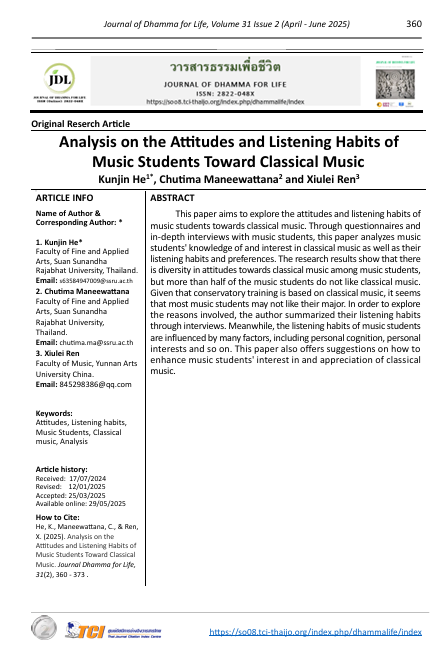
This paper aims to explore the attitudes and listening habits of music students towards classical music. Through questionnaires and in-depth interviews with music students, this paper analyzes music students' knowledge of and interest in classical music as well as their listening habits and preferences. The research results show that there is diversity in attitudes towards classical music among music students, but more than half of the music students do not like classical music. Given that conservatory training is based on classical music, it seems that most music students may not like their major. In order to explore the reasons involved, the author summarized their listening habits through interviews. Meanwhile, the listening habits of music students are influenced by many factors, including personal cognition, personal interests and so on. This paper also offers suggestions on how to enhance music students' interest in and appreciation of classical music.
Article Details
References
Cai, L., & Huang, H. (2008). Aesthetic education and humanistic spirit. Beijing Normal University Press.
Cai, Z. (Annot. & Trans.). (2004). Chinese music aesthetics: Annotated and translated. People's Music Publishing House.
Che, W. (2003). The value and experience of music. Journal of Music Research, (4), 122–127.
Che, W. (2003). Humanistic psychology. Zhejiang Education Press.
Greenberg, D. M., Baron-Cohen, S., Stillwell, D. J., Kosinski, M., & Rentfrow, P. J. (2016). Musical preferences are linked to cognitive styles. PLOS ONE, 11(7), e0153206. https://doi.org/10.1371/journal.pone.0153206
Hao, P. (2008). Fantasia of life: Talking about the visual concept and visual promotion of classical music. Art and Design (Theory), 120.
Huang, H. (2002). Music aesthetics and cultural psychology. Beijing: People's Music Publishing House.
Huang, H. (2002). The music of words and the music without words: Aesthetic reflections on the connection and transformation of vocal music and instrumental music. Chinese Music, 7.
Liu, C. (1998). On the comparison of tone aesthetics between Chinese and Western music. Beijing: China Conservatory of Music Press.
Liu, C. (1998). The divine rhythm of Chinese music. Fujian People's Publishing House.
Luo, X., & Huang, H. (2008). The psychology of music (p. 217).
Meyer, L. B. (1956). Emotion and meaning in music. University of Chicago Press.
Plato. (1963). The dialogues on literature and art (Zhu Guangqian, Trans.). People's Literature Publishing House.
Ren, H. (2020). Cultural psychology of music and the contempt chain of genres. Beijing: Renmin University Press.
Ren, H. (2020). Is there a hierarchy in music? Analyzing the psychological factors of music identity from the chain of contempt. Harbin Conservatory of Music, 222.
Rosa, H. (2013). Social acceleration: A new theory of modernity (J. Trejo-Mathys, Trans.). Columbia University Press.
Tang, M. (2015). Review of several reasons for the difficulty of popularizing classical music. Art and Literature for the Masses, 133.
Wang, C., & Xiao, R. (2020). Study on the influence of the phenomenon of "TikTok fever" on the ideological behavior of college students and its response. Science and Technology Communication, 135.
Xinhuanet. (2017, October 22). Fine arts entering the schools: Promoting aesthetic education through cultural services. http://www.news.cn/edu/2017-10/22/c_1121835349.htm
Zheng, J. (2021). An analysis of new forms of classical music dissemination in the post-epidemic era: An investigation based on online mobile behavioral data. Art Education, 160.
Zhou, H. (2004). Music and its expressive world (pp. 213–214). Central Conservatory of Music Press.