Cyberbullying Behavior of Junior High School Students in Demonstration School of Phranakhon Si Ayutthaya Rajabhat University
Article Sidebar
Main Article Content
Abstract
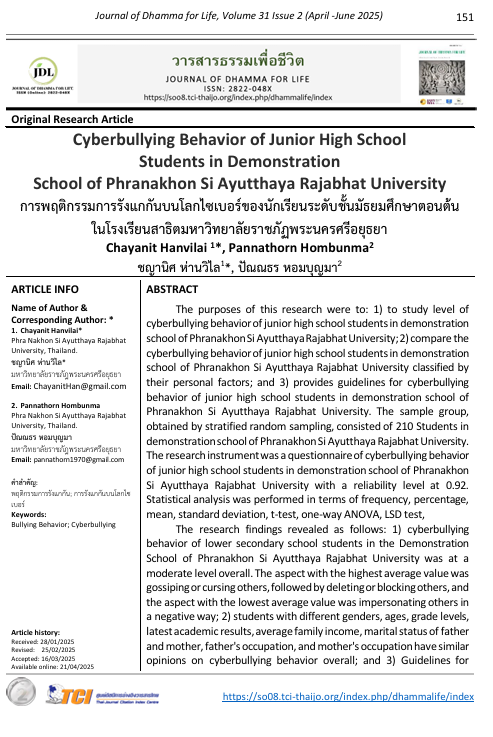
The purposes of this research were to: 1) to study level of cyberbullying behavior of junior high school students in demonstration school of Phranakhon Si Ayutthaya Rajabhat University; 2) compare the cyberbullying behavior of junior high school students in demonstration school of Phranakhon Si Ayutthaya Rajabhat University classified by their personal factors; and 3) provides guidelines for cyberbullying behavior of junior high school students in demonstration school of Phranakhon Si Ayutthaya Rajabhat University. The sample group, obtained by stratified random sampling, consisted of 210 Students in demonstration school of Phranakhon Si Ayutthaya Rajabhat University. The research instrument was a questionnaire of cyberbullying behavior of junior high school students in demonstration school of Phranakhon Si Ayutthaya Rajabhat University with a reliability level at 0.92. Statistical analysis was performed in terms of frequency, percentage, mean, standard deviation, t-test, one-way ANOVA, LSD test,
The research findings revealed as follows: 1) cyberbullying behavior of lower secondary school students in the Demonstration School of Phranakhon Si Ayutthaya Rajabhat University was at a moderate level overall. The aspect with the highest average value was gossiping or cursing others, followed by deleting or blocking others, and the aspect with the lowest average value was impersonating others in a negative way; 2) students with different genders, ages, grade levels, latest academic results, average family income, marital status of father and mother, father's occupation, and mother's occupation have similar opinions on cyberbullying behavior overall; and 3) Guidelines for reducing cyberbullying behavior: gossiping or cursing others, there are 16 items, such as do not post gossip or curse others in cyberspace because it is a bad thing; defamation of others, there are 11 items, such as do not post defamation of others in cyberspace; and impersonation of others in a negative way, there are 11 items, such as having a good conscience and not impersonating others in a negative way. Think about empathy and the impact it will have on others. In terms of disclosing personal or other people's secrets, there are 9 items, such as parents, guardians, or teachers should teach children that they should not disclose their own personal information on cyberspace. And in terms of deleting or blocking others, there are 6 items, such as deleting or blocking others if it is a personal matter, it is an individual's right to do so. But if it is a group with a large number of people using it together, deleting or blocking others without reason should not be done.
Article Details
References
กรมสุขภาพจิต. (2562). โปรแกรมการพัฒนาทักษะการควบคุมตนเอง (Self-control) เพื่อป้องกันพฤติกรรมการรังแกกัน (Bullying) ในเด็กประถมศึกษาที่ 1 – 3. กรม.
ฆีร อักษรทิพย์. (2561). ปัจจัยทางจิตสังคมที่เกี่ยวข้องกับพฤติกรรมการรังแกผ่านพื้นที่ไซเบอร์ของวัยรุ่นในกรุงเทพมหานคร. [ปริญญานิพนธ์การศึกษามหาบัณฑิต], มหาวิทยาลัยศรีนครินทรวิโรฒ.
จันทรา ที่อุปมา. (2562). ผลของกระบวนการกลุ่มที่มีต่อการเห็นคุณค่าในตนเองของวัยรุ่นที่ถูกรังแกบนโลกไซเบอร์. [วิทยานิพนธ์ศึกษาศาสตรมหาบัณฑิต], มหาวิทยาลัยขอนแก่น.
ชโรชีนีย์ ชัยมินทร์. (2566). ทักษะการรู้เท่าทันสื่อสำหรับเด็กและเยาวชนเพื่อส่งเสริมความเป็นพลเมืองดิจิทัล.วารสารห้องสมุด, 67(1), 21 – 39.
ชินดนัย ศิริสมฤทัย. (2560). การรับรู้ ทัศนคติ และความตั้งใจในการเกิดพฤติกรรมการกลั่นแกล้งบนโลกไซเบอร์. [การค้นคว้าอิสระนิเทศศาสตรมหาบัณฑิต], มหาวิทยาลัยกรุงเทพ.
ธนกร สุกหอม. (2565). ความรับผิดทางอาญาของการกลั่นแกล้งรังแกทางออนไลน์. [สารนิพนธ์นิติศาสตรมหาบัณฑิต], มหาวิทยาลัยศรีปทุม.
บุญชม ศรีสะอาด. (2560). การวิจัยเบื้องต้น (พิมพ์ครั้งที่ 10). สุวีริยาสาส์น.
พัทธ์รดา ยาประเสริฐ. (2564). นวัตกรรมการปรึกษาเชิงบูรณาการเพื่อเสริมสร้างกลยุทธ์เชิงบวกในการเผชิญปัญหาการถูกรังแกบนโลกไซเบอร์ของนักเรียนวัยรุ่นไทย. [ดุษฎีนิพนธ์ปรัชญาดุษฎีบัณฑิต], มหาวิทยาลัยบูรพา.
พิมพลอย รุ่งแสง. (2560). ผลของกลุ่มการปรึกษาเชิงจิตวิทยาต่อการเห็นคุณค่าในตนเองของนักเรียนมัธยมศึกษาตินต้นที่ถูกข่มเหงรังแกทางโลกไซเบอร์. [วิทยานิพนธ์ศิลปศาสตรมหาบัณฑิต], จุฬาลงกรณ์มหาวิทยาลัย.
รัตติยา ดีน้ำจืด. (2560). พฤติกรรมการรังแกผ่านโลกไซเบอร์ของนักเรียนระดับชั้นมัธยมศึกษาตอนปลาย. [วิทยานิพนธ์รัฐศาสตรมหาบัณฑิต], มหาวิทยาลัยบูรพา. โรงเรียนสาธิตมหาวิทยาลัยราชภัฏพระนครศรีอยุธยา. (2567ก). เกี่ยวกับโรงเรียน. https://aru.ac.th/stay/.
ฤทัยชนนี สิทธิชัย. (2560). พฤติกรรมการรังแกบนโลกไซเบอร์ของเยาวชนในสามจังหวัดชายแดนใต้. วารสาร วิทบริการ มหาวิทยาลัยสงขลานครินทร์, 28(1), 86 – 99.
วรพงษ์ วิไล. (2561). พฤติกรรมการรังแกกันผ่านโลกไซเบอร์ของนักเรียนระดับมัธยมศึกษาในจังหวัดเชียงราย: กรณีศึกษาโรงเรียนเทศบาล 6 นครเชียงราย. CRRU Journal of Communication Chiangrai Rajabhat University, 1(2), 1 – 24.
สำนักงานคณะกรรมการกิจการกระจายเสียง กิจการโทรทัศน์ และกิจการโทรคมนาคมแห่งชาติ (กสทช.). (2565). การศึกษาเพื่อพัฒนากลไกหรือมาตรการป้องกันการรังแก ข่มขู่คุกคามสตรี เด็ก และเยาชนโดยช่องทางการรณรงค์ผ่านสื่อมัลติมีเดียต่าง ๆ (รายงานการวิจัย). สำนักงาน.
Donegan, R. (2012). Bullying and cyber bullying: history, statistics, law, prevention and analysis. The Elon Journal of Undergraduate Research in Communications, 3(1), 33 - 42.