Quality of Life of 3 months Post-Stroke patients at King Chulalongkorn Memorial Hospital
Article Sidebar
Main Article Content
Abstract
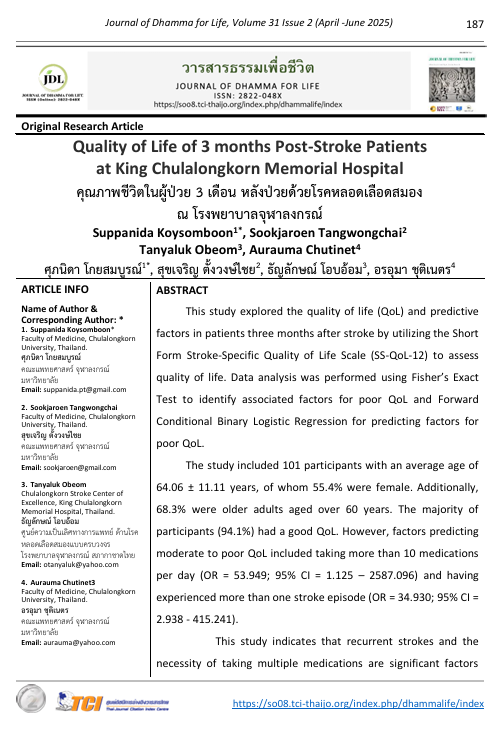
This study explored the quality of life (QoL) and predictive factors in patients three months after stroke by utilizing the Short Form Stroke-Specific Quality of Life Scale (SS-QoL-12) to assess quality of life. Data analysis was performed using Fisher’s Exact Test to identify associated factors for poor QoL and Forward Conditional Binary Logistic Regression for predicting factors for poor QoL.
The study included 101 participants with an average age of 64.06 ± 11.11 years, of whom 55.4% were female. Additionally, 68.3% were older adults aged over 60 years. The majority of participants (94.1%) had a good QoL. However, factors predicting moderate to poor QoL included taking more than 10 medications per day (OR = 53.949; 95% CI = 1.125 – 2587.096) and having experienced more than one stroke episode (OR = 34.930; 95% CI = 2.938 - 415.241).
This study indicates that recurrent strokes and the necessity of taking multiple medications are significant factors associated with poor QoL. Early identification and care for at-risk individuals could help improve their QoL and enhance the effectiveness of physical rehabilitation.
Article Details
References
Adams, C. (2003). Quality of life for caregivers and stroke survivors in the immediate discharge period. Applied Nursing Research, 16(2), 126–130.
Alexander, P. C., Thapar, A., Qureshi, M. I., Jenkins, H., & Davies, A. H. (2017). The definition of stroke. Journal of the Royal Society of Medicine, 110, 9–12.
American Stroke Association. (2024). About stroke. https://www.stroke.org/en/about-stroke
Deb-Chatterji, M., Pinho, J., Flottmann, F., Meyer, L., Broocks, G., Brekenfeld, C., Reich, A., Fiehler, J., Gerloff, C., Thomalla, G., & GSR-ET Investigators. (2021). Health-related quality of life after thrombectomy in young-onset versus older stroke patients: A multicenter analysis. Journal of NeuroInterventional Surgery, 14(11), 1145–1150.
Wallraj, H. (2016). Factors of quality of life of stroke patients, Yala Hospital, Yala Province [Master’s thesis, Yala Rajabhat University].
Jitpugdee, W., Suntibenchakul, S., & Piravej, K. (2017). Prevalence of anxiety and depressive symptoms in home-care stroke patients: Effect on motor recovery and functional ability. Chulalongkorn Medical Journal, 61, 233–247.
National Heart, Lung, and Blood Institute. (2023). What is a stroke? https://www.nhlbi.nih.gov/health/stroke
Ketsarinhomhuan, N., & Ratttananited, A. (2011). Nursing the stroke patient. Sanpasit Medical Journal, 32, 63–74.
Neuroscience Institute. (2017). Guidelines for nursing patients with stroke for general nurses (in Thai). Thana Press Company Limited.
Phengrueng, P., Toskulkao, T., & Changmai, S. (2024). Selected factors influencing health-related quality of life among ischemic stroke patients in Prachuap Khiri Khan Province. Health Science Journal of Thailand, 6(2), 9–16.
Posai, V., Boonchoo, R., Watradul, D., Makkabphalanon, K., & Thangkratok, P. (2021). Mental health literacy and quality of life among patients with stroke. Chiang Mai Medical Journal, 60(1), 63–74.
Thangkratok, P., Posai, V., Pipatsombat, P., Tranattawan, W., & Suksatan, W. (2019). Validity and reliability of the Thai version of the stroke specific quality of life scale. Journal of Medicine and Health Sciences, 26(3), 33–43.