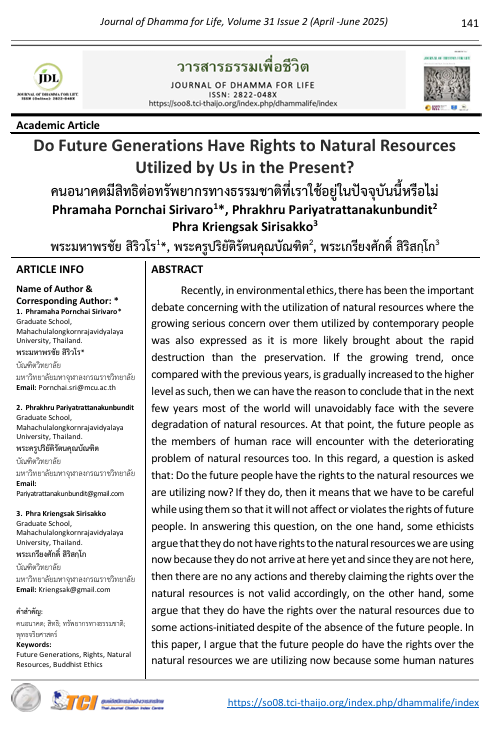
Do Future Generations have Rights to Natural Resources Utilized by Us in the Present?
Article Sidebar
Main Article Content
Abstract
Recently, in environmental ethics, there has been the important debate concerning with the utilization of natural resources where the growing serious concern over them utilized by contemporary people was also expressed as it is more likely brought about the rapid destruction than the preservation. If the growing trend, once compared with the previous years, is gradually increased to the higher level as such, then we can have the reason to conclude that in the next few years most of the world will unavoidably face with the severe degradation of natural resources. At that point, the future people as the members of human race will encounter with the deteriorating problem of natural resources too. In this regard, a question is asked that: Do the future people have the rights to the natural resources we are utilizing now? If they do, then it means that we have to be careful while using them so that it will not affect or violates the rights of future people. In answering this question, on the one hand, some ethicists argue that they do not have rights to the natural resources we are using now because they do not arrive at here yet and since they are not here, then there are no any actions and thereby claiming the rights over the natural resources is not valid accordingly, on the other hand, some argue that they do have the rights over the natural resources due to some actions initiated despite of the absence of the future people. In this paper, I argue that the future people do have the rights over the natural resources we are utilizing now because some human natures can perform an act in the future even though the future itself does not arrive here yet. In discussing this, I will utilize the Buddhist ethical perspectives.
Article Details
References
มหาจุฬาลงกรณราชวิทยาลัย. (2539). พระไตรปิฎกฉบับภาษาไทย ฉบับมหาจุฬาลงกรณราชวิทยาลัย. กรุงเทพฯ: โรงพิมพ์มหาจุฬาลงกรณราชวิทยาลัย.
ณัฏสุภรณ์ เตียวเพชรภัสกร. (2562). ความมีอยู่ของเวลา: การศึกษาเชิงวิพากษ์ในพุทธปรัชญาเถรวาท.วารสาร มจร ปรัชญาปริทรรศน์, 2 (6) 1-15.
https://so06.tci-thaijo.org/index.php/jmpr/article/view/250272
Feinberg, Joel. (1970). The Nature and Value of Rights. In The Journal of Value Inquiry, vol. 4, no. 4, pp. 243–260. DOI: 10.1007/BF00137935.
Kalupahana, D. J. (1991). The Buddhist concept of time and temporality. In Essays on Time in Buddhism. Edited by Prasad H.S., Delhi: Sri Satguru Publicaiton.
Keown, D. (1998). Are There Human Rights In Buddhism? In Keown, V.D., Prebish, C. S., and Husted, W. R. (Edited). (P. 17). Great Britain: Curzon Press.
Pojman, L.P., Pojman, P., and McShane. (2015). Introduction. In Environmental Ethics: Readings in Theory and Application, (7th Ed.). (P. 1-3). United States: Cengage Learning.
------------------------ (2015). Climate Change. In In Environmental Ethics: Readings in Theory and Application, (7th Ed.). (P. 605). United States: Cengage Learning.
Parfit, Derek. (2015). Future Generations. In Environmental Ethics: Readings in Theory and Application, (7th Ed.). (P. 49). United States: Cengage Learning.
---------------------- (2015). Future Generations. In Environmental Ethics: Readings in Theory and Application, (7th Ed.). (P. 50-51). United States: Cengage Learning.