Strategy for managing conflict in organization's
Article Sidebar
Main Article Content
Abstract
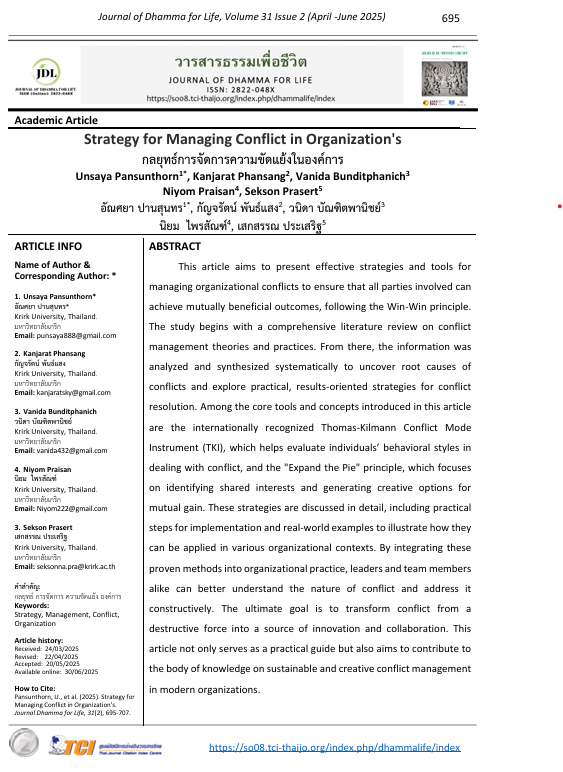
This article aims to present effective strategies and tools for managing organizational conflicts to ensure that all parties involved can achieve mutually beneficial outcomes, following the Win-Win principle. The study begins with a comprehensive literature review on conflict management theories and practices. From there, the information was analyzed and synthesized systematically to uncover root causes of conflicts and explore practical, results-oriented strategies for conflict resolution. Among the core tools and concepts introduced in this article are the internationally recognized Thomas-Kilmann Conflict Mode Instrument (TKI), which helps evaluate individuals’ behavioral styles in dealing with conflict, and the "Expand the Pie" principle, which focuses on identifying shared interests and generating creative options for mutual gain. These strategies are discussed in detail, including practical steps for implementation and real-world examples to illustrate how they can be applied in various organizational contexts. By integrating these proven methods into organizational practice, leaders and team members alike can better understand the nature of conflict and address it constructively. The ultimate goal is to transform conflict from a destructive force into a source of innovation and collaboration. This article not only serves as a practical guide but also aims to contribute to the body of knowledge on sustainable and creative conflict management in modern organizations.
Article Details
References
เสกสรรณ ประเสริฐ. (2562). หลักสูตรนวัตกรรมการสื่อสารการสืบสวนสอบสวน (วิชาบริหารความขัดแย้ง). กรุงเทพฯ: คณะศิลปศาสตร์ มหาวิทยาลัยเกริก.
ราชบัณฑิตยสถาน. (2554). พจนานุกรมฉบับราชบัณฑิตยสถาน. กรุงเทพฯ: ศิริวัฒนาอินเตอร์พริ้นท์.
อภิวุฒิ พิมลแสงสุริยา. (2564, 18 กรกฎาคม)./ โดยมูลนิธิสานอนาคตการศึกษาคอนเน็กซ์ อีดี เรื่องเทคนิคการ จัดการความขัดแย้ง แหล่งที่มา YouTube: CONNEXTED Foundation Website: connected.org . สืบค้นเมื่อ 1 มีนาคม 2567.
จุฑาทิพย์ สุจริตกุล. (2565). การบริหารความขัดแย้งในองค์กร. วารสารรัชต์ภาคย์ มนุษยศาสตร์และ สังคมศาสตร์, 16(48), 1-16.
Aimwattanakul, S. (2010). The case study of Conflict of the Sub District Administrations Organizations of Dankhuntod District, Nakhon Ratchasima Province [Master’s Thesis,. Suranaree University of Technology].
Thomas, K.W. (2006). Making Conflict Management a Strategic Advantage. Semantic Scholar https://www.semanticscholar.org/paper/Making-Conflict-Management-a-Strategic- Advantage-%7C-Thomas/148eb85ff31bc3ff5e9171265146777b913e51b5
Thomas, K.W., & Kilmann, R.H. (2015). An Overview of the Thomas-Kilmann Conflict Mode Instrument (TKI). http://www.kilmanndiagnostics.com/overview-thomaskilmann- conflict- mode-instrument-tki.
Tuckman, B.W. (1965). Developmental sequence in small groups. Psychological Bulletin, 63(6), 384-399.
Johnson, D.W., & Johnson, R.T. (1987). Learning together and alone: Cooperative, competitive, and individualistic learning (2nd ed.). Englewood Cliffs, NJ: Prentice-Hall.
Neuman, W. L., & Bruehl, B. A. (2014). Social Research Methods (7th ed.). Boston: Pearson.
Thomas, K. W., & Schmidt, W. H. (1976). A Survey of Managerial Interests with Respect to Conflict. Academy of Management Journal, 19, 315-318.
Maslow, A. H. (1943). A theory of human motivation. Psychological Review, 50(4), 370-396.
Smith, J. (2020). The Human Relations. New York: HarperCollins.