
The Behavior of Receiving Marketing Communications through Soft Power from the Popularity of Korean Dramas Among Employees of Private Companies in Thailand
Article Sidebar
Main Article Content
Abstract
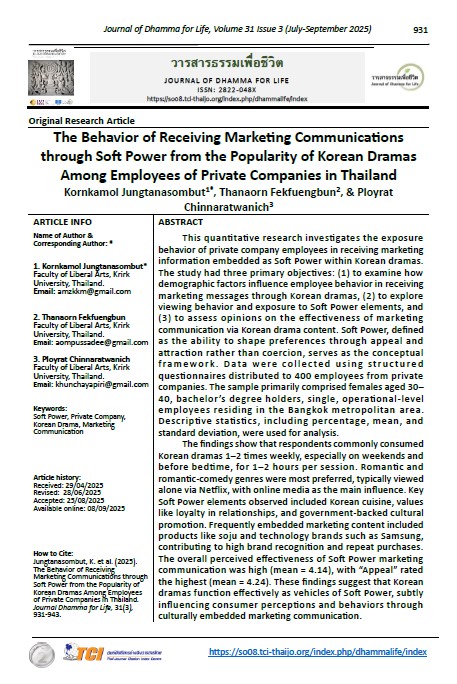
This quantitative research investigates the exposure behavior of private company employees in receiving marketing information embedded as Soft Power within Korean dramas. The study had three primary objectives: (1) to examine how demographic factors influence employee behavior in receiving marketing messages through Korean dramas, (2) to explore viewing behavior and exposure to Soft Power elements, and (3) to assess opinions on the effectiveness of marketing communication via Korean drama content. Soft Power, defined as the ability to shape preferences through appeal and attraction rather than coercion, serves as the conceptual framework. Data were collected using structured questionnaires distributed to 400 employees from private companies. The sample primarily comprised females aged 30–40, bachelor’s degree holders, single, operational-level employees residing in the Bangkok metropolitan area. Descriptive statistics, including percentage, mean, and standard deviation, were used for analysis.
The findings show that respondents commonly consumed Korean dramas 1–2 times weekly, especially on weekends and before bedtime, for 1–2 hours per session. Romantic and romantic-comedy genres were most preferred, typically viewed alone via Netflix, with online media as the main influence. Key Soft Power elements observed included Korean cuisine, values like loyalty in relationships, and government-backed cultural promotion. Frequently embedded marketing content included products like soju and technology brands such as Samsung, contributing to high brand recognition and repeat purchases. The overall perceived effectiveness of Soft Power marketing communication was high (mean = 4.14), with “Appeal” rated the highest (mean = 4.24). These findings suggest that Korean dramas function effectively as vehicles of Soft Power, subtly influencing consumer perceptions and behaviors through culturally embedded marketing communication.
