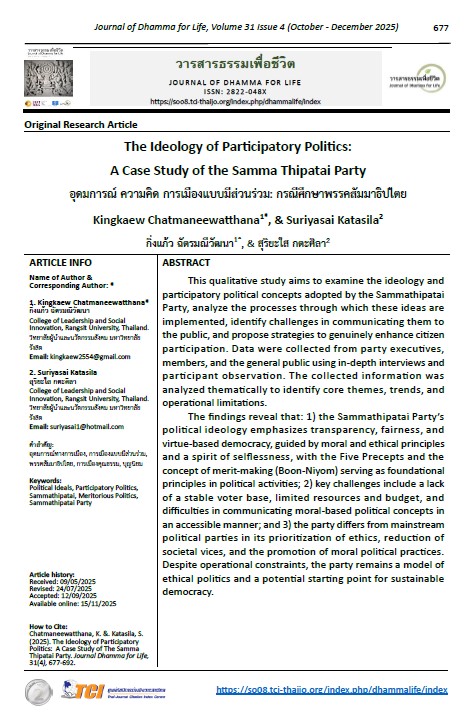
The Ideology of Participatory Politics: A Case Study of the Samma Thipatai Party
Article Sidebar
Main Article Content
Abstract
This qualitative study aims to examine the ideology and participatory political concepts adopted by the Sammathipatai Party, analyze the processes through which these ideas are implemented, identify challenges in communicating them to the public, and propose strategies to genuinely enhance citizen participation. Data were collected from party executives, members, and the general public using in-depth interviews and participant observation. The collected information was analyzed thematically to identify core themes, trends, and operational limitations.
The findings reveal that: 1) the Sammathipatai Party’s political ideology emphasizes transparency, fairness, and virtue-based democracy, guided by moral and ethical principles and a spirit of selflessness, with the Five Precepts and the concept of merit-making (Boon-Niyom) serving as foundational principles in political activities; 2) key challenges include a lack of a stable voter base, limited resources and budget, and difficulties in communicating moral-based political concepts in an accessible manner; and 3) the party differs from mainstream political parties in its prioritization of ethics, reduction of societal vices, and the promotion of moral political practices. Despite operational constraints, the party remains a model of ethical politics and a potential starting point for sustainable democracy.
