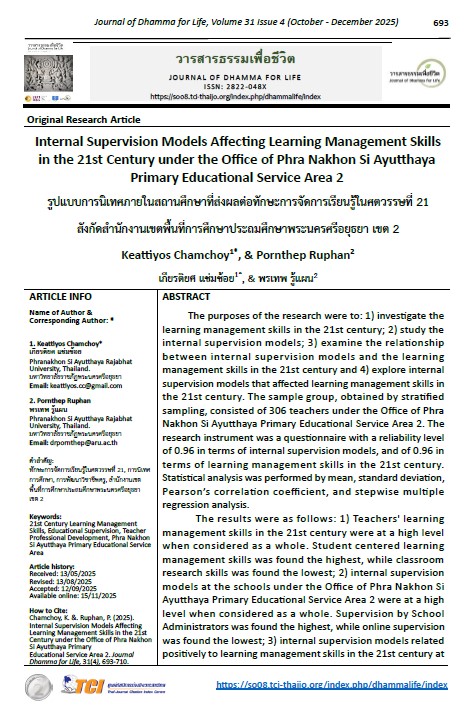
Internal Supervision Models Affecting Learning Management Skills in the 21st Century under the Office of Phra Nakhon Si Ayutthaya Primary Educational Service Area 2
Article Sidebar
Main Article Content
Abstract
The purposes of the research were to: 1) investigate the learning management skills in the 21st century; 2) study the internal supervision models; 3) examine the relationship between internal supervision models and the learning management skills in the 21st century and 4) explore internal supervision models that affected learning management skills in the 21st century. The sample group, obtained by stratified sampling, consisted of 306 teachers under the Office of Phra Nakhon Si Ayutthaya Primary Educational Service Area 2. The research instrument was a questionnaire with a reliability level of 0.96 in terms of internal supervision models, and of 0.96 in terms of learning management skills in the 21st century. Statistical analysis was performed by mean, standard deviation, Pearson’s correlation coefficient, and stepwise multiple regression analysis.
The results were as follows: 1) Teachers' learning management skills in the 21st century were at a high level when considered as a whole. Student centered learning management skills was found the highest, while classroom research skills was found the lowest; 2) internal supervision models at the schools under the Office of Phra Nakhon Si Ayutthaya Primary Educational Service Area 2 were at a high level when considered as a whole. Supervision by School Administrators was found the highest, while online supervision was found the lowest; 3) internal supervision models related positively to learning management skills in the 21st century at a high level with statistical significance at .01; and 4) internal supervision models that affected learning management skills in the 21st century with statistical significant level at .05, comprised of three aspects: Supervision by School Administrators, peer Supervision and clinical supervision. They jointly predicted learning management skills in the 21st century accounting for 51.4%.
