Sign Consumption For Sustainable Cultural Tourism: Case Of “Mount Lushan”, Jiujiang City
Article Sidebar
Main Article Content
Abstract
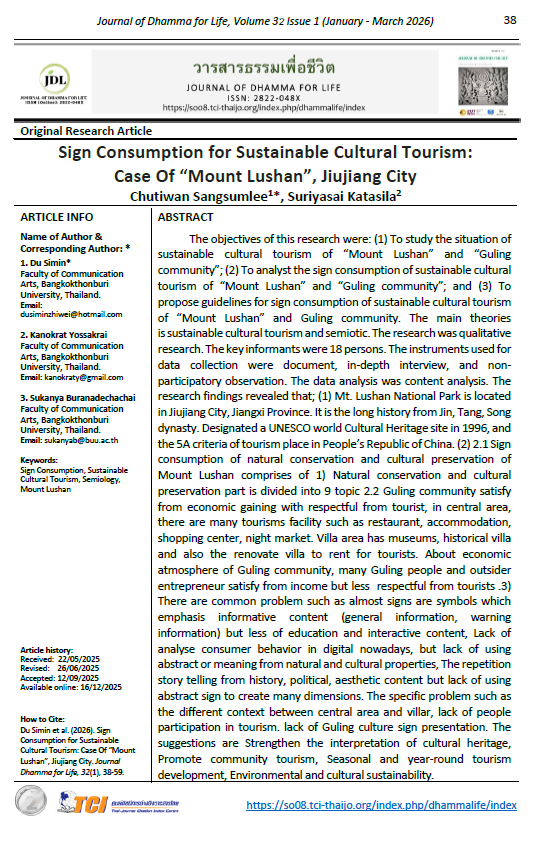
The objectives of this research were: (1) To study the situation of sustainable cultural tourism of “Mount Lushan” and “Guling community”; (2) To analyst the sign consumption of sustainable cultural tourism of “Mount Lushan” and “Guling community”; and (3) To propose guidelines for sign consumption of sustainable cultural tourism of “Mount Lushan” and Guling community. The main theories is sustainable cultural tourism and semiotic. The research was qualitative research. The key informants were 18 persons. The instruments used for data collection were document, in-depth interview, and non-participatory observation. The data analysis was content analysis. The research findings revealed that; (1) Mt. Lushan National Park is located in Jiujiang City, Jiangxi Province. It is the long history from Jin, Tang, Song dynasty. Designated a UNESCO world Cultural Heritage site in 1996, and the 5A criteria of tourism place in People’s Republic of China. (2) 2.1 Sign consumption of natural conservation and cultural preservation of Mount Lushan comprises of 1)Natural conservation and cultural preservation part is divided into 9 topic 2.2 Guling community satisfy from economic gaining with respectful from tourist, in central area, there are many tourisms facility such as restaurant, accommodation, shopping center, night market. Villa area has museums, historical villa and also the renovate villa to rent for tourists. About economic atmosphere of Guling community, many Guling people and outsider entrepreneur satisfy from income but less respectful from tourists .3) There are common problem such as almost signs are symbols which emphasis informative content (general information, warning information) but less of education and interactive content, Lack of analyse consumer behavior in digital nowadays, but lack of using abstract or meaning from natural and cultural properties, The repetition story telling from history, political, aesthetic content but lack of using abstract sign to create many dimensions. The specific problem such as the different context between central area and villar, lack of people participation in tourism. lack of Guling culture sign presentation. The suggestions are Strengthen the interpretation of cultural heritage, Promote community tourism, Seasonal and year-round tourism development, Environmental and cultural sustainability.
Article Details
References
Alisa, F., & Ridho, Z. (2020). Sustainable cultural tourism development: A strategy for revenue generation in local community. Journal of Economic and Tropical Life Science, 4(2), 47–56.
Cai, Z., Fang, C., Zhang, Q., & Chen, F. (2021). Harmonious coexistence of cultural heritage protection and tourism: The “Mount Lushan” comprehensive tourism platform. (Note: Author names were standardized based on likely "Surname, First Name" order from the input. The title was completed based on context from the source file.)
Global Market Consulting. (n.d.). China tourism market research report. Global Info Research. https://www.globalinforesearch.com.cn/reports/859026/domestic-tourism
Kaothep, K. (2011). Entry point to study local object/material media. In Traditional media in communication (pp. 246–344). Pappim.
Liu, F., Zhang, J., Zhang, J., & Chen, D. (2014). The process and spatial-temporal feature of tourism destination network evolution: A case study of Mt. Huangshan scenic area and Tangkou. Scientia Geographica Sinica, 34(12), 1428–1437. https://doi.org/10.13249/j.cnki.sgs.2014.012.1428
Lushan Municipal People’s Government. (2022, July 27). Strengthen tourism services and market regulation to meet the tourist season.
Na, G., Yossakrai, K., & Buranadechachai, S. (2025). New media consumption process though Xiaohongshu application for Henan tourism economic promotion. Journal of Dhamma for Life, 31(1), 691–719.
National Bureau of Statistics of China. (2023, January 28). Annual report on government information disclosure from 2015 to 2022.
Phalalert, P., & Dejasvanong, C. (2013). The presentation of locality through cultural commodities of Klong Lat Mayom floating market community [Research report]. Pranakorn Rajchamongkol Technology University. https://dric.nrct.go.th
