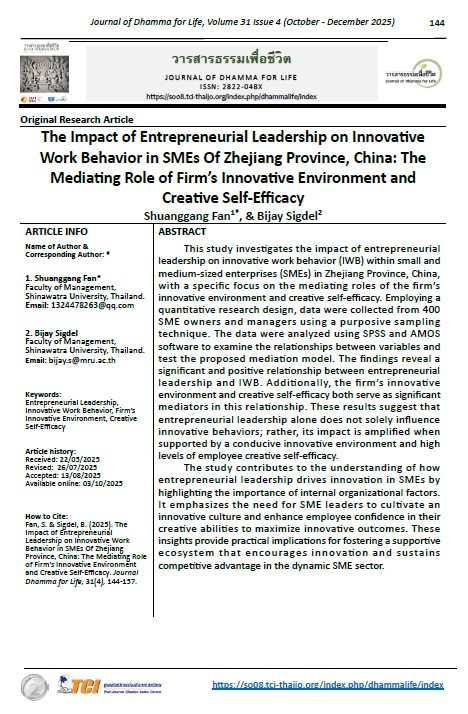
The Impact of Entrepreneurial Leadership on Innovative Work Behavior in SMEs Of Zhejiang Province, China: The Mediating Role of Firm’s Innovative Environment and Creative Self-Efficacy
Article Sidebar
Main Article Content
Abstract
This study investigates the impact of entrepreneurial leadership on innovative work behavior (IWB) within small and medium-sized enterprises (SMEs) in Zhejiang Province, China, with a specific focus on the mediating roles of the firm’s innovative environment and creative self-efficacy. Employing a quantitative research design, data were collected from 400 SME owners and managers using a purposive sampling technique. The data were analyzed using SPSS and AMOS software to examine the relationships between variables and test the proposed mediation model. The findings reveal a significant and positive relationship between entrepreneurial leadership and IWB. Additionally, the firm’s innovative environment and creative self-efficacy both serve as significant mediators in this relationship. These results suggest that entrepreneurial leadership alone does not solely influence innovative behaviors; rather, its impact is amplified when supported by a conducive innovative environment and high levels of employee creative self-efficacy.
The study contributes to the understanding of how entrepreneurial leadership drives innovation in SMEs by highlighting the importance of internal organizational factors. It emphasizes the need for SME leaders to cultivate an innovative culture and enhance employee confidence in their creative abilities to maximize innovative outcomes. These insights provide practical implications for fostering a supportive ecosystem that encourages innovation and sustains competitive advantage in the dynamic SME sector.
