China–Thailand Mutual Visa Exemption as a Driver of Inbound Tourism: A Multi-segment Socioeconomic Analysis
Article Sidebar
Main Article Content
Abstract
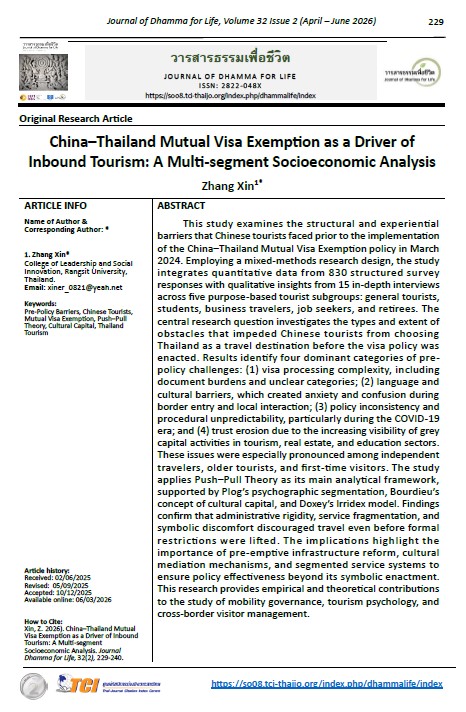
This study examines the structural and experiential barriers that Chinese tourists faced prior to the implementation of the China–Thailand Mutual Visa Exemption policy in March 2024. Employing a mixed-methods research design, the study integrates quantitative data from 830 structured survey responses with qualitative insights from 15 in-depth interviews across five purpose-based tourist subgroups: general tourists, students, business travelers, job seekers, and retirees. The central research question investigates the types and extent of obstacles that impeded Chinese tourists from choosing Thailand as a travel destination before the visa policy was enacted. Results identify four dominant categories of pre-policy challenges: (1) visa processing complexity, including document burdens and unclear categories; (2) language and cultural barriers, which created anxiety and confusion during border entry and local interaction; (3) policy inconsistency and procedural unpredictability, particularly during the COVID-19 era; and (4) trust erosion due to the increasing visibility of grey capital activities in tourism, real estate, and education sectors. These issues were especially pronounced among independent travelers, older tourists, and first-time visitors. The study applies Push–Pull Theory as its main analytical framework, supported by Plog’s psychographic segmentation, Bourdieu’s concept of cultural capital, and Doxey’s Irridex model. Findings confirm that administrative rigidity, service fragmentation, and symbolic discomfort discouraged travel even before formal restrictions were lifted. The implications highlight the importance of pre-emptive infrastructure reform, cultural mediation mechanisms, and segmented service systems to ensure policy effectiveness beyond its symbolic enactment. This research provides empirical and theoretical contributions to the study of mobility governance, tourism psychology, and cross-border visitor management.
Article Details
References
Ajzen, I. (1991). The theory of planned behavior. Organizational Behavior and Human Decision Processes, 50(2), 179–211.
Bourdieu, P. (1986). The forms of capital. In J. G. Richardson (Ed.), Handbook of theory and research for the sociology of education (pp. 241–258). Greenwood Press.
Chen, C.-F., & Chen, F.-S. (2010). Experience quality, perceived value, satisfaction and behavioral intentions for heritage tourists. Tourism Management, 31(1), 29–35.
Chen, C.-F., & Phou, S. (2013). A closer look at destination: Image, personality, relationship and loyalty. Tourism Management, 36, 269–278.
Crawford, D. W., & Godbey, G. (1987). Reconceptualizing barriers to family leisure. Leisure Sciences, 9(2), 119–127.
Crompton, J. L. (1979). Motivations for pleasure vacation. Annals of Tourism Research, 6(4), 408–424. https://doi.org/10.1016/0160-7383(79)90004-5
Dann, G. M. S. (1977). Anomie, ego-enhancement and tourism. Annals of Tourism Research, 4(4), 184–194. https://doi.org/10.1016/0160-7383(77)90037-8
Doxey, G. V. (1975). A causation theory of visitor–resident irritants: Methodology and research inferences. In Proceedings of the Travel Research Association Sixth Annual Conference (pp. 195–198). Travel Research Association.
Gössling, S., Scott, D., & Hall, C. M. (2020). Pandemics, tourism and global change: A rapid assessment of COVID-19. Journal of Sustainable Tourism, 29(1), 1–20.
Li, G., Song, H., & Witt, S. F. (2005). Recent developments in econometric modeling and forecasting. Journal of Travel Research, 44(1), 82–99.
Ministry of Tourism and Sports. (2019). International tourist arrivals to Thailand 2019. Author.
Ministry of Tourism and Sports. (2022). Tourism statistics 2022. Author.
National Bureau of Statistics of China. (2023). Statistical communiqué on outbound tourism. Author.
Neumayer, E. (2010). Visa restrictions and bilateral travel. The Professional Geographer, 62(2), 171–181.
Oliver, R. L. (1980). A cognitive model of the antecedents and consequences of satisfaction decisions. Journal of Marketing Research, 17(4), 460–469.
Plog, S. C. (1974). Why destination areas rise and fall in popularity. Cornell Hotel and Restaurant Administration Quarterly, 14(4), 55–58. https://doi.org/10.1177/001088047401400409
Plog, S. C. (2001). Why destination areas rise and fall in popularity: An update of a Cornell Quarterly classic. Cornell Hotel and Restaurant Administration Quarterly, 42(3), 13–24.
Royal Thai Embassy Beijing. (2024). Implementation of Thailand–China mutual visa exemption scheme. Author.
Tasci, A. D. A., & Gartner, W. C. (2007). Destination image and its functional relationships. Journal of Travel Research, 45(4), 413–425.
Tourism Authority of Thailand. (2024). Thailand–China mutual visa exemption announcement. Author.
United Nations Conference on Trade and Development. (2022). COVID-19 and tourism: Assessing the economic consequences. Author.
Urry, J. (1990). The tourist gaze: Leisure and travel in contemporary societies. Sage Publications.
Urry, J., & Larsen, J. (2011). The tourist gaze 3.0. Sage.
World Bank. (2022). Thailand economic monitor: Restoring incomes; recovering jobs. Author.
World Tourism Organization. (2023). International tourism highlights (2023 ed.). Author.
World Travel & Tourism Council. (2023). Economic impact report: Thailand 2023. Author.
Yang, Y., Zhang, H., & Chen, X. (2020). Coronavirus pandemic and tourism: Dynamic stochastic general equilibrium modeling of infectious disease outbreak. Annals of Tourism Research, 83, 102913.
