Facilitating Mobility or Fueling Complexity? A Segment-Based Assessment of the Thailand–China Visa Waiver Agreement
Article Sidebar
Main Article Content
Abstract
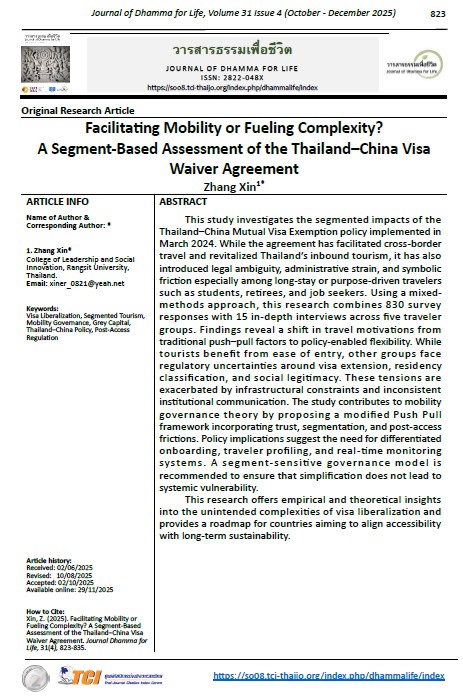
This study investigates the segmented impacts of the Thailand–China Mutual Visa Exemption policy implemented in March 2024. While the agreement has facilitated cross-border travel and revitalized Thailand’s inbound tourism, it has also introduced legal ambiguity, administrative strain, and symbolic friction especially among long-stay or purpose-driven travelers such as students, retirees, and job seekers. Using a mixed-methods approach, this research combines 830 survey responses with 15 in-depth interviews across five traveler groups. Findings reveal a shift in travel motivations from traditional push–pull factors to policy-enabled flexibility. While tourists benefit from ease of entry, other groups face regulatory uncertainties around visa extension, residency classification, and social legitimacy. These tensions are exacerbated by infrastructural constraints and inconsistent institutional communication. The study contributes to mobility governance theory by proposing a modified Push Pull framework incorporating trust, segmentation, and post-access frictions. Policy implications suggest the need for differentiated onboarding, traveler profiling, and real-time monitoring systems. A segment-sensitive governance model is recommended to ensure that simplification does not lead to systemic vulnerability.
This research offers empirical and theoretical insights into the unintended complexities of visa liberalization and provides a roadmap for countries aiming to align accessibility with long-term sustainability.
Article Details
References
Bourdieu, P. (1986). The forms of capital. In J. Richardson (Ed.), Handbook of Theory and Research for the Sociology of Education (241–258). Greenwood.
Chantavanich, S., & Middleton, T. (2023). Post-entry governance and migrant experiences in Thailand. Chulalongkorn University Press.
Cohen, E., & Cohen, S. A. (2019). Tourism theory: Between foundationalism and pluralism. Tourism Analysis, 24(3), 283–295.
Crompton, J. L. (1979). Motivations for pleasure vacation. Annals of Tourism Research, 6(4), 408–424.
Dann, G. M. S. (1977). Anomie, ego-enhancement and tourism. Annals of Tourism Research, 4(4), 184–194.
Geiger, M., & Pécoud, A. (2020). The International Organization for Migration: The new ‘UN migration agency’. Palgrave Macmillan.
Gössling, S., Scott, D., & Hall, C. M. (2021). Pandemics, tourism and global change: A rapid assessment of COVID-19. Journal of Sustainable Tourism, 29(1), 1–20.
Guild, E. (2020). The making of migration policy: Security, rights, and democracy in the EU. Routledge.
Hall, C. M., Scott, D., & Gössling, S. (2020). Pandemics, transformations and tourism: Be careful what you wish for. Tourism Geographies, 22(3), 577–598.
Hamenstädt, U. (2022). Legal ambiguity and migrant precarity: The governance of temporary mobility. Migration Studies, 10(2), 245–263.
Kunz, R. (2020). Moralizing mobility: The moral economy of migration policies. International Political Sociology, 14(1), 48–65.
Liu-Farrer, G. (2020). Immigrant Japan: Mobility and belonging in an ethno-nationalist society. Cornell University Press.
Ministry of Tourism and Sports Thailand. (2024). Thailand–China Mutual Visa Exemption Agreement: Policy brief and implementation report. Bangkok: MoTS.
Novy, A. (2022). Governance voids in contemporary mobility systems. Journal of Urban Affairs, 44(2), 254–270.
Neumayer, E. (2006). Unequal access to foreign spaces: How states use visa restrictions to regulate mobility. Transactions of the Institute of British Geographers, 31(1), 72–84.
Salazar, N. B. (2020). Momentous mobilities: Anthropological musings on the meanings of travel. Berghahn Books.
Sheller, M. (2018). Mobility justice: The politics of movement in an age of extremes. Verso Books.
Salter, M. B. (2021). The unmaking of passports: Mobility, security, and the moral ordering of movement. Political Geography, 89, 102430.
Song, H., Li, G., & Cao, Z. (2012). Tourism demand modeling and forecasting: How should demand be measured. Tourism Economics, 18(6), 1109–1134.
UN World Tourism Organization (UNWTO). (2022). Visa Openness Report 2022. Madrid: UNWTO.
UN World Tourism Organization (UNWTO). (2023). Tourism Recovery Dashboard. Madrid: UNWTO.
Xiang, B., & Lindquist, J. (2014). Migration infrastructure. International Migration Review, 48(s1), S122–S148.
Xiang, B. (2021). The mobility regime: Migration, control, and the geopolitics of movement. Stanford University Press.
Yeoh, B. S. A., & Lin, W. (2013). Chinese migration to Southeast Asia: Negotiating identities and transnational mobility. Asian and Pacific Migration Journal, 22(1), 1–22.
Zhang, H. Q., & Pine, R. (2020). Segmented tourism markets in Asia: Evolving trends and policy implications. Asia Pacific Journal of Tourism Research, 25(4), 345–360.
