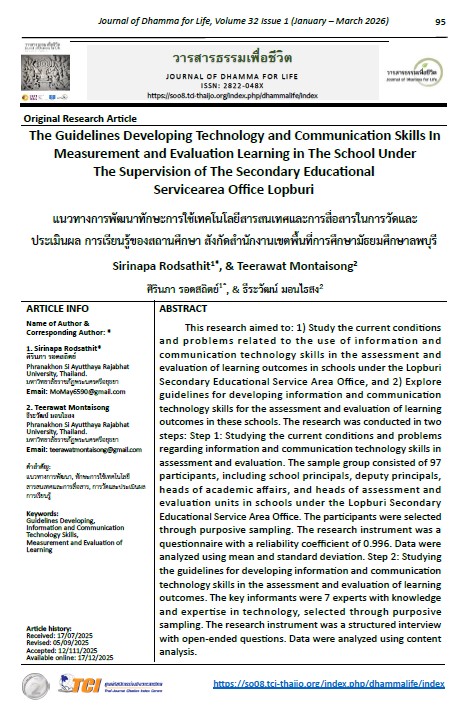
The Guidelines Developing Technology and Communication Skills In Measurement and Evaluation Learning in The School Under The Supervision of The Secondary Educational Servicearea Office Lopburi
Article Sidebar
Main Article Content
Abstract
This research aimed to: 1) Study the current conditions and problems related to the use of information and communication technology skills in the assessment and evaluation of learning outcomes in schools under the Lopburi Secondary Educational Service Area Office, and 2) Explore guidelines for developing information and communication technology skills for the assessment and evaluation of learning outcomes in these schools. The research was conducted in two steps: Step 1: Studying the current conditions and problems regarding information and communication technology skills in assessment and evaluation. The sample group consisted of 97 participants, including school principals, deputy principals, heads of academic affairs, and heads of assessment and evaluation units in schools under the Lopburi Secondary Educational Service Area Office. The participants were selected through purposive sampling. The research instrument was a questionnaire with a reliability coefficient of 0.996. Data were analyzed using mean and standard deviation. Step 2: Studying the guidelines for developing information and communication technology skills in the assessment and evaluation of learning outcomes. The key informants were 7 experts with knowledge and expertise in technology, selected through purposive sampling. The research instrument was a structured interview with open-ended questions. Data were analyzed using content analysis.
The results of the research were as follows: 1) The overall condition of Information and communication technology skills in the assessment and evaluation of learning outcomes in schools was at a high level. Similarly, the overall level of problems related to Information and communication technology skills in this context was also at a high level. 2) The proposed guidelines for developing the use of Information and communication technology in the assessment and evaluation of learning outcomes in schools include the following: Schools should encourage teachers to utilize technology comprehensively—such as data backup, communication via email and LINE, media creation using various software and AI tools, data analysis using Excel or Google Sheets, use of School MIS/SGS systems, and interactive platforms. Additionally, schools should organize training on cybersecurity and promote knowledge sharing through subject groups and external experts.
Article Details
References
กระทรวงศึกษาธิการ. (2567). แนวทางการลดภาระครูด้วย Digital Transformation. สืบค้นจาก https://www.moe.go.th
กรณัฏฐ์ ฐิตากรพงศ์สถิต. (2565). แนวทางการสภาพ ความต้องการจำเป็นและแนวทางพัฒนาทักษะดิจิทัลของครูเพื่อส่งเสริมการจัดการเรียนการสอนในศตวรรษที่ 21 สังกัดสำนักงานเขตพื้นที่การศึกษามัธยมศึกษามุกดาหาร. วารสารรัชต์ภาคย์, 16(47), 189-206.
ทัศน์ศิรินทร์, ส.บ. (2563). การพัฒนาแนวทางการประยุกต์ใช้เทคโนโลยีในการวัดและประเมินผลการเรียนรู้สำหรับนิสิตคณะศึกษาศาสตร์ มหาวิทยาลัยมหาสารคาม [วิทยานิพนธ์ปริญญามหาบัณฑิต, มหาวิทยาลัยมหาสารคาม]. สำนักหอสมุด มหาวิทยาลัยมหาสารคาม.
วันทนา รองไชย. (2560). พฤติกรรมการบริหารจัดการชั้นเรียนโดยใช้เครือข่ายสังคมออนไลน์ของครู และนักเรียนโรงเรียนวัดหนองขาม จังหวัดชลบุรี. วิทยานิพนธ์ปริญญาการศึกษามหาบัณฑิต สาขาวิชา การบริหารการศึกษา คณะศึกษาศาสตร์, มหาวิทยาลัยบูรพา.
สำนักงานคณะกรรมการพัฒนาการเศรษฐกิจและสังคมแห่งชาติ. (2560). แผนพัฒนาเศรษฐกิจและสังคมแห่งชาติ ฉบับที่ 12 (พ.ศ. 2560–2564). กรุงเทพฯ: สำนักงานคณะกรรมการพัฒนาการเศรษฐกิจและสังคมแห่งชาติ.
สำนักงานเขตพื้นที่การศึกษามัธยมศึกษาลพบุรี. (2567). แผนบริหารการศึกษาขั้นพื้นฐาน ประจำปีงบประมาณ พ.ศ. 2567 สำนักงานเขตพื้นที่การศึกษามัธยมศึกษาลพบุรี. สำนักงานเขตพื้นที่การศึกษามัธยมศึกษาลพบุรี
สำนักงานเลขาธิการสภาการศึกษา. (2560). การพัฒนาการศึกษาในยุคดิจิทัล. กรุงเทพฯ: สำนักงานเลขาธิการสภาการศึกษา.
สุรีย์รัตน์, ก., กฤษฎา, ก., & วุฒิชัย, พ. (2564). การพัฒนาการจัดการเรียนรู้เรื่องการใช้เทคโนโลยีสารสนเทศอย่างปลอดภัยโดยใช้ Interland สำหรับนักเรียนระดับชั้นมัธยมศึกษาปีที่ 3. วารสารการศึกษาและพัฒนาการศึกษา, 12(2), 45–62.
สิริพงศ์ อังคสกุลเกียรติ. (2567). การใช้เทคโนโลยีสารสนเทศในงานวิชาการของโรงเรียนมัธยมศึกษา. กรุงเทพฯ: สำนักพิมพ์การศึกษา.
สำนักงานเขตพื้นที่การศึกษามัธยมศึกษาลพบุรี. (2567). ข้อมูลสถานศึกษาและบุคลากรในสังกัด. ลพบุรี: สำนักงานเขตพื้นที่การศึกษามัธยมศึกษาลพบุรี.
ไอรินลดา, ช.ก. (2566). แนวทางการพัฒนาการเรียนการสอนออนไลน์ของครูผู้สอน [วิทยานิพนธ์ปริญญามหาบัณฑิต, มหาวิทยาลัยมหาสารคาม]. สำนักหอสมุด มหาวิทยาลัยมหาสารคาม.
Black, P., & Wiliam, D. (1998). Assessment and classroom learning. Assessment in Education: Principles, Policy & Practice, 5(1), 7–74. https://doi.org/10.1080/0969595980050102
Jonassen, D. H. (1996). Computers in the classroom: Mindtools for critical thinking. Prentice Hall.
Kozma, R. B. (2003). Technology and classroom practices: An international study. Journal of Research on Technology in Education, 36(1), 1–14.
