Structural Equation Modeling of Factors Influencing Organizational Performance of General Primary School Teachers: A Case Study of Guangxi, China
Article Sidebar
Main Article Content
Abstract
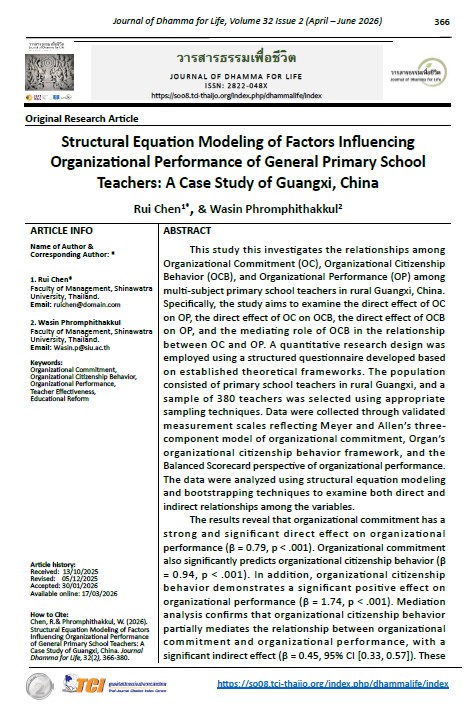
This study this investigates the relationships among Organizational Commitment (OC), Organizational Citizenship Behavior (OCB), and Organizational Performance (OP) among multi-subject primary school teachers in rural Guangxi, China. Specifically, the study aims to examine the direct effect of OC on OP, the direct effect of OC on OCB, the direct effect of OCB on OP, and the mediating role of OCB in the relationship between OC and OP. A quantitative research design was employed using a structured questionnaire developed based on established theoretical frameworks. The population consisted of primary school teachers in rural Guangxi, and a sample of 380 teachers was selected using appropriate sampling techniques. Data were collected through validated measurement scales reflecting Meyer and Allen’s three-component model of organizational commitment, Organ’s organizational citizenship behavior framework, and the Balanced Scorecard perspective of organizational performance. The data were analyzed using structural equation modeling and bootstrapping techniques to examine both direct and indirect relationships among the variables.
The results reveal that organizational commitment has a strong and significant direct effect on organizational performance (β = 0.79, p < .001). Organizational commitment also significantly predicts organizational citizenship behavior (β = 0.94, p < .001). In addition, organizational citizenship behavior demonstrates a significant positive effect on organizational performance (β = 1.74, p < .001). Mediation analysis confirms that organizational citizenship behavior partially mediates the relationship between organizational commitment and organizational performance, with a significant indirect effect (β = 0.45, 95% CI [0.33, 0.57]). These findings suggest that teacher commitment enhances school performance both directly and indirectly through citizenship behaviors. The study contributes to the theoretical integration of OC, OCB, and OP while providing practical implications for strengthening teacher commitment and promoting voluntary behaviors to improve educational performance in rural schools.
Article Details
References
Chen, X., & Phromphithakkul, C. (2025). Teacher commitment, organizational citizenship behavior, and school performance: Evidence from rural educational institutions. International Journal of Educational Management, 39(2), 215–231.
Fan, X., & Liu, Q. (2022). Organizational commitment, organizational citizenship behavior, and school performance: Evidence from Chinese primary schools. Educational Management Administration & Leadership, 50(5), 832–850. https://doi.org/10.1177/1741143221 1036420
Fan, Y., & Liu, H. (2022). The mediating role of organizational citizenship behavior in the relationship between teacher commitment and school performance. Frontiers in Psychology, 13, 845732.
Gong, Y. (2020). Educational reform and teacher professional development in rural China: Challenges and policy implications. Asia Pacific Education Review, 21(3), 421–432.
Kaplan, R. S., & Norton, D. P. (1996). The balanced scorecard: Translating strategy into action. Harvard Business School Press.
Lin, J., Zhang, W., & Li, Q. (2021). Teacher workload, professional identity, and educational reform in rural China. Teaching and Teacher Education, 103, 103345.
Lin, Y., Zhang, X., & Zhao, H. (2021). Teacher organizational commitment and school effectiveness: The mediating role of organizational citizenship behavior. Frontiers in Psychology, 12, 742345. https://doi.org/10.3389/fpsyg.2021.742345
MacKenzie, S. B., Podsakoff, P. M., & Podsakoff, N. P. (2011). Challenge-oriented organizational citizenship behaviors and organizational effectiveness: Do challenge-oriented behaviors really have an impact on the organization? Personnel Psychology, 64(3), 559–592.
Meyer, J. P., & Allen, N. J. (1991). A three-component conceptualization of organizational commitment. Human Resource Management Review, 1(1), 61–89. https://doi.org/ 10.1016/ 1053-48 22(91)90011-Z
Organ, D. W. (1988). Organizational citizenship behavior: The good soldier syndrome. Lexington Books.
Podsakoff, P. M., MacKenzie, S. B., Paine, J. B., & Bachrach, D. G. (2000). Organizational citizenship behaviors: A critical review of the theoretical and empirical literature and suggestions for future research. Journal of Management, 26(3), 513–563. https://doi.org /10.1177/014920630002600307
Suriya, K., & Boonchuay, P. (2021). Teacher organizational commitment and school effectiveness in Thai primary schools. International Journal of Educational Management, 35(7), 1483–1497. https://doi.org/10.1108/IJEM-02-2021-0064
Yu, L. (2022). Organizational commitment and teachers’ extra-role behavior in primary education: Evidence from China. Asia Pacific Education Review, 23(4), 689–702. https://doi.org/10.1007/s12564-021-09740-6
Yu, L. (2022). Organizational commitment and teachers’ citizenship behavior in rural primary schools: Implications for educational management in China. Educational Management Administration & Leadership, 50(5), 789–804.
