Boon Phawet: Literature, Tradition, Way of Life, and the Influence of the Two Banks of the Mekong
Article Sidebar
Main Article Content
Abstract
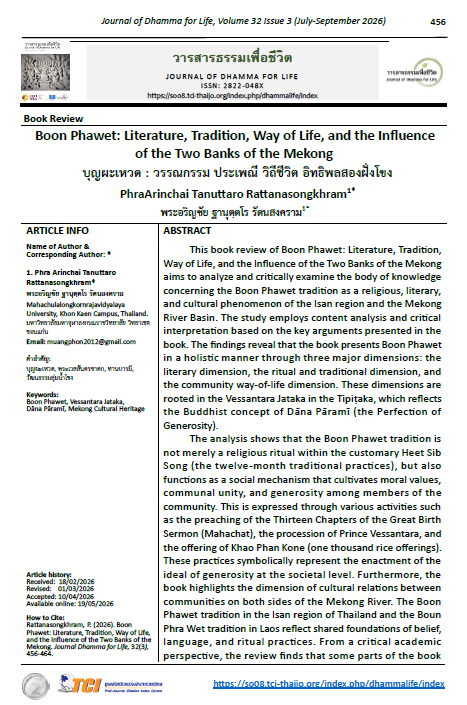
This book review of Boon Phawet: Literature, Tradition, Way of Life, and the Influence of the Two Banks of the Mekong aims to analyze and critically examine the body of knowledge concerning the Boon Phawet tradition as a religious, literary, and cultural phenomenon of the Isan region and the Mekong River Basin. The study employs content analysis and critical interpretation based on the key arguments presented in the book. The findings reveal that the book presents Boon Phawet in a holistic manner through three major dimensions: the literary dimension, the ritual and traditional dimension, and the community way-of-life dimension. These dimensions are rooted in the Vessantara Jataka in the Tipiṭaka, which reflects the Buddhist concept of Dāna Pāramī (the Perfection of Generosity).
The analysis shows that the Boon Phawet tradition is not merely a religious ritual within the customary Heet Sib Song (the twelve-month traditional practices), but also functions as a social mechanism that cultivates moral values, communal unity, and generosity among members of the community. This is expressed through various activities such as the preaching of the Thirteen Chapters of the Great Birth Sermon (Mahachat), the procession of Prince Vessantara, and the offering of Khao Phan Kone (one thousand rice offerings). These practices symbolically represent the enactment of the ideal of generosity at the societal level. Furthermore, the book highlights the dimension of cultural relations between communities on both sides of the Mekong River. The Boon Phawet tradition in the Isan region of Thailand and the Boun Phra Wet tradition in Laos reflect shared foundations of belief, language, and ritual practices. From a critical academic perspective, the review finds that some parts of the book tend to emphasize descriptive explanations and the compilation of factual information rather than theoretical analysis or comparison with contemporary research, resulting in a limited depth of academic interpretation. The key insight derived from this review is the understanding of Boon Phawet as a cultural and ethical institution of the community that plays an important role in transmitting Buddhist teachings, shaping social identity, and preserving the local wisdom of Mekong societies. This perspective can serve as a foundation for further studies in cultural Buddhism and the development of future research within contemporary social contexts.
Article Details
References
กอบชัย รัฐอุบล, & ปฐม หงส์สุวรรณ. (2564). ความทรงจำทางสังคมและการสร้างภาพตัวแทนความศักดิ์สิทธิ์ในประเพณีบุญผะเหวดของชาวชุมชนวัดช้างเผือก ตำบลพานพร้าว อำเภอศรีเชียงใหม่ จังหวัดหนองคาย. วารสารสังคมศาสตร์และมานุษยวิทยาเชิงพุทธ, 6(11), 214–228.
ธวัช ปุณโณทก. (2549). วัฒนธรรมอีสานกับพุทธศาสนา. กรุงเทพฯ: มติชน.
นิธิ เอียวศรีวงศ์. (2545). พุทธศาสนาแบบชาวบ้าน. กรุงเทพฯ: มติชน.
พระธรรมปิฎก (ป. อ. ปยุตฺโต). (2543). พุทธธรรม. กรุงเทพฯ: มหาจุฬาลงกรณราชวิทยาลัย.
พระมหาประมวล ฐานทตฺโต. (2555). เวสสันดรสะท้อนธรรม. ขอนแก่น: ขอนแก่นการพิมพ์.
พระโสภณพัฒนบัณฑิต, และคณะ. (2566). บุญผะเหวด: วรรณกรรม ประเพณี วิถีชีวิต อิทธิพลสองฝั่งโขง. ขอนแก่น: โรงพิมพ์คลังนานาวิทยา.
สุจิตต์ วงษ์เทศ. (2550). บุญประเพณีอีสาน. กรุงเทพฯ: เรือนแก้วการพิมพ์.
เสฐียรโกเศศ. (2551). มหาเวสสันดรชาดก: การศึกษาเชิงวรรณกรรมและสังคม. กรุงเทพฯ: ศยาม.
อานันท์ กาญจนพันธุ์. (2554). วัฒนธรรมกับการเปลี่ยนแปลงทางสังคม. เชียงใหม่: สำนักพิมพ์มหาวิทยาลัยเชียงใหม่.
Keyes, C. F. (1987). Thailand: Buddhist kingdom as modern nation-state. Boulder, CO: Westview Press.
