
Level of Innovative Leadership among Clothing and Dress Design Students at Guangxi Economic and Trade Vocational Institute, China
Article Sidebar
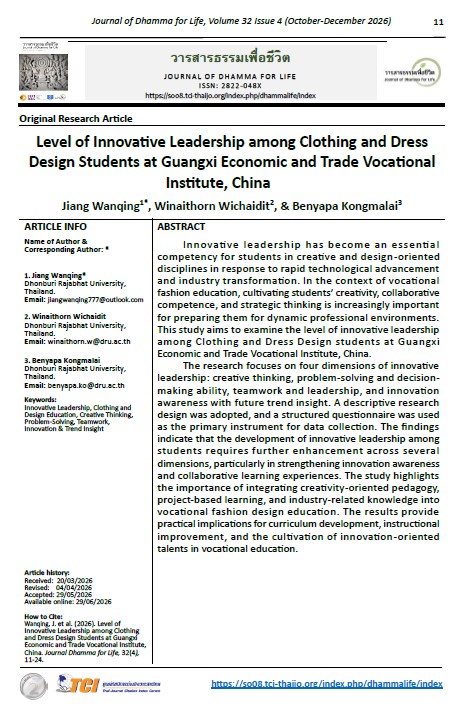
Main Article Content
Abstract
Innovative leadership has become an essential competency for students in creative and design-oriented disciplines in response to rapid technological advancement and industry transformation. In the context of vocational fashion education, cultivating students’ creativity, collaborative competence, and strategic thinking is increasingly important for preparing them for dynamic professional environments. This study aims to examine the level of innovative leadership among Clothing and Dress Design students at Guangxi Economic and Trade Vocational Institute, China.
The research focuses on four dimensions of innovative leadership: creative thinking, problem-solving and decision-making ability, teamwork and leadership, and innovation awareness with future trend insight. A descriptive research design was adopted, and a structured questionnaire was used as the primary instrument for data collection. The findings indicate that the development of innovative leadership among students requires further enhancement across several dimensions, particularly in strengthening innovation awareness and collaborative learning experiences. The study highlights the importance of integrating creativity-oriented pedagogy, project-based learning, and industry-related knowledge into vocational fashion design education. The results provide practical implications for curriculum development, instructional improvement, and the cultivation of innovation-oriented talents in vocational education.
Article Details
References
Amabile, T. M., & Pratt, M. G. (2016). The dynamic componential model of creativity and innovation in organizations: Making progress, making meaning. Annual Review of Organizational Psychology and Organizational Behavior, 3, 55–63.
Amabile, T. M., & Pratt, M. G. (2016). The dynamic componential model of creativity and innovation in organizations: Making progress, making meaning. Research in Organizational Behavior, 36, 157–183.
Bell, S. (2010). Project-based learning for the 21st century: Skills for the future. The Clearing House, 83(2), 39–43.
Buchanan, R. (2019). Systems thinking and design thinking: The search for principles in design. Design Issues, 35(2), 3–14.
Burt, R. S. (2004). Structural holes and good ideas. American Journal of Sociology, 110(2), 349–399.
Burt, S. (2004). The international diffusion of fashion trends. Journal of Fashion Marketing and Management, 8(1), 25–35.
Casciani, D., Charnley, F., & Millward-Hopkins, J. (2022). Fashion and sustainability: Designing for circularity. Journal of Cleaner Production, 365, 132–145.
Casciani, D., et al. (2022). [Details of publication on digital transformation in fashion/design education need verification].
Dorst, K. (2011). The core of ‘design thinking’ and its application. Design Studies, 32(6), 521–532.
Faerm, S. (2012). Design education: Creating future designers. Fairchild Books.
Gafour, W. H., & Gafour, W. A. (2020). Creative thinking skills in education. Journal of Education and Practice, 11(9), 45–52.
Gumusluoglu, L., & Ilsev, A. (2009). Transformational leadership and organizational innovation. Journal of Business Research, 62(4), 461–473.
Hetian, A., & Naeim, B. (2025). [Title of the article/book needed]. [Journal/Publisher name needed], [volume(issue)], [page range]. https://doi.org/[if available]
Johnson, D. W., & Johnson, R. T. (2009). An educational psychology success story: Social interdependence theory and cooperative learning. Educational Researcher, 38(5), 365–379.
Johnson, D. W., & Johnson, R. T. (2009). An educational psychology success story: Social interdependence theory and cooperative learning. Educational Researcher, 38(5), 365-379.
Larraz-Rábanos, N. (2021). Developing creative thinking in higher education. Thinking Skills and Creativity, 41, 100–112.
Larraz-Rábanos, N. (2021). [Details of publication on creativity development need verification].
Ma, J. J. (2023). Development of education for sustainable fashion design using a challenge-based learning approach. International Journal of Fashion Design, Technology and Education, 16(2), 164-174.
McFadzean, E. (2000). Techniques for creative problem solving. Team Performance Management, 6(3–4), 62–73.
Ollenburg, C. (2018). Fashion forecasting and trend analysis in design education. International Journal of Fashion Design, Technology and Education, 11(2), 123–134.
Salas, E., Shuffler, M. L., Thayer, A. L., Bedwell, W. L., & Lazzara, E. H. (2015). Understanding and improving teamwork in organizations. Human Resource Management Review, 25(4), 468–481.
Salas, E., Shuffler, M. L., Thayer, A. L., Bedwell, W. L., & Lazzara, E. H. (2015). Understanding and improving teamwork in organizations: A scientifically based practical guide. Annual Review of Organizational Psychology and Organizational Behavior, 2, 471–499.
Savery, J. R. (2015). Overview of problem-based learning: Definitions and distinctions. Interdisciplinary Journal of Problem-Based Learning, 1(1), 9–20.
Savery, J. R. (2015). Overview of problem-based learning: Definitions and distinctions. Interdisciplinary Journal of Problem-Based Learning, 9(2), 5–15.
Smith, K. A., Sheppard, S. D., Johnson, D. W., & Johnson, R. T. (2005). Pedagogies of engagement: Classroom-based practices. Journal of Engineering Education, 94(1), 87–101.
Sutthadaanantaphokin, K., Channuwong, S., Moolngearn, P., Luangsmarnkul, P., & Wang, S. (2025). Transformational leadership influencing mission implementation of Thai Universities. Sciences of Conservation and Archaeology, 37(3), 58-67.
Tan, Z., Luo, Z., & Lin, S. (2022). Exploration and practice of progressive PBL in costume design course: The example Engineering and Design College of Hunan Normal University. Ergonomics in Design, 47, 30–38.
Wang, A. Y. (2015). Cultivating innovative design thinking in fashion education. International Journal of Fashion Design, Technology and Education, 8(3), 1–9.
Wang, Y. (2015, May). Exploration on combinative knowing and doing training mode for fashion design teaching in universities. In 1st International Conference on Arts, Design and Contemporary Education (ICADCE 2015) (645-649). Atlantis Press. 205-213.
Yurtseven, R., Akkas Baysal, Ö., & Ocak, G. (2021). Analysis of the Relationship between Decision Making Skills and Problem-Solving Skills of Primary School Students. International Online Journal of Education and Teaching, 8(3), 2117-2130.
Yurtseven, N., Vatansever, S., & Aydın, H. (2021). Decision-making and problem-solving in design education. Design and Technology Education, 26(1), 55–70.
