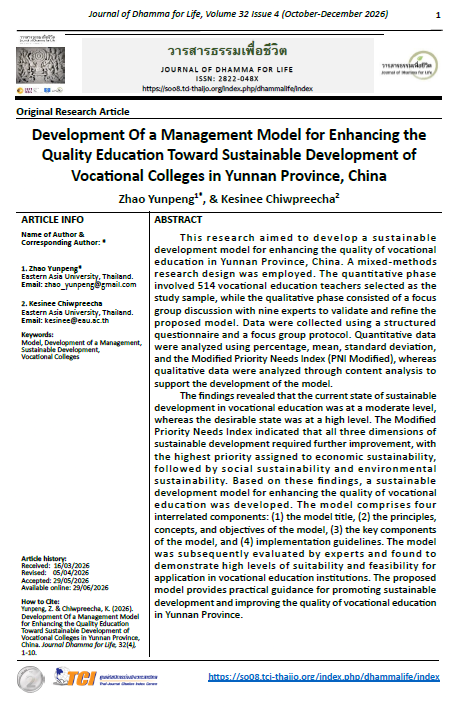
Development Of a Management Model for Enhancing the Quality Education Toward Sustainable Development of Vocational Colleges in Yunnan Province, China
Article Sidebar
Main Article Content
Abstract
This research aimed to develop a sustainable development model for enhancing the quality of vocational education in Yunnan Province, China. A mixed-methods research design was employed. The quantitative phase involved 514 vocational education teachers selected as the study sample, while the qualitative phase consisted of a focus group discussion with nine experts to validate and refine the proposed model. Data were collected using a structured questionnaire and a focus group protocol. Quantitative data were analyzed using percentage, mean, standard deviation, and the Modified Priority Needs Index (PNI Modified), whereas qualitative data were analyzed through content analysis to support the development of the model.
The findings revealed that the current state of sustainable development in vocational education was at a moderate level, whereas the desirable state was at a high level. The Modified Priority Needs Index indicated that all three dimensions of sustainable development required further improvement, with the highest priority assigned to economic sustainability, followed by social sustainability and environmental sustainability. Based on these findings, a sustainable development model for enhancing the quality of vocational education was developed. The model comprises four interrelated components: (1) the model title, (2) the principles, concepts, and objectives of the model, (3) the key components of the model, and (4) implementation guidelines. The model was subsequently evaluated by experts and found to demonstrate high levels of suitability and feasibility for application in vocational education institutions. The proposed model provides practical guidance for promoting sustainable development and improving the quality of vocational education in Yunnan Province.
Article Details
References
Billett, S. (2011). Vocational education: Purposes, traditions and prospects. Springer.
Chen, B., Liu, Y., & Zheng, J. (2022). Using data mining approach for student satisfaction with teaching quality in higher vocational education. Journal of Vocational Education Studies, 15 (2), 45–60.
Chen, M. (2024). Research on the Development Status of Higher Vocational Education in China. International Journal of Education and Humanities. 13 (2), 108-118.
Ding, R. & Zheng, Y. (2022). Education Partnership Assistance to Promote the Balanced and Sustainable Development of Higher Education: Lessons from China. Sustainability, MDPI, 14 (14), 83-93.
Fahim, A. (2021), Sustainable Higher Education Reform Quality Assessment Using SWOT Analysis with Integration of AHP and Entropy Models: A Case Study of Morocco. Sustainability 2021, 13 (8), 4312-4320.
Findeisen, S. (2022). Transition from School to Work – Explaining Persistence Intention in Vocational Education and Training in Switzerland Vocations and Learning. (2022) 15:129–154
Fodor, S. (2021). Approach for Sustainable Development in University-Level Education. Sustainability 2021, 13, 9977.
George, N. S. (2023). Higher Education Institutions’ Sustainable Development towards Agenda 2030: A Global Goals in Policy and Curriculum. International Journal of Research and Innovation in Social Science,12 (4), 1320-1326.
Jackson, D. (2015). Employability skill development in work-integrated learning: Barriers and best practice. Studies in Higher Education, 40(2), 350–367.
Jianling, X. (2024). The digital transformation of vocational education: Experience and reflections of Shenzhen Polytechnic University. VTE journal. 1 (2), 1-17.
Liu, Y. (2024). The influential relationship between technical and vocational education and training (TVET) and employment competence: A study from Yunnan Province, China. Journal of Ecohumanism, 3 (7), 4136–4142.
Ministry of Education (2023). Notice of the Office of the Ministry of Education on accelerating the reform of key tasks in the construction of a modern vocational education system. http://www.moe.gov.cn/srcsite/A07/zcs_zhgg/202307. Accessed March 20,2025.
OECD. (2020). Education at a glance 2020 Vocational Management (OECD, 2020, OECD indicators. OECD Publishing. https://doi.org/10.1787/69096873
UNESCO. (2024). Beijing consensus on artificial intelligence and education. from http://www. moe.gov.cn/jyb_xwfb/gzdt_gzdt/s5987/201908/W020190828311234688933.pdf. Accessed March 20, 2025.
Witkin, B. R., & Altschuld, J.W. (1995). Planning and conducting needs assessments: A practical guide. Thousand Oaks, CA: Sage Publications.
World Bank. (2023). Improving vocational education brings opportunities for young people in Yunnan.Retrieved from https://www.worldbank.org/en/news/feature/2023/03/13/ improving-vocational-education-brings-opportunities-for-young-people-in-yunnan.
Yu, C. (2025). Revitalizing Higher Vocational Education in Yunnan, China through Curriculum. Redesign, Industry Partnerships, and Professional DevelopmentASEAN. Journal of Education 11 (1), 1-10.
Zhao, J. (2024). The construction path of the industry education integration community in higher vocational colleges from the perspective of the "Double High Plan". Chin Vocat Tech Edu. 15 (1), 61-67.
