Study and Analyze the Value of Kathin Merit-Making That Influences Thai Society
Article Sidebar
Main Article Content
Abstract
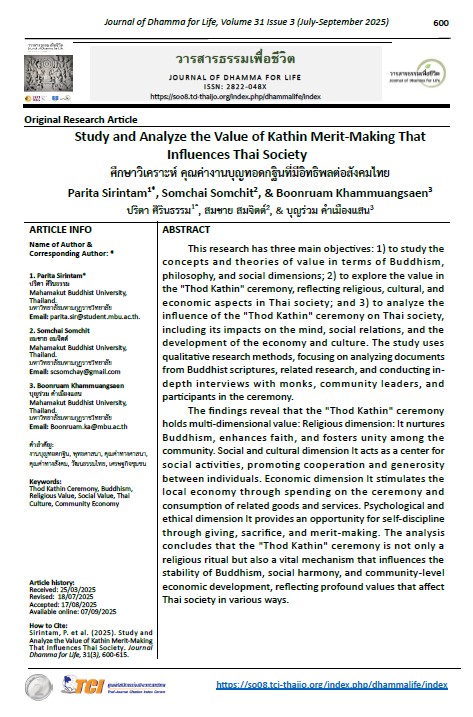
This research has three main objectives: 1) to study the concepts and theories of value in terms of Buddhism, philosophy, and social dimensions; 2) to explore the value in the "Thod Kathin" ceremony, reflecting religious, cultural, and economic aspects in Thai society; and 3) to analyze the influence of the "Thod Kathin" ceremony on Thai society, including its impacts on the mind, social relations, and the development of the economy and culture. The study uses qualitative research methods, focusing on analyzing documents from Buddhist scriptures, related research, and conducting in-depth interviews with monks, community leaders, and participants in the ceremony.
The findings reveal that the "Thod Kathin" ceremony holds multi-dimensional value: Religious dimension: It nurtures Buddhism, enhances faith, and fosters unity among the community. Social and cultural dimension It acts as a center for social activities, promoting cooperation and generosity between individuals. Economic dimension It stimulates the local economy through spending on the ceremony and consumption of related goods and services. Psychological and ethical dimension It provides an opportunity for self-discipline through giving, sacrifice, and merit-making. The analysis concludes that the "Thod Kathin" ceremony is not only a religious ritual but also a vital mechanism that influences the stability of Buddhism, social harmony, and community-level economic development, reflecting profound values that affect Thai society in various ways.
Article Details
References
จันทร์เพ็ญ, ศิริพร. (2564). ผลกระทบทางเศรษฐกิจของพิธีทอดกฐินในชุมชนท้องถิ่น. วารสารเศรษฐศาสตร์และการพัฒนา, 8(1), 120-135.
บุญชู. (2561). การเปลี่ยนแปลงของพิธีทอดกฐินในยุคสมัยใหม่. วารสารมนุษยศาสตร์และสังคมศาสตร์, 29(2), 102-120.
พระไตรปิฎก. (2525). พระไตรปิฎก (ฉบับสมบูรณ์). กรุงเทพฯ: สำนักพิมพ์มหามกุฏราชวิทยาลัย.
พุทธทาสภิกขุ. (พ.ศ. 2500). ธรรมะเรื่องการให้ (dāna).
พิชญา. (2564). ผลกระทบทางวัฒนธรรมของงานทอดกฐินในสังคมเมืองและชนบท. วิทยานิพนธ์ปริญญาเอก, มหาวิทยาลัยเชียงใหม่.
นภัสสร. (2565). แนวโน้มและการเปลี่ยนแปลงของงานทอดกฐินในสังคมสมัยใหม่. รายงานการวิจัย, มหาวิทยาลัยขอนแก่น.
สมาคมส่งเสริมพระพุทธศาสนาแห่งประเทศไทย. (2565). ประวัติและความสำคัญของงานบุญทอดกฐิน. กรุงเทพฯ: สำนักพิมพ์ธรรมะ.
สมชาย. (2562). คุณค่าทางศาสนาและจิตใจของงานบุญทอดกฐินในสังคมไทย. วิทยานิพนธ์ปริญญาโท, มหาวิทยาลัยธรรมศาสตร์.
สารานุกรมพุทธศาสนา. (2548). บุญกิริยาวัตถุและงานทอดกฐิน. กรุงเทพฯ: สำนักพิมพ์สยาม.
สำนักพระพุทธศาสนาแห่งชาติ. (2566). คู่มือการจัดงานบุญทอดกฐิน: แนวทางและประเพณี. นนทบุรี: สำนักพิมพ์กรมการศาสนา.
เศรษฐา ศิลาอ่อน. (2554). ผลกระทบทางเศรษฐกิจของงานบุญประเพณีท้องถิ่น: กรณีศึกษางานทอดกฐิน. วารสารสังคมศาสตร์, 22(3), 45-67.
วิริยะ, ธีรชัย. (2563). บทบาทของงานบุญทอดกฐินในการสร้างความสามัคคีของชุมชนไทย. วารสารสังคมศาสตร์มหาวิทยาลัยเชียงใหม่, 12(2), 45-60.
อนันต์. (2560). บทบาทของงานทอดกฐินในการเสริมสร้างความสัมพันธ์ระหว่างพระสงฆ์และชุมชน. วารสารสังคมวิทยา, 22(3), 80-95.
Frankena, W. K. (1973). Ethics. Prentice-Hall.
Geertz, C. (1973). The interpretation of cultures. Basic Books.
Gethin, R. (1998). The foundations of Buddhism. Oxford University Press.
Harvey, P. (2000). An introduction to Buddhism: Teachings, history and practices. Cambridge University Press.
Jackson, P. (1989). Thai Buddhist festivals and the construction of community. Journal of Southeast Asian Studies, 20(1), 57-79.
Kagan, S. (1998). Normative ethics. Westview Press.
Keyes, C. F. (1983). The religious tradition of Thailand. In Asia: Tradition and Change.
Putnam, R. D. (2000). Bowling alone: The collapse and revival of American community. Simon & Schuster.
Rahula, W. (1974). What the Buddha taught. Grove Press.
Schwartz, S. H. (1992). Universals in the content and structure of values: Theoretical advances and empirical tests in 20 countries. In M. Zanna (Ed.), Advances in experimental social psychology (Vol. 25, pp. 1-65). Academic Press.
Swearer, D. K. (1995). The Buddhist world of Southeast Asia. State University of New York Press.
Tambiah, S. J. (1976). World conqueror and world renouncer: A study of Buddhism and polity in Thailand against a historical background. Cambridge University Press.
Urkheim, E. (1912). The elementary forms of religious life.
Vandergeest, P. (1996). The political ecology of peasant-state relations in Thailand. The Journal of Asian Studies, 55(2).
