An Analysis of Sutamayañãṇa in Patisambhidâmagga Scripture
Article Sidebar
Main Article Content
Abstract
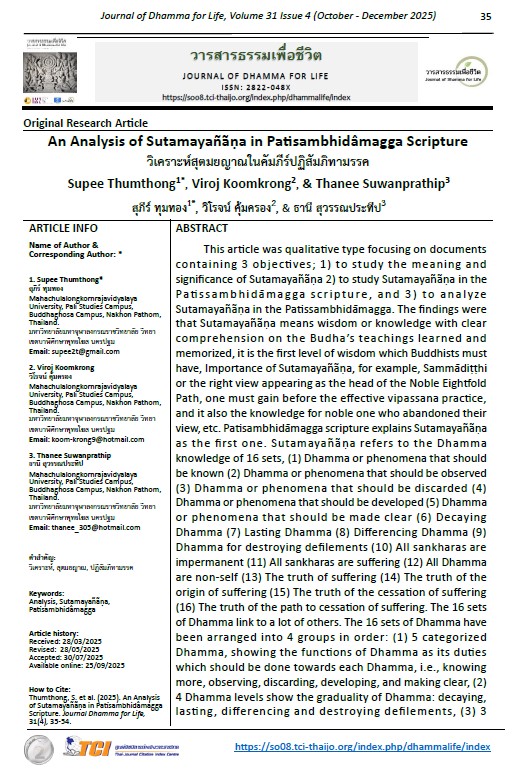
This article was qualitative type focusing on documents containing 3 objectives; 1) to study the meaning and significance of Sutamayañãṇa 2) to study Sutamayañãṇa in the Patissambhidāmagga scripture, and 3) to analyze Sutamayañãṇa in the Patissambhidāmagga. The findings were that Sutamayañãṇa means wisdom or knowledge with clear comprehension on the Budha’s teachings learned and memorized, it is the first level of wisdom which Buddhists must have, Importance of Sutamayañãṇa, for example, Sammādiṭṭhi or the right view appearing as the head of the Noble Eightfold Path, one must gain before the effective vipassana practice, and it also the knowledge for noble one who abandoned their view, etc. Patisambhidāmagga scripture explains Sutamayañãṇa as the first one. Sutamayañãṇa refers to the Dhamma knowledge of 16 sets, (1) Dhamma or phenomena that should be known (2) Dhamma or phenomena that should be observed (3) Dhamma or phenomena that should be discarded (4) Dhamma or phenomena that should be developed (5) Dhamma or phenomena that should be made clear (6) Decaying Dhamma (7) Lasting Dhamma (8) Differencing Dhamma (9) Dhamma for destroying defilements (10) All sankharas are impermanent (11) All sankharas are suffering (12) All Dhamma are non-self (13) The truth of suffering (14) The truth of the origin of suffering (15) The truth of the cessation of suffering (16) The truth of the path to cessation of suffering. The 16 sets of Dhamma link to a lot of others. The 16 sets of Dhamma have been arranged into 4 groups in order: (1) 5 categorized Dhamma, showing the functions of Dhamma as its duties which should be done towards each Dhamma, i.e., knowing more, observing, discarding, developing, and making clear, (2) 4 Dhamma levels show the graduality of Dhamma: decaying, lasting, differencing and destroying defilements, (3) 3 characteristics are knowledge of Vipassanā, namely impermanence, suffering, and non-self, (4) 4 Noble Truth signifies the true knowledge leading to the attainment of the Noble Ones, namely suffering, its causes, Nibbana, and the path, These 16 sets of Dhamma are the principles, Buddhists should follow, study, contemplate and revise many times as the first level of wisdom for the advance wisdom in higher steps.
