
Managing the Cultural Landscape through Social Enterprise Concepts in the Digital Age
Article Sidebar
Main Article Content
Abstract
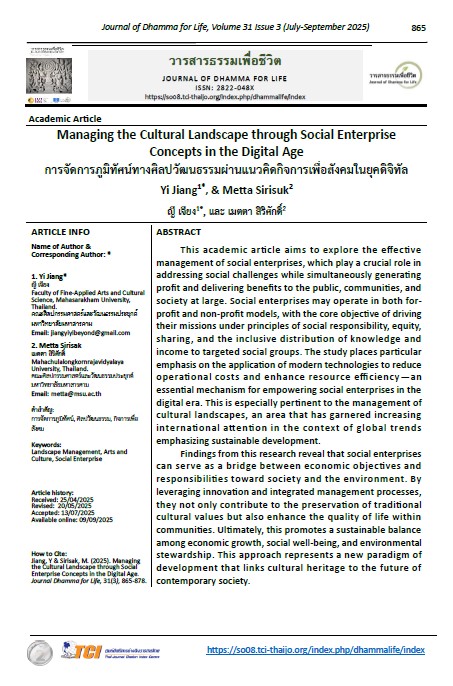
This academic article aims to explore the effective management of social enterprises, which play a crucial role in addressing social challenges while simultaneously generating profit and delivering benefits to the public, communities, and society at large. Social enterprises may operate in both for-profit and non-profit models, with the core objective of driving their missions under principles of social responsibility, equity, sharing, and the inclusive distribution of knowledge and income to targeted social groups. The study places particular emphasis on the application of modern technologies to reduce operational costs and enhance resource efficiency—an essential mechanism for empowering social enterprises in the digital era. This is especially pertinent to the management of cultural landscapes, an area that has garnered increasing international attention in the context of global trends emphasizing sustainable development.
Findings from this research reveal that social enterprises can serve as a bridge between economic objectives and responsibilities toward society and the environment. By leveraging innovation and integrated management processes, they not only contribute to the preservation of traditional cultural values but also enhance the quality of life within communities. Ultimately, this promotes a sustainable balance among economic growth, social well-being, and environmental stewardship. This approach represents a new paradigm of development that links cultural heritage to the future of contemporary society.
