Burnout among Healthcare Workers in a Private Setting in Thailand.
Article Sidebar
Main Article Content
Abstract
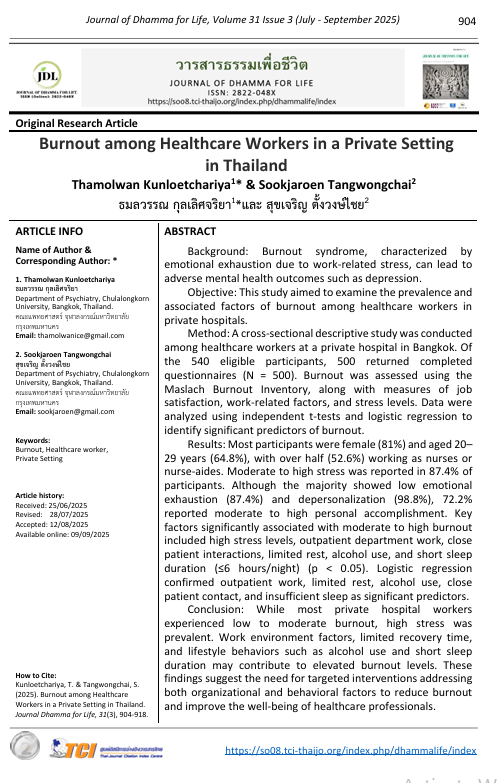
Background: Burnout syndrome is emotional exhaustion from work stress, potentially leading to depression.
Objectives: This study focuses on burnout among private hospital employees, aiming to study the prevalence and associated factors of burnout among healthcare workers in private hospitals.
Method: This cross-sectional descriptive study involved 500 healthcare workers at a private hospital in Bangkok. Burnout was measured using the Maslach Burnout Inventory, along with job satisfaction, job-related factors, and stress levels. Independent t-tests and logistic regression analysis were used to identify factors associated with burnout.
Results: The study found 81% of participants were female, with 64.8% aged 20-29, and 52.6% working as nurses and nurse-aides. Moderate and high stress levels were reported by 83.8% and 3.6% of participants, respectively. Low levels of emotional exhaustion (87.4%) and depersonalization (98.8%) were observed, while 72.2% experienced moderate to high personal accomplishment. Overall, burnout was low in 55.9%, moderate in 42.7%, and high in 1.2% of participants. Moderate to high burnout was associated with high stress, outpatient work, heavy workloads, long commutes, close patient interactions, COVID-19 challenges, insufficient rest, alcohol use, and short sleep (≤6 hours/night) (p < 0.05). Logistic regression highlighted outpatient work, close patient interactions, limited rest, alcohol use, and short sleep as key predictors of moderate to high burnout.
Conclusion: In this private healthcare setting, most workers experienced low to moderate burnout, though the majority faced moderate stress levels. High burnout levels may be linked to a demanding work environment, limited recovery time, and alcohol use.
KEYWORDS: Burnout, Healthcare worker, Private Setting.
