Thung Chompoo Model: A Model For Managing Small Water Resources To Reduce Poverty And Inequality
Article Sidebar
Main Article Content
Abstract
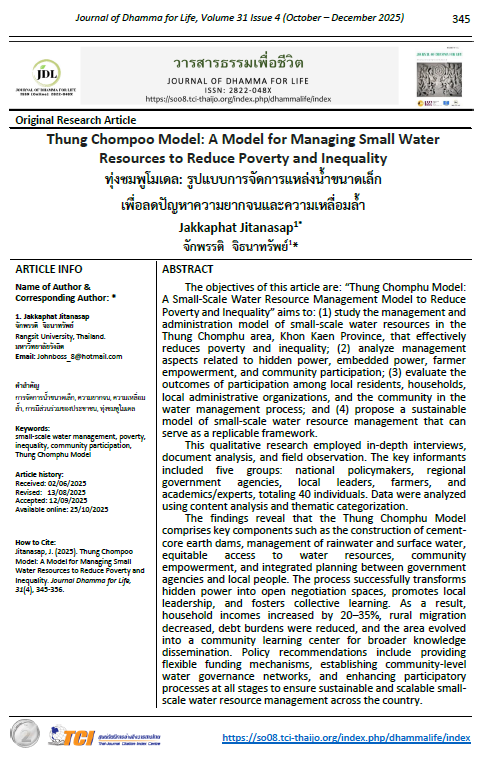
The objectives of this article are: “Thung Chomphu Model: A Small-Scale Water Resource Management Model to Reduce Poverty and Inequality” aims to: (1) study the management and administration model of small-scale water resources in the Thung Chomphu area, Khon Kaen Province, that effectively reduces poverty and inequality; (2) analyze management aspects related to hidden power, embedded power, farmer empowerment, and community participation; (3) evaluate the outcomes of participation among local residents, households, local administrative organizations, and the community in the water management process; and (4) propose a sustainable model of small-scale water resource management that can serve as a replicable framework.
This qualitative research employed in-depth interviews, document analysis, and field observation. The key informants included five groups: national policymakers, regional government agencies, local leaders, farmers, and academics/experts, totaling 40 individuals. Data were analyzed using content analysis and thematic categorization.
The findings reveal that the Thung Chomphu Model comprises key components such as the construction of cement-core earth dams, management of rainwater and surface water, equitable access to water resources, community empowerment, and integrated planning between government agencies and local people. The process successfully transforms hidden power into open negotiation spaces, promotes local leadership, and fosters collective learning. As a result, household incomes increased by 20–35%, rural migration decreased, debt burdens were reduced, and the area evolved into a community learning center for broader knowledge dissemination. Policy recommendations include providing flexible funding mechanisms, establishing community-level water governance networks, and enhancing participatory processes at all stages to ensure sustainable and scalable small-scale water resource management across the country.
