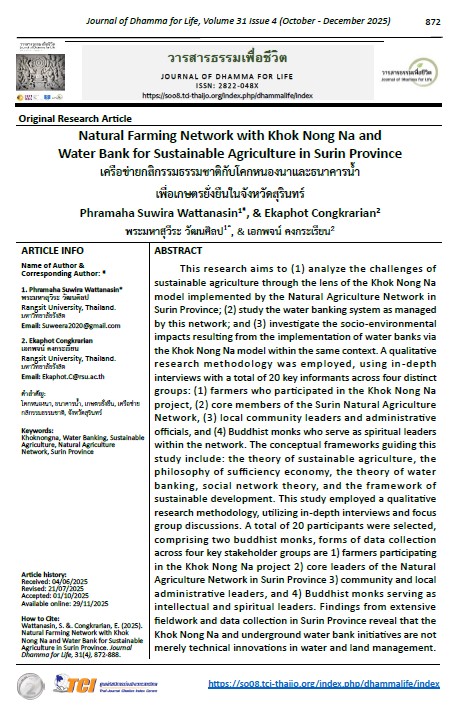
Natural Farming Network with Khok Nong Na and Water Bank for Sustainable Agriculture in Surin Province
Article Sidebar
Main Article Content
Abstract
This research aims to (1) analyze the challenges of sustainable agriculture through the lens of the Khok Nong Na model implemented by the Natural Agriculture Network in Surin Province; (2) study the water banking system as managed by this network; and (3) investigate the socio-environmental impacts resulting from the implementation of water banks via the Khok Nong Na model within the same context. A qualitative research methodology was employed, using in-depth interviews with a total of 20 key informants across four distinct groups: (1) farmers who participated in the Khok Nong Na project, (2) core members of the Surin Natural Agriculture Network, (3) local community leaders and administrative officials, and (4) Buddhist monks who serve as spiritual leaders within the network. The conceptual frameworks guiding this study include: the theory of sustainable agriculture, the philosophy of sufficiency economy, the theory of water banking, social network theory, and the framework of sustainable development. This study employed a qualitative research methodology, utilizing in-depth interviews and focus group discussions. A total of 20 participants were selected, comprising two buddhist monks, forms of data collection across four key stakeholder groups are 1) farmers participating in the Khok Nong Na project 2) core leaders of the Natural Agriculture Network in Surin Province 3) community and local administrative leaders, and 4) Buddhist monks serving as intellectual and spiritual leaders. Findings from extensive fieldwork and data collection in Surin Province reveal that the Khok Nong Na and underground water bank initiatives are not merely technical innovations in water and land management. Rather, they represent a structural transformation of local livelihood systems, production processes, and social relations—particularly in communities that have historically faced drought, poverty, and dependency on vulnerable external economic systems. The discussion of results can be framed around three major dimensions: the eco-economic dimension, the community-based knowledge management dimension, and the social network management dimension for sustainability. The study highlights the interconnection between sustainable agriculture, the philosophy of sufficiency economy, and water bank management through the Khok Nong Na approach; the collective power of social networks in driving forward these innovations; and the alignment of these practices with the broader goals of sustainable development.
Article Details
References
กรมพัฒนาที่ดิน. (2565). รายงานสถานการณ์ทรัพยากรดินประเทศไทย ปี 2565. กระทรวงเกษตรและสหกรณ์.
กสิกรรมธรรมชาติ. (2564). โคก หนอง นา โมเดล: แนวทางปฏิบัติเพื่อการฟื้นฟูระบบเกษตรกรรม. มูลนิธิกสิกรรมธรรมชาติ.
ดร. นรีนุช ดำรงชัย. (2561). แนวทางการสร้างความยั่งยืนในการพัฒนาชุมชนไทยภายใต้แนวความคิดเศรษฐกิจพอเพียง. วารสารสุโขทัยธรรมาธิราช, 31(1), 92-107.
พรเทพ เทพสุทิน. (2562). การพัฒนาเกษตรกรรมยั่งยืนตามแนวเศรษฐกิจพอเพียง. กรุงเทพฯ: สำนักพิมพ์แห่ง จุฬาลงกรณ์มหาวิทยาลัย.
สุธิดา วิมุตตานนท์. (2563). การจัดการทรัพยากรธรรมชาติแบบมีส่วนร่วมในระดับชุมชน. กรุงเทพฯ: สำนักพิมพ์มหาวิทยาลัยธรรมศาสตร์.
สำนักงานเกษตรจังหวัดสุรินทร์. (2566). รายงานข้อมูลสถิติการเกษตรจังหวัดสุรินทร์. สุรินทร์: สำนักงานเกษตรจังหวัดสุรินทร์.
สำนักงานเศรษฐกิจการเกษตร. (2566). รายงานสถานการณ์และตัวชี้วัดภาคเกษตรไทย. กรุงเทพฯ: สำนักงานเศรษฐกิจการเกษตร.
สำนักงานส่งเสริมเศรษฐกิจฐานราก. (2565). รายงานการพัฒนาเศรษฐกิจฐานรากและเกษตรกรรายย่อย. กรุงเทพฯ: สำนักส่งเสริมเศรษฐกิจฐานราก.
วิฑูรย์ เลี่ยนจำรูญ. (2559). เกษตรกรรมไทยและภูมิปัญญาท้องถิ่น. กรุงเทพฯ: สำนักพิมพ์มหาวิทยาลัยเกษตรศาสตร์.
Altieri, M. A. (1995). Agroecology: The science of sustainable agriculture (2nd ed.). Boulder, CO: Westview Press.
Altieri, M. A., & Nicholls, C. I. (2003). Soil fertility management and insect pests: Harmonizing soil and pest management. In M. A. Altieri (Ed.), Agroecology: Principles and strategies for designing sustainable farming systems (177–202). CRC Press.
Bouwer, H. (2002). Artificial recharge of groundwater: Hydrogeology and engineering. Hydrogeology Journal, 10(1), 121–142.
Chambers, R. (1997). Whose reality counts? Putting the first last. London: Intermediate Technology Publications.
Dillon, P. (2005). Future management of aquifer recharge. Hydrogeology Journal, 13(1), 313–316.
Dillon, P., Pavelic, P., Page, D., Beringen, H., & Ward, J. (2009). Managed aquifer recharge: An introduction. Waterlines, 28(1), 10–12.
Food and Agriculture Organization of the United Nations (FAO). (2017). The future of food and agriculture – Trends and challenges. Rome: FAO.
Food and Agriculture Organization of the United Nations (FAO). (2018). Sustainable agriculture. Rome: FAO.
Gale, I. N., McDonnell, J. J., & Stewart, M. K. (2013). Groundwater and surface water interactions: Models, methods, and case studies. Wiley.
Gaventa, J. (2006). Finding the spaces for change: A power analysis. IDS Bulletin, 37(6), 23–33. https://doi.org/10.1111/j.1759-5436.2006.tb00320.x.
Gleick, P. H. (2003). Water use. Annual Review of Environment and Resources, 28, 275–314.
Gleeson, T., Wada, Y., Bierkens, M. F. P., & van Beek, L. P. H. (2012). Water balance of global aquifers revealed by groundwater footprint. Nature, 488, 197–200.
Gliessman, S. R. (2007). Agroecology: The ecology of sustainable food systems (2nd ed.). Boca Raton, FL: CRC Press.
Gliessman, S. R. (2015). Agroecology: The ecology of sustainable food systems (3rd ed.). CRC Press.
Pholphirul, P. (2012). Sufficiency economy philosophy: A pathway to sustainable development in Thailand. Asian Social Science, 8(7), 34–44.
Postel, S., Polak, P., Gonzales, F., & Keller, J. (1996). Drip irrigation for small farmers: A new initiative to alleviate hunger and poverty. Water International, 21(1), 3–13.
Pretty, J. (2008). Agricultural sustainability: Concepts, principles and evidence. Philosophical Transactions of the Royal Society B: Biological Sciences, 363(1491), 447–465. https://doi.org/10.1098/rstb.2007.2163.
Raksasat, S. (2018). Application of the sufficiency economy philosophy in community development. Journal of Social Sciences, 14(2), 45–56.
Sangtong, K. (2016). Sufficiency economy and sustainable development: Case studies in rural Thailand. Kasetsart Journal of Social Sciences, 37(1), 12–22.
Scanlon, B. R., Reedy, R. C., & Pool, D. R. (2007). Groundwater recharge in arid and semiarid regions. Hydrogeology Journal, 15(1), 153–167.
Tilman, D., Cassman, K. G., Matson, P. A., Naylor, R., & Polasky, S. (2002). Agricultural sustainability and intensive production practices. Nature, 418(6898), 671–677.
World Bank. (2022). Thailand economic monitor: Agriculture and rural development. Washington, DC: World Bank.
Zhang, H., Liu, W., & Wang, L. (2018). Water banking and its potential for sustainable water management. Journal of Hydrology, 560, 392–401.
Office of the Royal Development Projects Board. (2010). Sufficiency economy philosophy. Bangkok: Office of the Royal Development Projects Board.
