
The Efficacy of Isochronic Tones via Mobile Application on Sleep Quality of Early Adulthood
Article Sidebar
Main Article Content
Abstract
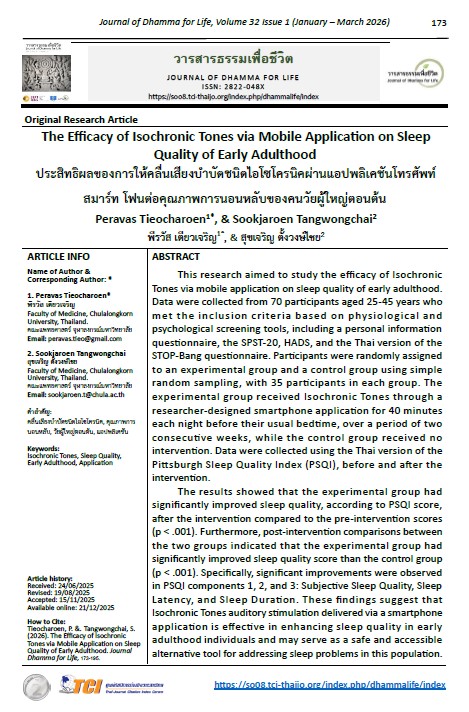
This research aimed to study the efficacy of Isochronic Tones via mobile application on sleep quality of early adulthood. Data were collected from 70 participants aged 25-45 years who met the inclusion criteria based on physiological and psychological screening tools, including a personal information questionnaire, the SPST-20, HADS, and the Thai version of the STOP-Bang questionnaire. Participants were randomly assigned to an experimental group and a control group using simple random sampling, with 35 participants in each group. The experimental group received Isochronic Tones through a researcher-designed smartphone application for 40 minutes each night before their usual bedtime, over a period of two consecutive weeks, while the control group received no intervention. Data were collected using the Thai version of the Pittsburgh Sleep Quality Index (PSQI), before and after the intervention.
The results showed that the experimental group had significantly improved sleep quality, according to PSQI score, after the intervention compared to the pre-intervention scores (p < .001). Furthermore, post-intervention comparisons between the two groups indicated that the experimental group had significantly improved sleep quality score than the control group (p < .001). Specifically, significant improvements were observed in PSQI components 1, 2, and 3: Subjective Sleep Quality, Sleep Latency, and Sleep Duration. These findings suggest that Isochronic Tones auditory stimulation delivered via a smartphone application is effective in enhancing sleep quality in early adulthood individuals and may serve as a safe and accessible alternative tool for addressing sleep problems in this population.
Article Details
References
ตะวันชัย จิรประมุขพิทักษ์, & วรัญ ตันชัยสวัสดิ์. (2557). คู่มือการใช้แบบสอบถามคุณภาพการนอนหลับ PSQI ฉบับภาษาไทย. กรุงเทพฯ: สำนักพิมพ์มหาวิทยาลัย.
ตะวัน จิรประมุขพิทักษ์, & วรัญ ตันชัยสวัสดิ์ (2557). ดัชนีคุณภาพการนอนหลับของพิตส์เบิร์กฉบับภาษาไทย: ความน่าเชื่อถือและความถูกต้อง. วารสารการพยาบาลและการดูแลสุขภาพ, 32(2), 45–52.
Abeln, V., Schneider, S., Vogt, T., & Strüder, H. K. (2014). Effects of auditory stimulation with binaural beats on sleep quality. Frontiers in Human Neuroscience, 8, 1–8. https://doi.org/10.3389/fnhum.2014.00741.
Berger, H. (1929). Über das Elektrenkephalogramm des Menschen. Archiv für Psychiatrie und Nervenkrankheiten, 87(1), 527–570. https://doi.org/10.1007/BF01797193.
Buysse, D. J., Reynolds, C. F., Monk, T. H., Berman, S. R., & Kupfer, D. J. (1989). The Pittsburgh Sleep Quality Index: A new instrument for psychiatric practice and research. Psychiatry Research, 28(2), 193–213. https://doi.org/10.1016/0165-1781(89)90047-4.
Cohen, J. (1988). Statistical power analysis for the behavioral sciences (2nd ed.). Lawrence Erlbaum Associates.
Hopkins, W. G. (2002). A scale of magnitudes for effect statistics. A New View of Statistics. http://www.sportsci.org/resource/stats/effectmag.html.
Ho, F. Y. Y., Chung, K. F., & Yeung, W. F. (2021). Clinical significance of sleep improvement: Minimal clinically important difference of the Pittsburgh Sleep Quality Index. Sleep Medicine, 84, 145–150. https://doi.org/10.1016/j.sleep.2021.06.013.
Huang, T. L., & Charyton, C. (2008). A comprehensive review of the psychological effects of brainwave entrainment. Alternative Therapies in Health and Medicine, 14(5), 38–50.
Jirakittayakorn, N., & Wongsawat, Y. (2018a). Brain responses to binaural beat and effects on sleep: An EEG study. Clinical Neurophysiology, 129(2), 251–259. https://doi.org/10.1016/j.clinph.2017.11.024.
Jirakittayakorn, N., & Wongsawat, Y. (2018b). Brainwave entrainment: Effects of auditory beats on sleep quality and brain activity. Journal of Sleep Research, 27(3), e12670. https://doi.org/10.1111/jsr.12670.
Jirakittayakorn, N., & Wongsawat, Y. (2018c). Brainwave entrainment using binaural beats enhances deep sleep-in humans. Frontiers in Human Neuroscience, 12, 360. https://doi.org/10.3389/fnhum.2018.00360.
Lane, J. D., Kasian, S. J., Owens, J. E., & Marsh, G. R. (1998). Binaural auditory beats affect vigilance performance and mood. Physiology & Behavior, 63(2), 249–252. https://doi.org/10.1016/S0031-9384(97)00436-8.
Le Scouarnec, R. P., Poirier, R. M., Owens, J. E., Gauthier, J., Taylor, A. G., & Foresman, P. A. (2001). Use of binaural beat tapes for treatment of anxiety: A pilot study of tape preference and outcomes. Alternative Therapies in Health and Medicine, 7(1), 58–63.
Massar, S. A. A., Lim, J., & Chee, M. W. L. (2021). Digital life and sleep: The impact of technology on young adults’ sleep patterns. Current Opinion in Behavioral Sciences, 42, 15–22. https://doi.org/10.1016/j.cobeha.2021.01.007.
Na Wichian, S., Tantirattanakul, N., & Suwannahitatorn, P. (2018). Effects of binaural beat audio stimulation on sleep quality in young adults. Journal of Sleep Research, 27(5), e12608. https://doi.org/10.1111/jsr.12608.
Obleser, J., Henry, M. J., & Lakatos, P. (2017). What do we talk about when we talk about rhythm? PLoS Biology, 15(9), e2002794. https://doi.org/10.1371/journal.pbio.2002794.
