Tourism Behavior of International Students at Phitsanulok University During Their Studies in the Soft Power Program under the DTV Visa Scheme
Article Sidebar
Main Article Content
Abstract
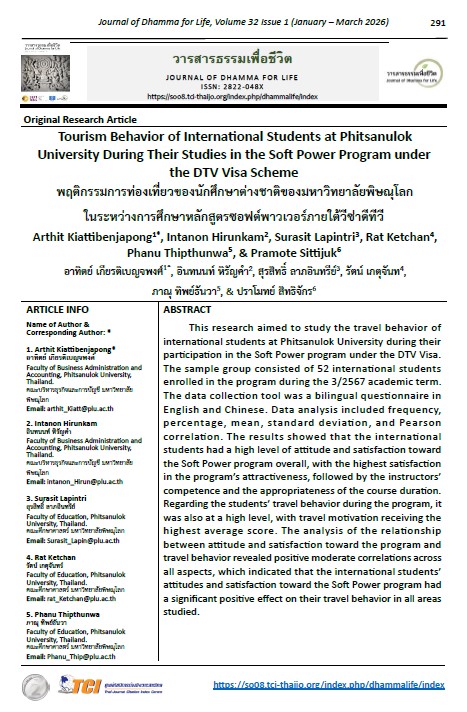
This research aimed to study the travel behavior of international students at Phitsanulok University during their participation in the Soft Power program under the DTV Visa. The sample group consisted of 52 international students enrolled in the program during the 3/2567 academic term. The data collection tool was a bilingual questionnaire in English and Chinese. Data analysis included frequency, percentage, mean, standard deviation, and Pearson correlation. The results showed that the international students had a high level of attitude and satisfaction toward the Soft Power program overall, with the highest satisfaction in the program’s attractiveness, followed by the instructors’ competence and the appropriateness of the course duration. Regarding the students’ travel behavior during the program, it was also at a high level, with travel motivation receiving the highest average score. The analysis of the relationship between attitude and satisfaction toward the program and travel behavior revealed positive moderate correlations across all aspects, which indicated that the international students’ attitudes and satisfaction toward the Soft Power program had a significant positive effect on their travel behavior in all areas studied.
Article Details
References
พรนภา ธนโพธิวิรัตน์, ณฐมน สังวาลย์, ปาริฉัตร์ คำเพ็ง, วีรัชญาน์ สิริมงคลวิวัฒน์, จิณณพัต เชยชม, เสฎฐวุฒิ แต่งปราณีต, และวรรณนิษา นามแสง. (2567). แนวโน้มของซอฟต์พาวเวอร์ห้าด้านที่ส่งผลต่อการตัดสินใจท่องเที่ยวในจังหวัดพระนครศรีอยุธยาของนักท่องเที่ยวชาวไทย. Journal of Liberal Arts RMUTT, 5(2), 37-48.
พรภิรมย์ ยอดบุญ, พระมหาประสพสุข สุขล้วน, พระมหาปิยะ บัวอ่อน, & นฤมล โพธิ์ทอง. (2568). กระบวนการพัฒนาฐานข้อมูลและศักยภาพการส่งเสริมการท่องเที่ยวเชิงวัฒนธรรมในจังหวัดฉะเชิงเทรา. วารสารนวัตกรรมการจัดการศึกษาและการวิจัย, 7(2), 173–186.
ภูริ ชุณห์ขจร, พงศ์สุระ ธัญญเจริญอนุกูล, ธีราพัทธ์ ชมชื่นจิตต์สิน, นิลุบล ประเคนภัทรา, & ปุณยนุช ลีฬหะ สุวรรณ. (2568). การส่งเสริมแนวทางการท่องเที่ยวเชิงอาหารจังหวัดนนทบุรี. วารสารคหกรรมศาสตร์และวัฒนธรรมอย่างยั่งยืน, 7(1), 88–99.
ศุภชัย แจ้งใจ, พิทยา ลิ่มบุตร, และเอมีล่า แวอีซอ. (2568). อิทธิพลของการเปิดรับสื่อประชาสัมพันธ์ทางการตลาดที่มีต่อการตัดสินใจเดินทางท่องเที่ยวในจังหวัดภูเก็ตของนักท่องเที่ยวชาวจีน. วารสารการศึกษานานาชาติ มหาวิทยาลัยสงขลานครินทร์, 15(1), 65–75.
สำนักงานเลขาธิการวุฒิสภา. (2567). แนวคิดซอฟต์พาวเวอร์และการพัฒนาหลักสูตรภายใต้นโยบายวีซ่าดีทีวี. กรุงเทพฯ: สำนักงานเลขาธิการวุฒิสภา.
สำนักงานเลขาธิการวุฒิสภา. (2567). นโยบายซอฟต์พาวเวอร์ของประเทศไทยกับการส่งเสริมการท่องเที่ยวและการพัฒนากำลังคนต่างชาติ. กรุงเทพฯ: สำนักงานเลขาธิการวุฒิสภา.
เทวินทร์ พิมพ์ใจพงศ์, & ปิ่นกนก วงศ์ปิ่นเพ็ชร์ พิบูลแถว. (2568). การศึกษาพฤติกรรมการตัดสินใจท่องเที่ยวต่างประเทศในภูมิภาคเอเชียแปซิฟิก: กรณีศึกษาบุคลากรภาครัฐ. วารสารราชพฤกษ์, 23(1), 51–66.
วนิดา สุขไสว, สุภัทรา มะปรางทอง, & กิ่งกนก เสาวภาวงศ์. (2025). การศึกษาการรับรู้ซอฟต์พาวเวอร์กีฬา มวยไทยของนักท่องเที่ยวชาวต่างชาติในกรุงเทพมหานคร. วารสารวิชาการเทคโนโลยีการจัดการ, 6(1), 80–94.
Crompton, J. L. (1979). Motivations for pleasure vacation. Annals of Tourism Research, 6(4), 408–424.
Dann, G. M. S. (1977). Anomie, ego-enhancement and tourism. Annals of Tourism Research, 4(4), 184–194.
Fishbein, M., & Ajzen, I. (1975). Belief, attitude, intention, and behavior: An introduction to theory and research. Reading, MA: Addison-Wesley.
