Guidelines for Promoting Happiness from Vipassana Meditation Practitioners of the Vipassanathura Institute at Mahachulalongkornrajavidyalaya University
Article Sidebar
Main Article Content
Abstract
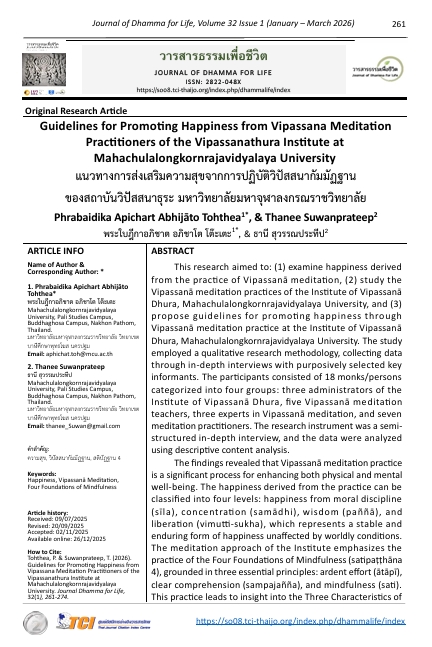
This research aimed to: (1) examine happiness derived from the practice of Vipassanā meditation, (2) study the Vipassanā meditation practices of the Institute of Vipassanā Dhura, Mahachulalongkornrajavidyalaya University, and (3) propose guidelines for promoting happiness through Vipassanā meditation practice at the Institute of Vipassanā Dhura, Mahachulalongkornrajavidyalaya University. The study employed a qualitative research methodology, collecting data through in-depth interviews with purposively selected key informants. The participants consisted of 18 monks/persons categorized into four groups: three administrators of the Institute of Vipassanā Dhura, five Vipassanā meditation teachers, three experts in Vipassanā meditation, and seven meditation practitioners. The research instrument was a semi-structured in-depth interview, and the data were analyzed using descriptive content analysis.
The findings revealed that Vipassanā meditation practice is a significant process for enhancing both physical and mental well-being. The happiness derived from the practice can be classified into four levels: happiness from moral discipline (sīla), concentration (samādhi), wisdom (paññā), and liberation (vimutti-sukha), which represents a stable and enduring form of happiness unaffected by worldly conditions. The meditation approach of the Institute emphasizes the practice of the Four Foundations of Mindfulness (satipaṭṭhāna 4), grounded in three essential principles: ardent effort (ātāpī), clear comprehension (sampajañña), and mindfulness (sati). This practice leads to insight into the Three Characteristics of existence: impermanence (anicca), suffering (dukkha), and non-self (anattā). Furthermore, the promotion of happiness through Vipassanā meditation requires supportive internal and external conditions. The knowledge synthesized from this research comprises seven key components: practice based on the Four Foundations of Mindfulness, internal supportive qualities (ātāpī, sampajañña, and sati), external supportive conditions (sappāya 7), principles of spiritual friendship (kalyāṇamittatā 7), the Five Hindrances (nīvaraṇa 5), the Ten Mental Bondages (palibodha 10), and happiness derived from Vipassanā meditation practice. These factors function as essential mechanisms for cultivating wisdom that enables practitioners to perceive mind and body as they truly are, leading to genuine liberation from suffering and sustainable happiness along the path of the Noble Eightfold Path.
Article Details
References
กรมสุขภาพจิต. (2564). รายงานสถานการณ์สุขภาพจิตของคนไทย. กรุงเทพมหานคร: กระทรวงสาธารณสุข.
เกษมสี สกุลชัยสิริวิช. (2565). การเจริญสติกับการบรรเทานิวรณ์ 5 ในการปฏิบัติวิปัสสนากัมมัฏฐาน. วิทยานิพนธ์พุทธศาสตรมหาบัณฑิต, มหาวิทยาลัยมหาจุฬาลงกรณราชวิทยาลัย.
ปิยะดี ประเสริฐสม, และคณะ. (2566). ผลของการปฏิบัติวิปัสสนากัมมัฏฐานต่อคลื่นสมองของผู้ปฏิบัติ. วารสารพุทธจิตวิทยาและสังคมศาสตร์, 8(2), 45–60.
พรรณราย รัตนไพฑูรย์. (2554). สติปัฏฐาน 4: ทางสายเอกเพื่อการพัฒนาจิตและปัญญา. กรุงเทพฯ: สำนักพิมพ์มหาจุฬาลงกรณราชวิทยาลัย.
พระกิตติธัช ถาวรธมฺโม. (2558). บทบาทของกัลยาณมิตรต่อการพัฒนาอริยมรรคมีองค์ 8. วิทยานิพนธ์พุทธศาสตรมหาบัณฑิต, มหาวิทยาลัยมหาจุฬาลงกรณราชวิทยาลัย.
พระครูปิยวัชราภรณ์ (ประทีป ปญฺญาทีโป). (2558). สิ่งแวดล้อมที่เอื้อต่อการปฏิบัติวิปัสสนากัมมัฏฐานตามหลักสัปปายะ 7. วิทยานิพนธ์พุทธศาสตรมหาบัณฑิต, มหาวิทยาลัยมหาจุฬาลงกรณราชวิทยาลัย.
พระไตรปิฎกภาษาไทย ฉบับมหาจุฬาลงกรณราชวิทยาลัย. (2539). กรุงเทพมหานคร: โรงพิมพ์มหาจุฬาลงกรณราชวิทยาลัย.
พระพรหมคุณาภรณ์ (ป.อ. ปยุตฺโต). (2556). พุทธธรรม (พิมพ์ครั้งที่ 35). กรุงเทพมหานคร: โรงพิมพ์มหาจุฬาลงกรณราชวิทยาลัย.
พระพรหมมังคลาจารย์ (ปัญญานันทภิกขุ). (2555). วิปัสสนากัมมัฏฐาน: หลักการและการปฏิบัติ. กรุงเทพมหานคร: ธรรมสภา.
พระอธิการอภิสิทธิ์ จารธมฺโม. (2561). การตัดปลิโพธกับการเจริญสมาธิในวิปัสสนากัมมัฏฐาน. วิทยานิพนธ์พุทธศาสตรมหาบัณฑิต, มหาวิทยาลัยมหาจุฬาลงกรณราชวิทยาลัย.
พุทธโฆสาจารย์. (2554). วิสุทธิมรรค (สมเด็จพระพุฒาจารย์ [อาจ อาสภมหาเถระ], ผู้แปล). กรุงเทพมหานคร: มหามกุฏราชวิทยาลัย.
ศศิญดา ธนยศโสภณ. (2558). ผลการเข้าร่วมโครงการพัฒนาจิตเพื่อพ่อ 97 ต่อการเปลี่ยนแปลงด้านจิตใจและพฤติกรรมของผู้เข้าร่วม. วิทยานิพนธ์พุทธศาสตรมหาบัณฑิต, มหาวิทยาลัยมหาจุฬาลงกรณราชวิทยาลัย.
อเนก นาคะบุตร. (2561). การเปลี่ยนแปลงทางสังคมไทยในยุคโลกาภิวัตน์. กรุงเทพมหานคร: สำนักพิมพ์แห่งจุฬาลงกรณ์มหาวิทยาลัย.
Epstein, M. (1995). Thoughts without a thinker: Psychotherapy from a Buddhist perspective. New York, NY: Basic Books.
