Potential Efficacy of Brief Intervention for Risk of Substance Use among Thai Conscripts in Prachinburi Province
Article Sidebar
Main Article Content
Abstract
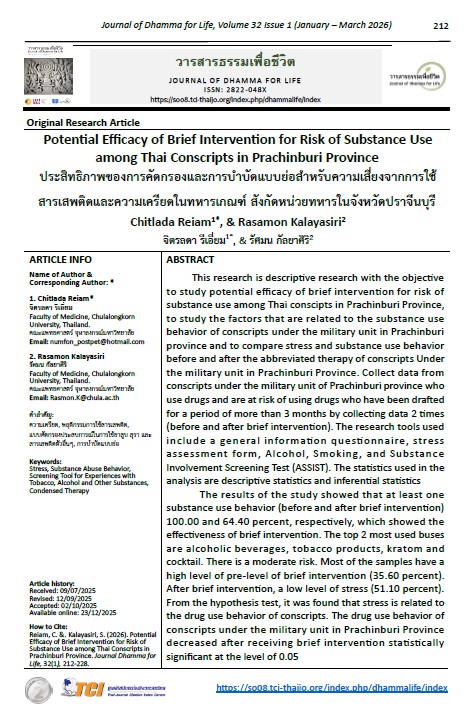
This research is descriptive research with the objective to study potential efficacy of brief intervention for risk of substance use among Thai conscipts in Prachinburi Province, to study the factors that are related to the substance use behavior of conscripts under the military unit in Prachinburi province and to compare stress and substance use behavior before and after the abbreviated therapy of conscripts Under the military unit in Prachinburi Province. Collect data from conscripts under the military unit of Prachinburi province who use drugs and are at risk of using drugs who have been drafted for a period of more than 3 months by collecting data 2 times (before and after brief intervention). The research tools used include a general information questionnaire, stress assessment form, Alcohol, Smoking, and Substance Involvement Screening Test (ASSIST). The statistics used in the analysis are descriptive statistics and inferential statistics
The results of the study showed that at least one substance use behavior (before and after brief intervention) 100.00 and 64.40 percent, respectively, which showed the effectiveness of brief intervention. The top 2 most used buses are alcoholic beverages, tobacco products, kratom and cocktail. There is a moderate risk. Most of the samples have a high level of pre-level of brief intervention (35.60 percent). After brief intervention, a low level of stress (51.10 percent). From the hypothesis test, it was found that stress is related to the drug use behavior of conscripts. The drug use behavior of conscripts under the military unit in Prachinburi Province decreased after receiving brief intervention statistically significant at the level of 0.05
Article Details
References
กนิษฐา ไทยกล้า. (2565). สถานการณ์ยาเสพติดในประเทศไทยและแนวโน้มการแพร่ระบาด. กรุงเทพฯ: สำนักงานคณะกรรมการป้องกันและปราบปรามยาเสพติด.
กุนนที นวลสุวรรณ. (2555). ความเครียด และวิธีการเผชิญความเครียดของพลทหารใหม่. วารสารพยาบาล ทหารบก 2555; 132: 72-81.
คณิน จินตนาปราโมทย์, และพรชัย สิทธิศรัณย์กุล. (2562). ความเครียดและปัจจัยที่เกี่ยวข้องกับการใช้สารเสพติดในทหารเกณฑ์. วารสารสุขภาพจิตแห่งประเทศไทย, 27(3), 45–58.
พัชรี. (2563). ความเครียดและพฤติกรรมการใช้สารเสพติดของทหารและบุคลากรด้านความมั่นคง. วารสารวิจัยด้านสุขภาพจิตและสังคม, 11(2), 45–58.
พาตีเมาะ นิมา, และคณะ. (2561). การพัฒนาและประเมินผลแบบคัดกรอง ASSIST ในประชากรไทย. วารสารการพยาบาลและสุขภาพ, 12(2), 89–103.
วราภรณ์. (2561). อิทธิพลของบริบทชุมชนต่อพฤติกรรมการใช้สารเสพติด. วารสารสาธารณสุขชุมชน, 10(1), 55–68.
โรงเรียนรัชชประภาวิทยาคม. (2562). รายงานผลการสำรวจสถานการณ์การใช้สารเสพติดในประเทศไทย ปี 2562. กรุงเทพฯ: ผู้จัดทำ.
สำนักงานกองทุนสนับสนุนการสร้างเสริมสุขภาพ (สสส.). (2554). คู่มือการคัดกรองและบำบัดแบบย่อด้วย ASSIST สำหรับบุคลากรสุขภาพ. กรุงเทพฯ: สสส.
สมชาย, ร., ธนพล, ว., และกมล, น. (2562). ปัจจัยทางเศรษฐกิจที่สัมพันธ์กับการใช้สารเสพติดของกลุ่มแรงงานและทหารเกณฑ์. วารสารสังคมศาสตร์และพฤติกรรมศาสตร์, 14(3), 23–39.
สุพัตรา, ก., สมบัติ, ข., และนฤมล, จ. (2564). ผลของการบำบัดแบบย่อต่อความเครียดและพฤติกรรมการใช้สารเสพติด. วารสารการพยาบาลและการสาธารณสุข, 35(1), 89–102.
สุรศักดิ์, พ., อนันต์, ช., และวิภา, ส. (2560). พัฒนาการมนุษย์กับพฤติกรรมเสี่ยงในวัยผู้ใหญ่ตอนต้น. กรุงเทพฯ: สำนักพิมพ์มหาวิทยาลัย.
Humeniuk, R. E., Dennington, V., & Ali, R. L. (2008). The Alcohol, Smoking and Substance Involvement Screening Test (ASSIST): Manual for use in primary care. Geneva: World Health Organization.
Lazarus, R. S., & Folkman, S. (1984). Stress, appraisal, and coping. New York: Springer Publishing Company.
Miller, W. R., & Rollnick, S. (2013). Motivational interviewing: Helping people change (3rd ed.). New York: Guilford Press.
World Health Organization. (2014). Social determinants of health. Geneva: World Health Organization.
