Approach Development Well-Being of The Elderly with Vipassana Mebitation of School for Eldrly, Nonglan, Tamaka District, Kanchanaburi Province
Article Sidebar
Main Article Content
Abstract
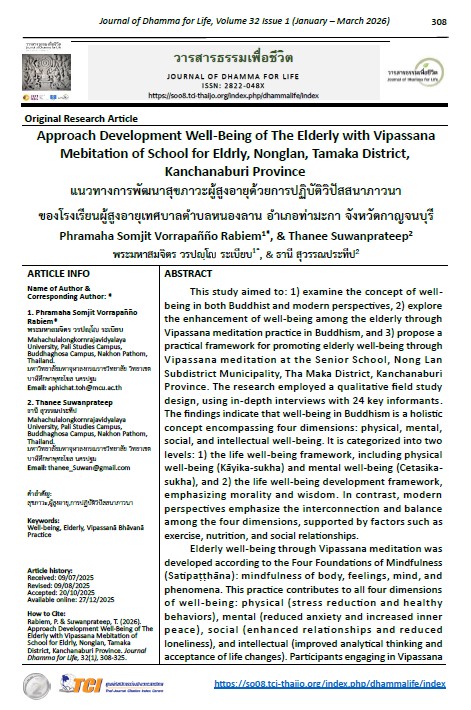
This study aimed to: 1) examine the concept of well-being in both Buddhist and modern perspectives, 2) explore the enhancement of well-being among the elderly through Vipassana meditation practice in Buddhism, and 3) propose a practical framework for promoting elderly well-being through Vipassana meditation at the Senior School, Nong Lan Subdistrict Municipality, Tha Maka District, Kanchanaburi Province. The research employed a qualitative field study design, using in-depth interviews with 24 key informants. The findings indicate that well-being in Buddhism is a holistic concept encompassing four dimensions: physical, mental, social, and intellectual well-being. It is categorized into two levels: 1) the life well-being framework, including physical well-being (Kāyika-sukha) and mental well-being (Cetasika-sukha), and 2) the life well-being development framework, emphasizing morality and wisdom. In contrast, modern perspectives emphasize the interconnection and balance among the four dimensions, supported by factors such as exercise, nutrition, and social relationships.
Elderly well-being through Vipassana meditation was developed according to the Four Foundations of Mindfulness (Satipaṭṭhāna): mindfulness of body, feelings, mind, and phenomena. This practice contributes to all four dimensions of well-being: physical (stress reduction and healthy behaviors), mental (reduced anxiety and increased inner peace), social (enhanced relationships and reduced loneliness), and intellectual (improved analytical thinking and acceptance of life changes). Participants engaging in Vipassana meditation exhibited better health, improved emotional regulation, positive social interactions, and adaptability to life transitions. Based on these findings, a practical model, the PMSI Model (Physical, Mental, Social, Intelligence Well-Being), integrated with continuous mindfulness practice, is proposed as a framework for promoting elderly well-being.
Article Details
References
สำนักงานสถิติแห่งชาติ. (2553). โครงสร้างทางอายุและเพศของประชากรไทย. กรุงเทพฯ: สำนักงานสถิติแห่งชาติ.
สำนักงานสถิติแห่งชาติ. (2565). ประชากรไทย พ.ศ. 2565. กรุงเทพฯ: สำนักงานสถิติแห่งชาติ.
นางสาวพรประภา สุทธิจิตร. (2563). เรื่องการเสริมสร้างสุขภาวะองค์รวมของผู้สูงอายุโดยการรำไทเก๊กเชิงพุทธบูรณาการ [วิทยานิพนธ์ปริญญาโท]. มหาวิทยาลัยมหาสารคาม.
พระไตรปิฎกภาษาไทย ฉบับมหาจุฬาลงกรณราชวิทยาลัย. (2539). กรุงเทพมหานคร: โรงพิมพ์มหาจุฬาลงกรณราชวิทยาลัย.
พระครูสุวรรณจันทกิจ (สมพร จนทสุวณุโณ). (2562). เรื่องการประยุกต์ใช้หลักสติปัฏฐาน 4 ในการปฏิบัติธรรมของชุมชนตำบลโนนสว่าง อำเภอเมือง จังหวัดบึงกาฬ [วิทยานิพนธ์ปริญญาโท]. มหาวิทยาลัยมหาสารคาม.
พระวิมาน คมฺภีรปญฺโญ. (2564). พัฒนาแนวทางการส่งเสริมสุขภาวะเชิงพุทธในสถานการณ์การแพร่ระบาดโรคโควิด 19 ของพระสงฆ์อำเภอกันทรวิชัย จังหวัดมหาสารคาม [วิทยานิพนธ์ปริญญาโท]. มหาวิทยาลัยมหาสารคาม.
Chiesa, A., & Serretti, A. (2010). A systematic review of mindfulness-based interventions in healthy people. Psychology and Health, 25(7), 773–792. https://doi.org/10.1080/08870440903430097
Creswell, J. D. (2017). Mindfulness interventions. Annual Review of Psychology, 68, 491–516. https://doi.org/10.1146/annurev-psych-042716-051139
Diener, E., Oishi, S., & Lucas, R. E. (2018). Subjective well-being: The science of happiness and life satisfaction. In Handbook of Well-Being. Noba Scholar.
Grossman, P., Niemann, L., Schmidt, S., & Walach, H. (2004). Mindfulness-based stress reduction and health benefits: A meta-analysis. Journal of Psychosomatic Research, 57(1), 35–43. https://doi.org/10.1016/S0022-3999(03)00573-7
Kabat-Zinn, J. (1990). Full catastrophe living: Using the wisdom of your body and mind to face stress, pain, and illness. New York: Delacorte.
Kabat-Zinn, J. (2003). Mindfulness-based interventions in context: Past, present, and future. Clinical Psychology: Science and Practice, 10(2), 144–156. https://doi.org/10.1093/clipsy.bpg016
Kusala, S., Dhammika, K., & Anuradha, W. (2019). Buddhist perspectives on holistic well-being. Asian Journal of Social Science, 47(2), 135–154.
Nāgārjuna. (2015). The Four Foundations of Mindfulness (Satipaṭṭhāna). In Mindfulness in Buddhist Practice. Oxford University Press.
Park, N. S. (2013). The role of social engagement in promoting well-being among older adults. Journal of Aging and Health, 25(5), 789–811. https://doi.org/10.1177/0898264313497507
Ryff, C. D., & Singer, B. (2008). Know thyself and become what you are: A eudaimonic approach to psychological well-being. Journal of Happiness Studies, 9(1), 13–39. https://doi.org/10.1007/s10902-006-9019-0
Tang, Y. Y., Ma, Y., Wang, J., Fan, Y., Feng, S., Lu, Q., … & Posner, M. I. (2007). Short-term meditation training improves attention and self-regulation. Proceedings of the National Academy of Sciences, 104(43), 17152–17156. https://doi.org/10.1073/pnas.0707678104
World Health Organization. (2011). Global health and aging. Geneva: WHO.
