The Model of Paṭiccasamuppāda Observing for Advanced Vipassana Meditation Practice at Dhammamoli Meditation Center, Pak Chong District, Nakhon Ratchasima Province
Article Sidebar
Main Article Content
Abstract
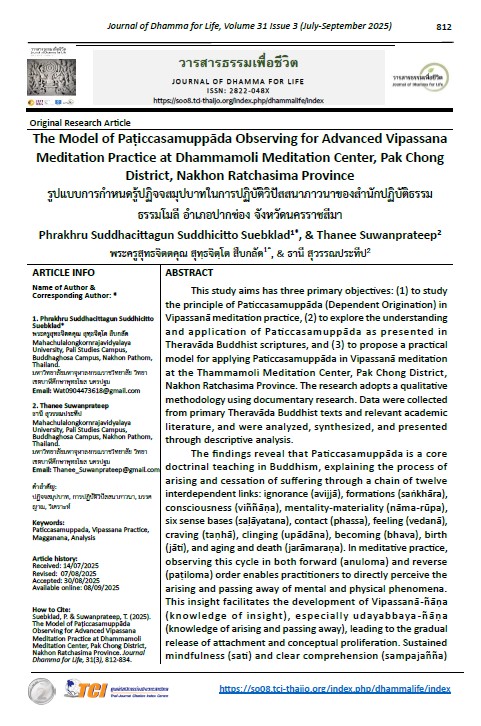
This study aims has three primary objectives: (1) to study the principle of Paticcasamuppāda (Dependent Origination) in Vipassanā meditation practice, (2) to explore the understanding and application of Paticcasamuppāda as presented in Theravāda Buddhist scriptures, and (3) to propose a practical model for applying Paticcasamuppāda in Vipassanā meditation at the Thammamoli Meditation Center, Pak Chong District, Nakhon Ratchasima Province. The research adopts a qualitative methodology using documentary research. Data were collected from primary Theravāda Buddhist texts and relevant academic literature, and were analyzed, synthesized, and presented through descriptive analysis.
The findings reveal that Paticcasamuppāda is a core doctrinal teaching in Buddhism, explaining the process of arising and cessation of suffering through a chain of twelve interdependent links: ignorance (avijjā), formations (saṅkhāra), consciousness (viññāṇa), mentality-materiality (nāma-rūpa), six sense bases (saḷāyatana), contact (phassa), feeling (vedanā), craving (taṇhā), clinging (upādāna), becoming (bhava), birth (jāti), and aging and death (jarāmaraṇa). In meditative practice, observing this cycle in both forward (anuloma) and reverse (paṭiloma) order enables practitioners to directly perceive the arising and passing away of mental and physical phenomena. This insight facilitates the development of Vipassanā-ñāṇa (knowledge of insight), especially udayabbaya-ñāṇa (knowledge of arising and passing away), leading to the gradual release of attachment and conceptual proliferation. Sustained mindfulness (sati) and clear comprehension (sampajañña) based on the Four Foundations of Mindfulness—body, feelings, mind, and mental objects—support this process. Ultimately, such practice can culminate in the realization of the Noble Path (magga), fruition (phala), and Nibbāna.
