Guidelines for Practicing Vipassana Meditation According to the Principles of Bodhipakkhiyadhamma
Article Sidebar
Main Article Content
Abstract
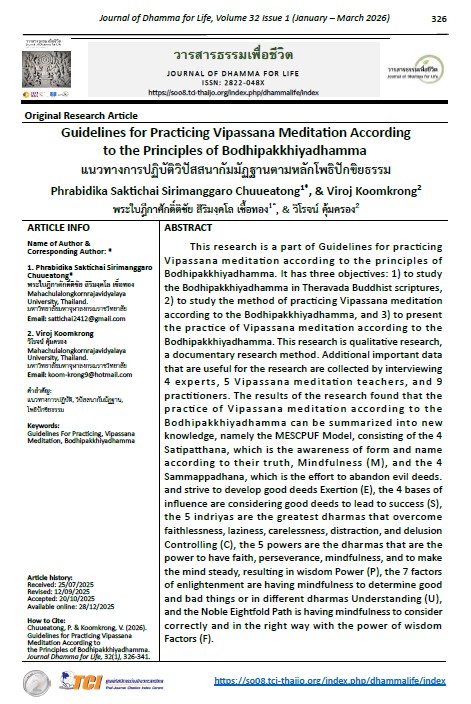
This research is a part of Guidelines for practicing Vipassana meditation according to the principles of Bodhipakkhiyadhamma. It has three objectives: 1) to study the Bodhipakkhiyadhamma in Theravada Buddhist scriptures, 2) to study the method of practicing Vipassana meditation according to the Bodhipakkhiyadhamma, and 3) to present the practice of Vipassana meditation according to the Bodhipakkhiyadhamma. This research is qualitative research, a documentary research method. Additional important data that are useful for the research are collected by interviewing 4 experts, 5 Vipassana meditation teachers, and 9 practitioners. The results of the research found that the practice of Vipassana meditation according to the Bodhipakkhiyadhamma can be summarized into new knowledge, namely the MESCPUF Model, consisting of the 4 Satipatthana, which is the awareness of form and name according to their truth, Mindfulness (M), and the 4 Sammappadhana, which is the effort to abandon evil deeds. and strive to develop good deeds Exertion (E), the 4 bases of influence are considering good deeds to lead to success (S), the 5 indriyas are the greatest dharmas that overcome faithlessness, laziness, carelessness, distraction, and delusion Controlling (C), the 5 powers are the dharmas that are the power to have faith, perseverance, mindfulness, and to make the mind steady, resulting in wisdom Power (P), the 7 factors of enlightenment are having mindfulness to determine good and bad things or in different dharmas Understanding (U), and the Noble Eightfold Path is having mindfulness to consider correctly and in the right way with the power of wisdom Factors (F).
Article Details
References
พระไตรปิฎก. (2545). ฉบับมหาจุฬาลงกรณราชวิทยาลัย. กรุงเทพฯ: มหาจุฬาลงกรณราชวิทยาลัย.
มหามกุฏราชวิทยาลัย. (2550). พระไตรปิฎกฉบับมหามกุฏ. กรุงเทพฯ: มหามกุฏราชวิทยาลัย.
พระไตรปิฎก (2540). มหาปรินิพพานสูตร. กรุงเทพฯ: มูลนิธิพระไตรปิฎก.
พระพุทธโฆสาจารย์. (2542). วิสุทธิมรรค. กรุงเทพฯ: มหาจุฬาลงกรณราชวิทยาลัย.
พระพรหมคุณาภรณ์ (ป.อ. ปยุตฺโต). (2556). โพธิปักขิยธรรม: แนวทางการพัฒนาจิตใจและปัญญา. กรุงเทพฯ: มหาจุฬาลงกรณราชวิทยาลัย.
พระพรหมคุณาภรณ์ (ป.อ. ปยุตฺโต). (2557). วิปัสสนากัมมัฏฐาน: การพัฒนาปัญญาในพระพุทธศาสนาเถรวาท. กรุงเทพฯ: มหาจุฬาลงกรณราชวิทยาลัย.
วศิน อินทสระ. (2547). จริยศาสตร์เชิงพุทธ: การปฏิบัติและหลักการ. กรุงเทพฯ: สำนักพิมพ์ธรรมสภา.
อนาลโย. (2549). สติปัฏฐานกับการเจริญปัญญาเชิงวิปัสสนา. กรุงเทพฯ: สำนักพิมพ์มหาจุฬาลงกรณราชวิทยาลัย.
Analayo, B. (2003). Satipaṭṭhāna: The direct path to realization. Birmingham: Windhorse Publications.
Bhikkhu Bodhi. (2005). In the Buddha’s words: An anthology of discourses from the Pāli Canon. Boston: Wisdom Publications.
Kabat-Zinn, J. (2003). Mindfulness-Based Stress Reduction (MBSR). New York: Guilford Press.
Ñāṇamoli, B., & Bodhi, B. (1995). The Middle Length Discourses of the Buddha: A Translation of the Majjhima Nikāya. Boston: Wisdom Publications.
Wilber, K. (2000). A Theory of Everything: An Integral Vision for Business, Politics, Science, and Spirituality. Boston: Shambhala.
