Guidelines for the Management of Educational Learning Resources of School Under Phra Nakorn Si Ayutthaya Secondary Educational Service Area
Article Sidebar
Main Article Content
Abstract
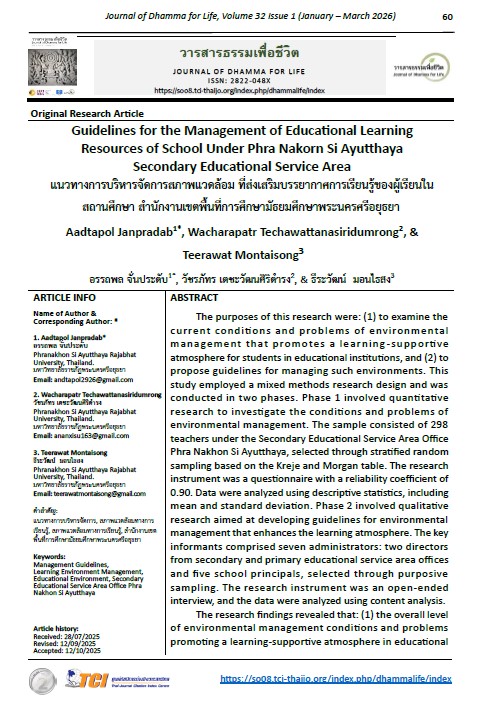
The purposes of this research were: (1) to examine the current conditions and problems of environmental management that promotes a learning-supportive atmosphere for students in educational institutions, and (2) to propose guidelines for managing such environments. This study employed a mixed methods research design and was conducted in two phases. Phase 1 involved quantitative research to investigate the conditions and problems of environmental management. The sample consisted of 298 teachers under the Secondary Educational Service Area Office Phra Nakhon Si Ayutthaya, selected through stratified random sampling based on the Kreje and Morgan table. The research instrument was a questionnaire with a reliability coefficient of 0.90. Data were analyzed using descriptive statistics, including mean and standard deviation. Phase 2 involved qualitative research aimed at developing guidelines for environmental management that enhances the learning atmosphere. The key informants comprised seven administrators: two directors from secondary and primary educational service area offices and five school principals, selected through purposive sampling. The research instrument was an open-ended interview, and the data were analyzed using content analysis.
The research findings revealed that: (1) the overall level of environmental management conditions and problems promoting a learning-supportive atmosphere in educational institutions was at a high level. Among the dimensions, safety had the highest mean score, followed by teaching and learning, while landscape management had the lowest mean score. (2) The guidelines for environmental management that promote a learning-supportive atmosphere consisted of six dimensions: facilities and buildings, landscape, safety, interpersonal interactions, teaching and learning, and management. These guidelines serve as essential strategies for improving educational environments that effectively and sustainably support student learning.
Article Details
References
เฉลิมชัย หาญกล้า. (2559). การวิจัยทางการศึกษา: แนวคิดและการประยุกต์ใช้ในชั้นเรียน. กรุงเทพฯ: โรงพิมพ์มหาวิทยาลัย.
ณิศศา ณภาส์ณัฐ. (2558). แนวทางการสร้างสภาพแวดล้อมที่เอื้อต่อการเรียนรู้ของผู้เรียน. เชียงใหม่: มหาวิทยาลัยเชียงใหม่.
ประวีณา โภควณิช. (2559). ความร่วมมือระหว่างบุคลากรและชุมชนกับประสิทธิภาพการจัดการศึกษา. กรุงเทพฯ: สำนักพิมพ์การศึกษาไทย.
ประยูร อนันต๊ะ. (2559). การพัฒนาทรัพยากรมนุษย์และสภาพแวดล้อมเพื่อการเรียนรู้ในสถานศึกษา. กรุงเทพฯ: สำนักพิมพ์การศึกษา.
พรรณี ลีกิจวัฒนะ. (2566). ระเบียบวิธีวิจัยสำหรับนักศึกษาและนักวิจัย (พิมพ์ครั้งที่ 1). กรุงเทพฯ: สำนักพิมพ์มหาวิทยาลัยเกษตรศาสตร์.
ไพศาล วรคำ. (2559). การวิจัยเชิงปริมาณสำหรับการศึกษา (พิมพ์ครั้งที่ 1). กรุงเทพฯ: สำนักพิมพ์แห่งจุฬาลงกรณ์มหาวิทยาลัย.
วรปภา โพธิ์สุ. (2556). การพัฒนาความร่วมมือในสถานศึกษาเพื่อส่งเสริมการเรียนรู้ของผู้เรียน. นนทบุรี: มหาวิทยาลัยสุโขทัยธรรมาธิราช.
สำนักงานเขตพื้นที่การศึกษามัธยมศึกษาพระนครศรีอยุธยา. (2567). ข้อมูลสารสนเทศของข้าราชการครูในสังกัด สพม.พระนครศรีอยุธยา. พระนครศรีอยุธยา: สำนักงานเขตพื้นที่การศึกษามัธยมศึกษา.
สำนักงานเขตพื้นที่การศึกษามัธยมศึกษาพระนครศรีอยุธยา. (2567). รายงานสภาพและปัญหาการบริหารจัดการสภาพแวดล้อมในสถานศึกษา. พระนครศรีอยุธยา: สำนักงานเขตพื้นที่การศึกษา.
สำนักงานเลขาธิการสภาการศึกษา. (2560). แผนพัฒนาการศึกษาแห่งชาติ ฉบับที่ 12 (พ.ศ. 2560–2564). กรุงเทพฯ: สำนักงานเลขาธิการสภาการศึกษา.
Astin, A. W. (1971). Predicting academic success: The role of the environment. San Francisco: Jossey-Bass.
Bronfenbrenner, U. (1979). The ecology of human development: Experiments by nature and design. Cambridge, MA: Harvard University Press.
Dewey, J. (1938). Experience and education. New York: Macmillan.
Fayol, H. (1949). General and industrial management (C. Storrs, Trans.). London: Pitman. (Original work published 1916)
Good, C. V. (1973). Dictionary of education (3rd ed.). New York: McGraw-Hill.
Lewin, K. (1951). Field theory in social science: Selected theoretical papers. New York: Harper & Row.
Maslow, A. H. (1954). Motivation and personality. New York: Harper & Row.
Moos, R. H. (1979). Evaluating educational environments: Procedures, measures, findings, and policy implications. San Francisco: Jossey-Bass.
Vygotsky, L. S. (1978). Mind in society: The development of higher psychological processes. Cambridge, MA: Harvard University Press.
