The Approach of Enhncement on Sima's Value Recognition for Sangha Performance Based on Vinaya's Discipline
Article Sidebar
Main Article Content
Abstract
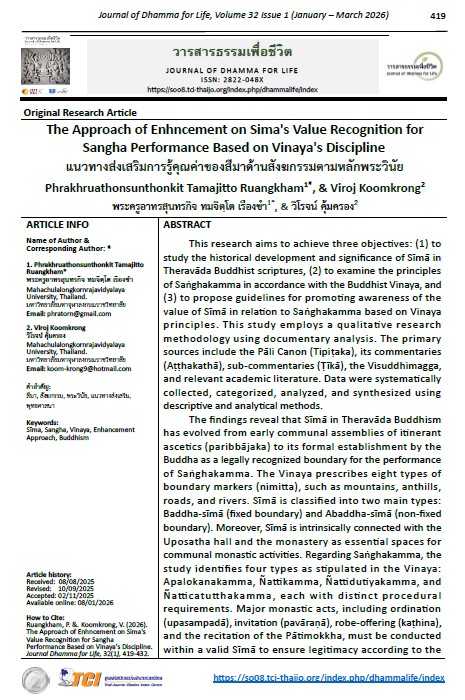
This research aims to achieve three objectives: (1) to study the historical development and significance of Sīmā in Theravāda Buddhist scriptures, (2) to examine the principles of Saṅghakamma in accordance with the Buddhist Vinaya, and (3) to propose guidelines for promoting awareness of the value of Sīmā in relation to Saṅghakamma based on Vinaya principles. This study employs a qualitative research methodology using documentary analysis. The primary sources include the Pāli Canon (Tipiṭaka), its commentaries (Aṭṭhakathā), sub-commentaries (Ṭīkā), the Visuddhimagga, and relevant academic literature. Data were systematically collected, categorized, analyzed, and synthesized using descriptive and analytical methods.
The findings reveal that Sīmā in Theravāda Buddhism has evolved from early communal assemblies of itinerant ascetics (paribbājaka) to its formal establishment by the Buddha as a legally recognized boundary for the performance of Saṅghakamma. The Vinaya prescribes eight types of boundary markers (nimitta), such as mountains, anthills, roads, and rivers. Sīmā is classified into two main types: Baddha-sīmā (fixed boundary) and Abaddha-sīmā (non-fixed boundary). Moreover, Sīmā is intrinsically connected with the Uposatha hall and the monastery as essential spaces for communal monastic activities. Regarding Saṅghakamma, the study identifies four types as stipulated in the Vinaya: Apalokanakamma, Ñattikamma, Ñattidutiyakamma, and Ñatticatutthakamma, each with distinct procedural requirements. Major monastic acts, including ordination (upasampadā), invitation (pavāraṇā), robe-offering (kaṭhina), and the recitation of the Pātimokkha, must be conducted within a valid Sīmā to ensure legitimacy according to the Buddha’s authorization. Furthermore, the research proposes five key approaches to enhancing awareness of the value of Sīmā: fostering communal harmony and respect for seniority, ensuring Vinaya correctness in monastic procedures, upholding the Buddha’s disciplinary legislation, aligning Saṅghakamma with appropriate procedural forms, and strengthening the sustainability of Buddhism. These insights culminate in the development of the “SS–UDRCL Model,” a new body of knowledge that can be applied to monastery management, Sīmā development, and the sustainable cultivation of awareness regarding the significance of Sīmā in Theravāda Buddhism.
Article Details
References
กรมศาสนา. (2561). การส่งเสริมและทำนุบำรุงพระพุทธศาสนาในสังคมไทย. กรุงเทพมหานคร: กรมศาสนา กระทรวงวัฒนธรรม.
มหาวิทยาลัยมหาจุฬาลงกรณราชวิทยาลัย. (2539). พระไตรปิฏกภาษาไทย ฉบับมหาจุฬาลงกรณราชวิทยาลัย. กรุงเทพมหานคร: โรงพิมพ์ มหาจุฬาลงกรณราชวิทยาลัย..
พระครูพิทักษ์ศิลปาคม (นุชิต วชิรวุฑฺโฒ). (2563). พระสงฆ์กับงานสังคมสงเคราะห์ในสังคมไทย. วารสารสหวิทยาการมนุษยศาสตร์และสังคมศาสตร์, 3(1), 105 – 114.
พระธรรมโกศาจารย์ (ป.อ. ปยุตฺโต). (2555). สังคหวัตถุ 4 กับการพัฒนาสังคม. กรุงเทพฯ: มูลนิธิพุทธธรรม.
พระพรหมคุณาภรณ์ (ป.อ. ปยุตฺโต). (2554). พระพุทธศาสนากับวินัยสงฆ์. กรุงเทพมหานคร: สำนักพิมพ์มูลนิธิพุทธธรรม.
พระธรรมปิฎก (ป.อ. ปยุตฺโต). (2541). พระวินัยปิฎก: หลักการและความหมายของสังฆกรรม. กรุงเทพฯ: มหาจุฬาลงกรณราชวิทยาลัย.
พระสนิท สุจิตฺโต (ท้วมดี). (2020). การอนุรักษ์โบราณสถาน โบราณวัตถุ และศิลปวัตถุของวัดขนอนอำเภอโพธาราม. วารสาร มจร สังคมศาสตร์ปริทรรศน์, 6(2-02), 531–542. สืบค้น จาก https://so03.tci-thaijo.org/index.php/jssr/article/view/242195.
สำนักส่งเสริมพระพุทธศาสนา. (2562). แนวทางการบริหารจัดการวัดและพื้นที่ศาสนสถาน. กรุงเทพมหานคร: สำนักส่งเสริมพระพุทธศาสนาแห่งชาติ.
Dhammika, S. (1992). Good Question, Good Answer. Singapore: Buddha Dhamma Mandala Society.
Gethin, R. (1998). The Foundations of Buddhism. Oxford: Oxford University Press.
Gombrich, R. H. (1988). Theravāda Buddhism: A Social History from Ancient Benares to Modern Colombo. London: Routledge.
Keown, D. (2005). Buddhist Ethics: A Very Short Introduction. Oxford: Oxford University Press.
Keown, D. (2013). Buddhism: A Very Short Introduction (2nd ed.). Oxford: Oxford University Press.
Luce, H. (1988). Moral Philosophy and Social Responsibility. London: Routledge.
Narada, M. (2006). The Buddha and His Teachings. Taipei: Corporate Body of the Buddha Educational Foundation.
Phan, P. C. (2011). Socially Engaged Buddhism. New York: Orbis Books.
Putnam, R. D. (2000). Bowling Alone: The Collapse and Revival of American Community. New York: Simon & Schuster.
Rahula, W. (1978). What the Buddha Taught. New York: Grove Press.
Wijeyaratne, W. A. (2014). Buddhist Social Ethics. Colombo: Buddhist Cultural Centre.
