An Analytical Study of Relationship of Kamma and Saṃsāra in Theravāda Buddhism
Article Sidebar
Main Article Content
Abstract
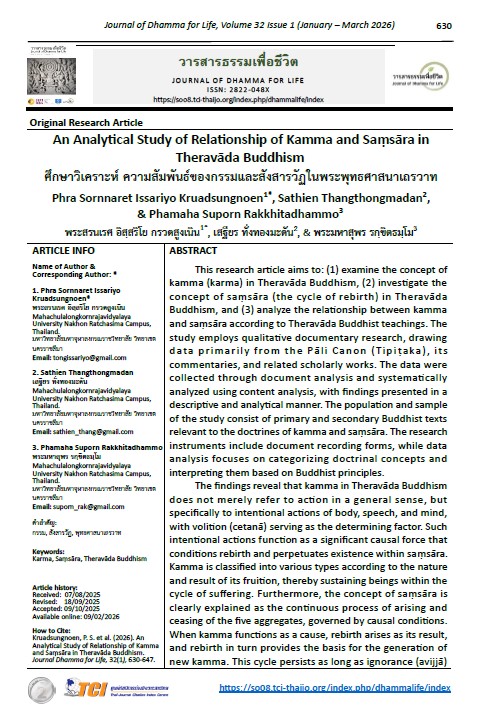
This research article aims to: (1) examine the concept of kamma (karma) in Theravāda Buddhism, (2) investigate the concept of saṃsāra (the cycle of rebirth) in Theravāda Buddhism, and (3) analyze the relationship between kamma and saṃsāra according to Theravāda Buddhist teachings. The study employs qualitative documentary research, drawing data primarily from the Pāli Canon (Tipiṭaka), its commentaries, and related scholarly works. The data were collected through document analysis and systematically analyzed using content analysis, with findings presented in a descriptive and analytical manner. The population and sample of the study consist of primary and secondary Buddhist texts relevant to the doctrines of kamma and saṃsāra. The research instruments include document recording forms, while data analysis focuses on categorizing doctrinal concepts and interpreting them based on Buddhist principles.
The findings reveal that kamma in Theravāda Buddhism does not merely refer to action in a general sense, but specifically to intentional actions of body, speech, and mind, with volition (cetanā) serving as the determining factor. Such intentional actions function as a significant causal force that conditions rebirth and perpetuates existence within saṃsāra. Kamma is classified into various types according to the nature and result of its fruition, thereby sustaining beings within the cycle of suffering. Furthermore, the concept of saṃsāra is clearly explained as the continuous process of arising and ceasing of the five aggregates, governed by causal conditions. When kamma functions as a cause, rebirth arises as its result, and rebirth in turn provides the basis for the generation of new kamma. This cycle persists as long as ignorance (avijjā) and craving (taṇhā) remain operative. The analysis demonstrates that kamma and saṃsāra are intrinsically interconnected, with kamma serving as both the cause and driving force of cyclic existence. Understanding this relationship is therefore fundamental to the cultivation of wisdom and the pursuit of liberation from the cycle of suffering in accordance with Theravāda Buddhism.
Article Details
References
มหาจุฬาลงกรณราชวิทยาลัย. (2539). พระไตรปิฎกภาษาไทย ฉบับมหาจุฬาลงกรณราชวิทยาลัย. กรุงเทพฯ: มหาจุฬาลงกรณราชวิทยาลัย.
พระไตรปิฎกภาษาไทย ฉบับมหาจุฬาลงกรณราชวิทยาลัย. เล่มที่ 12. กรุงเทพฯ: มหาจุฬาลงกรณราชวิทยาลัย.
พระไตรปิฎกภาษาไทย ฉบับมหาจุฬาลงกรณราชวิทยาลัย. เล่มที่ 20. กรุงเทพฯ: มหาจุฬาลงกรณราชวิทยาลัย.
พระธรรมกิตติวงศ์ (ทองดี สุรเตโช). (2553). พจนานุกรมเพื่อการศึกษาพุทธศาสน์. กรุงเทพฯ: เลี่ยงเชียง.
พระธรรมปิฎก (ป.อ. ปยุตฺโต). (2542). พุทธธรรม. กรุงเทพฯ: มหามกุฏราชวิทยาลัย.
พระธรรมปิฎก (ป.อ. ปยุตฺโต). (2546). พุทธธรรม: ฉบับปรับปรุงและขยายความ. กรุงเทพฯ: มหาจุฬาลงกรณราชวิทยาลัย.
พระธรรมปิฎก (ป.อ. ปยุตฺโต). (2554). พุทธธรรม ฉบับปรับขยาย. กรุงเทพฯ: โรงพิมพ์มหาจุฬาลงกรณราชวิทยาลัย.
พระพรหมคุณาภรณ์ (ป.อ. ปยุตฺโต). (2538). กรรมตามหลักพระพุทธศาสนา. กรุงเทพฯ: มูลนิธิพุทธธรรม.
พระพรหมคุณาภรณ์ (ป.อ. ปยุตฺโต). (2555). กรรมตามหลักพระพุทธศาสนา. กรุงเทพฯ: มูลนิธิพุทธธรรม.
พระพรหมคุณาภรณ์ (ป.อ. ปยุตฺโต). (2555). นิติธรรมกับกฎแห่งกรรม. กรุงเทพฯ: มูลนิธิพุทธธรรม.
พระพรหมคุณาภรณ์ (ป.อ. ปยุตฺโต). (2558). พุทธธรรมกับการอธิบายสังสารวัฏ. กรุงเทพฯ: มูลนิธิพุทธธรรม.
พระปลัดศานิตย์ นิจฺจงฺคุโณ. (2563). กรรมในทัศนะปรมัตถธรรม. กรุงเทพฯ: สำนักพิมพ์พุทธศาสน์.
สมเด็จพระญาณสังวร สมเด็จพระสังฆราช (เจริญ สุวฑฺฒโน). (2554). หลักกรรมและการดำเนินชีวิต. กรุงเทพฯ: มหามกุฏราชวิทยาลัย.
สุจิตต์ วงษ์เทศ. (2560). พุทธศาสนากับวัฒนธรรมความเชื่อเรื่องสังสารวัฏ. กรุงเทพฯ: สำนักพิมพ์มติชน.
สุภาณี จันทร์งาม. (2560). สมมติสัจจะและปรมัตถสัจจะในพระพุทธศาสนาเถรวาท. กรุงเทพฯ: สำนักพิมพ์แห่งจุฬาลงกรณ์มหาวิทยาลัย.
สุวรรณา สถาอานันท์. (2560). พุทธจริยศาสตร์กับการพัฒนามนุษย์ในสังคมร่วมสมัย. วารสารพุทธศาสน์ศึกษา, 24(2), 1–25.
วศิน อินทสระ. (2558). ปฏิจจสมุปบาท: หลักเหตุปัจจัยในพระพุทธศาสนา. กรุงเทพฯ: ธรรมสภา.
อภิญญา เฟื่องฟู. (2562). ความเชื่อเรื่องกรรมกับพฤติกรรมทางสังคมของชาวพุทธไทย. วารสารสังคมศาสตร์, 31(1), 45–68.
Collins, S. (1998). Nirvana and other Buddhist felicities: Utopias of the Pali imaginaire. Cambridge: Cambridge University Press.
Gombrich, R. (2009). What the Buddha thought. London: Equinox.
Harvey, P. (2013). An introduction to Buddhism: Teachings, history and practices (2nd ed.). Cambridge: Cambridge University Press.
Keown, D. (2016). Buddhist ethics: A very short introduction. Oxford: Oxford University Press.
Payutto, P. A. (2003). Good, evil and beyond: Kamma in the Buddha’s teaching. Bangkok: Buddhadhamma Foundation.
