Improving the Quality of Life of Teachers in Thai Society According to Theravada Buddhist Philosophy
Article Sidebar
Main Article Content
Abstract
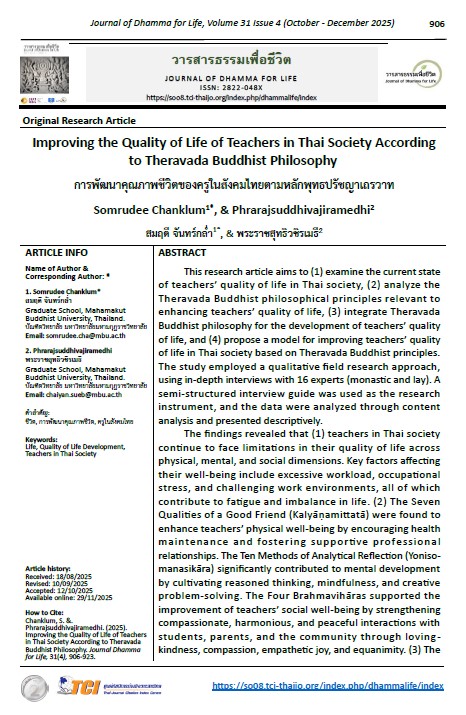
This research article aims to (1) examine the current state of teachers’ quality of life in Thai society, (2) analyze the Theravada Buddhist philosophical principles relevant to enhancing teachers’ quality of life, (3) integrate Theravada Buddhist philosophy for the development of teachers’ quality of life, and (4) propose a model for improving teachers’ quality of life in Thai society based on Theravada Buddhist principles. The study employed a qualitative field research approach, using in-depth interviews with 16 experts (monastic and lay). A semi-structured interview guide was used as the research instrument, and the data were analyzed through content analysis and presented descriptively.
The findings revealed that (1) teachers in Thai society continue to face limitations in their quality of life across physical, mental, and social dimensions. Key factors affecting their well-being include excessive workload, occupational stress, and challenging work environments, all of which contribute to fatigue and imbalance in life. (2) The Seven Qualities of a Good Friend (Kalyāṇamittatā) were found to enhance teachers’ physical well-being by encouraging health maintenance and fostering supportive professional relationships. The Ten Methods of Analytical Reflection (Yoniso-manasikāra) significantly contributed to mental development by cultivating reasoned thinking, mindfulness, and creative problem-solving. The Four Brahmavihāras supported the improvement of teachers’ social well-being by strengthening compassionate, harmonious, and peaceful interactions with students, parents, and the community through loving-kindness, compassion, empathetic joy, and equanimity. (3) The integration of these three sets of Theravada Buddhist principles proved effective in holistically developing teachers’ quality of life, facilitating a balanced relationship between work and personal life, and promoting greater happiness in the teaching profession. The study culminated in the creation of a new knowledge contribution, the “IDD Model,” consisting of: (I) physical development through the Seven Qualities of a Good Friend; (D) mental development through the Ten Methods of Analytical Reflection; and (D) social development through the Four Brahmavihāras. The findings indicate that Theravada Buddhist philosophy holds strong potential for improving teachers’ quality of life in Thai society. Its integrative and holistic nature offers a practical framework that can be applied to teacher development and educational institutions more broadly.
Article Details
References
กองทุนสนับสนุนการสร้างเสริมสุขภาพ (สสส.). (2564). รายงานสถานการณ์สุขภาวะครูไทย. กรุงเทพฯ: สสส.
คุรุสภา. (2562). การพัฒนาคุณภาพชีวิตครูไทย: แนวทางการประยุกต์หลักพุทธปรัชญาเถรวาท. กรุงเทพมหานคร: คุรุสภา.
ฉนฺทโก, พ.ศ. (2562). กัลยาณมิตร: แสงสว่างทางปัญญา. กรุงเทพฯ: สำนักพิมพ์ธรรมสภา.
นาคทอง, ปราณี. (2564). การพัฒนาคุณภาพชีวิตของครูตามหลักพุทธปรัชญาเถรวาท. กรุงเทพฯ: สำนักพิมพ์การศึกษา.
ปราณี นาคทอง และคณะ. (2564). ครูมืออาชีพยุคใหม่ในมุมมองของพุทธศาสนา. วารสารภาวนาสารปริทัศน์, (3), 1-12.
พระศักดิ์ดา ฉนฺทโก, & สมศักดิ์ บุญปู่. (2558). กระบวนการพัฒนาผู้เรียนตามแนวพระพุทธศาสนาในสังคมไทย. วารสารศึกษาศาสตร์ มหาวิทยาลัยนเรศวร, 17(3), 144–153.
พรหมคุณาภรณ์ (ป.อ. ปยุตฺโต). (2545). อริยสัจ 4 และการประยุกต์ในการพัฒนาคุณภาพชีวิต. กรุงเทพฯ: มูลนิธิพุทธธรรม.
พุทธทาสภิกขุ. (2542). พุทธธรรมกับการพัฒนาตนเอง. กรุงเทพฯ: ธรรมสภา.
มาลินี, แสงงาม. (2560). การพัฒนาคุณภาพชีวิตครูในประเทศไทย: แนวทางเชิงองค์รวม. วารสารการศึกษาปริทรรศน์, 12(2), 45–62.
ลังกา, วิ. (2563). หลักพรหมวิหาร 4 ประการกับภาวะผู้นำทางจริยธรรม. วารสารการศึกษาและพัฒนาครู, 12(2), 45–60.
ศิริภา, บุญเกื้อ. (2561). ความสัมพันธ์ทางสังคมและคุณภาพชีวิตครูไทย. วารสารศึกษาศาสตร์มหาวิทยาลัยเชียงใหม่, 36(1), 25–42.
สุมล อมรวิวัฒน์. (2530). แนวคิดเรื่องการคิดอย่างวิจารณญาณและการจัดการเรียนรู้ตามแนวโยนิโสมนสิการ. วารสารศึกษาศาสตร์ มหาวิทยาลัยศิลปากร, 4(1), 35–48.
สุมล อมรวิวัฒน์. (2535). การพัฒนาแนวการเรียนรู้โดยใช้กระบวนการเผชิญสถานการณ์ (รายงานการวิจัย). สำนักงานคณะกรรมการการศึกษาแห่งชาติ.
สำนักงานคณะกรรมการพัฒนาเศรษฐกิจและสังคมแห่งชาติ. (2561). แผนพัฒนาเศรษฐกิจและสังคมแห่งชาติ ฉบับที่ 13. กรุงเทพฯ: สำนักงานคณะกรรมการพัฒนาเศรษฐกิจและสังคมแห่งชาติ.
สำนักงานเลขาธิการสภาการศึกษา. (2559). พระราชดำรัสเกี่ยวกับการพัฒนาทรัพยากรมนุษย์. กรุงเทพมหานคร: สำนักงานเลขาธิการสภาการศึกษา.
อมรวิวัฒน์, ส. (2559). โยนิโสมนสิการ: การเรียนรู้เชิงลึกเพื่อชีวิตที่สมบูรณ์. เชียงใหม่: มหาวิทยาลัยเชียงใหม่.
Becker, G. S. (1993). Human capital: A theoretical and empirical analysis, with special reference to education (3rd ed.). University of Chicago Press.
Chittapanyo, P. (2018). The effects of mindfulness-based program on stress and job satisfaction among teachers in Thailand. Chulalongkorn University, Bangkok.
Deci, E. L., & Ryan, R. M. (2000). The “what” and “why” of goal pursuits: Human needs and the self-determination of behavior. Psychological Inquiry, 11(4), 227–268.
DuFour, R., & Eaker, R. (1998). Professional learning communities at work: Best practices for enhancing student achievement. Solution Tree Press.
Goleman, D. (1995). Emotional intelligence: Why it can matter more than IQ. New York: Bantam Books.
Kabat-Zinn, J. (2003). Mindfulness-based interventions in context: Past, present, and future. Clinical Psychology: Science and Practice, 10(2), 144–156.
Keown, D. (1992). The nature of Buddhist ethics. London: Macmillan.
Maslow, A. H. (1943). A theory of human motivation. Psychological Review, 50(4), 370–396.
Schultz, T. W. (1961). Investment in human capital. The American Economic Review, 51(1), 1–17.
Sirgy, M. J. (2001). Life satisfaction research: Lessons for the consumer research. Journal of Consumer Research, 28(1), 149–166. https://doi.org/10.1086/321947
United Nations. (2015). Sustainable development goals. New York, NY: United Nations.
UNESCO. (2020). Education for sustainable development and global citizenship in the 21st century. Paris: UNESCO Publishing.
Walton, R. E. (1973). Quality of working life: What is it. Sloan Management Review, 15(1), 11–21.
Wallace, B. A., & Shapiro, S. L. (2006). Mental balance and well-being: Building bridges between Buddhism and Western psychology. American Psychologist, 61(7), 690–701. https://doi.org/10.1037/0003-066X.61.7.690
World Health Organization (WHO). (1997). WHOQOL: Measuring quality of life. Geneva: WHO.
